Government announces a general ban on the dual listing of subsidiaries without the parent company's consent
The Financial Services Commission and the Korea Exchange 7 month 6 announced a general ban on the dual listing of subsidiaries without the consent of the parent company's shareholders and proposed related guidelines and amendments to listing and disclosure regulations. They will impose 5 obligations, including a shareholder impact assessment, require the consent of the parent company's shareholders when a subsidiary created through a physical split is listed, and apply the restriction on the largest shareholder's voting rights (the 3% rule).
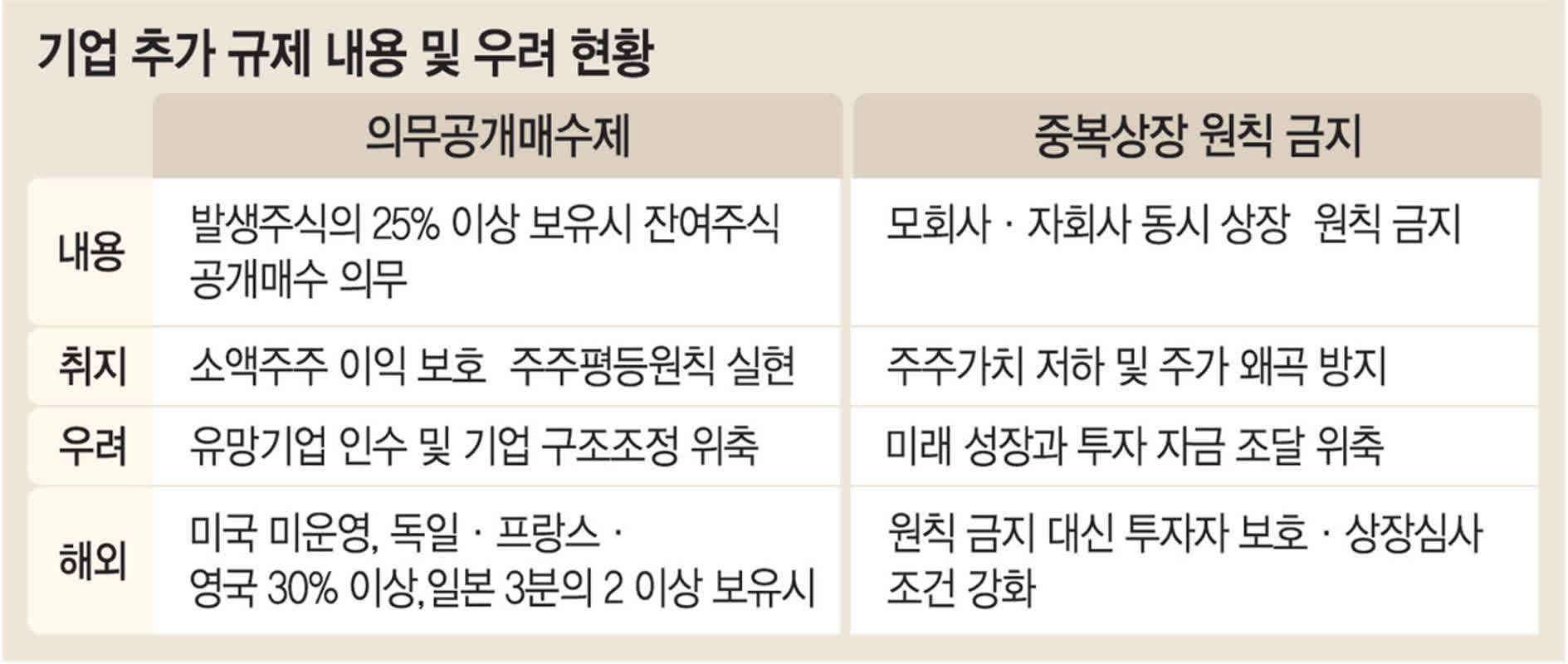
The Financial Services Commission and the Korea Exchange announced 6 that the dual listing of subsidiaries without the consent of the parent company's shareholders would be prohibited in principle. They explained that the measure was intended to protect minority shareholders' rights and address the market's problem of duplicate accounting.
The two institutions proposed amendments to the dual-listing guidelines and the detailed rules for implementing listing and disclosure regulations on the same day. The amendments cover changes to listing procedures and disclosure requirements.
As of the end of last year, the ratio of dual-listed companies to total market capitalization was . In the United States, it was lower at %, while in Japan it was %.11.2In the United States, it was lower at %0.05while in Japan it was %4.0.
The authorities said they would impose obligations on the parent company’s board, including a shareholder impact assessment, measures to protect shareholders, shareholder communications, and confirmation of shareholder consent, 5obligations. They will require consent from the parent company’s shareholders for the listing of a subsidiary created through a physical split, and will apply by reference a rule limiting the voting rights of the largest shareholder and related parties, 3the percent rule.
They established the principle that cross-listings would be permitted only in exceptional cases, and included the criteria for exceptions and the review procedures in the guidelines. The amendment is currently at the advance notice stage and is expected to be finalized after gathering opinions.
From a corporate perspective, when pursuing a subsidiary listing, the board must formally document the shareholder impact assessment, shareholder protection measures, and shareholder consent procedures. Investors need to check the relevant disclosures and the schedules of board and general meetings.