Bullstory Research September 3, 2026
TLT Monthly Dividend: Complete Guide, Dividend Date and Yield, and Whether It Is Advisable to Buy Now (2026)
Key takeaways
TLT has a dividend yield of 4.61%, and the most recent payment was 0.32dollars per share (payment date: 2026year 7month 7day). To receive the dividend, it was necessary to buy before the ex-dividend date of 2026year 7month 1day. However, because its effective duration is 15.28years, there is a significant possibility of losing principal due to share-price fluctuations.
How much monthly dividend can TLT pay right now
At the current price, 84.55TLT's dividend yield based on dollars is 4.61%.
The most recent payment was 0.32dollars per share, paid on 2026 year, 7 month, 7 day.
The cumulative dividend over the most recent 12 months is 3.90 dollars per share.
Once you finish reading this article, you will have a complete overview of the reality of TLT's dividend yield, how long you need to buy it beforehand to receive it, and the pitfalls you miss when approaching it based only on dividends.
How much is received per share
100If you hold 8,455 dollars' worth.
Approximately 32dollars are deposited into the account every month.
1After completing the term, 390dollars. Converted into a rate of return, that is 4.61%.
At first glance, it looks attractive compared with bank deposit interest rates.
However, it is risky to make a decision based solely on this one rate-of-return figure. The reason will be explained later.
The Dividend Amount Changes Every Month
TLT’s dividend is not fixed.
The most recent payment was 0.32dollars per share, while the cumulative annual dividend is around 3.9040dollars.
The reason the amount paid varies slightly from month to month is that the interest income received from the bonds held by TLT differs each time.
In other words, TLT’s dividend is not a “fixed monthly salary” but rather a “structure in which bond interest is collected and distributed.”
The dividend amount also changes when the interest-rate environment changes.
The details of this structure are covered in the “The Real Threat to Dividends” section.
Why You Shouldn’t Take This Yield at Face Value Right Now
4.61The figure expressed as % is calculated based on the current share price 84.55dollars.
The dividend yield (the ratio of total annual dividends to the share price) is structured so that it appears to rise when the share price falls.
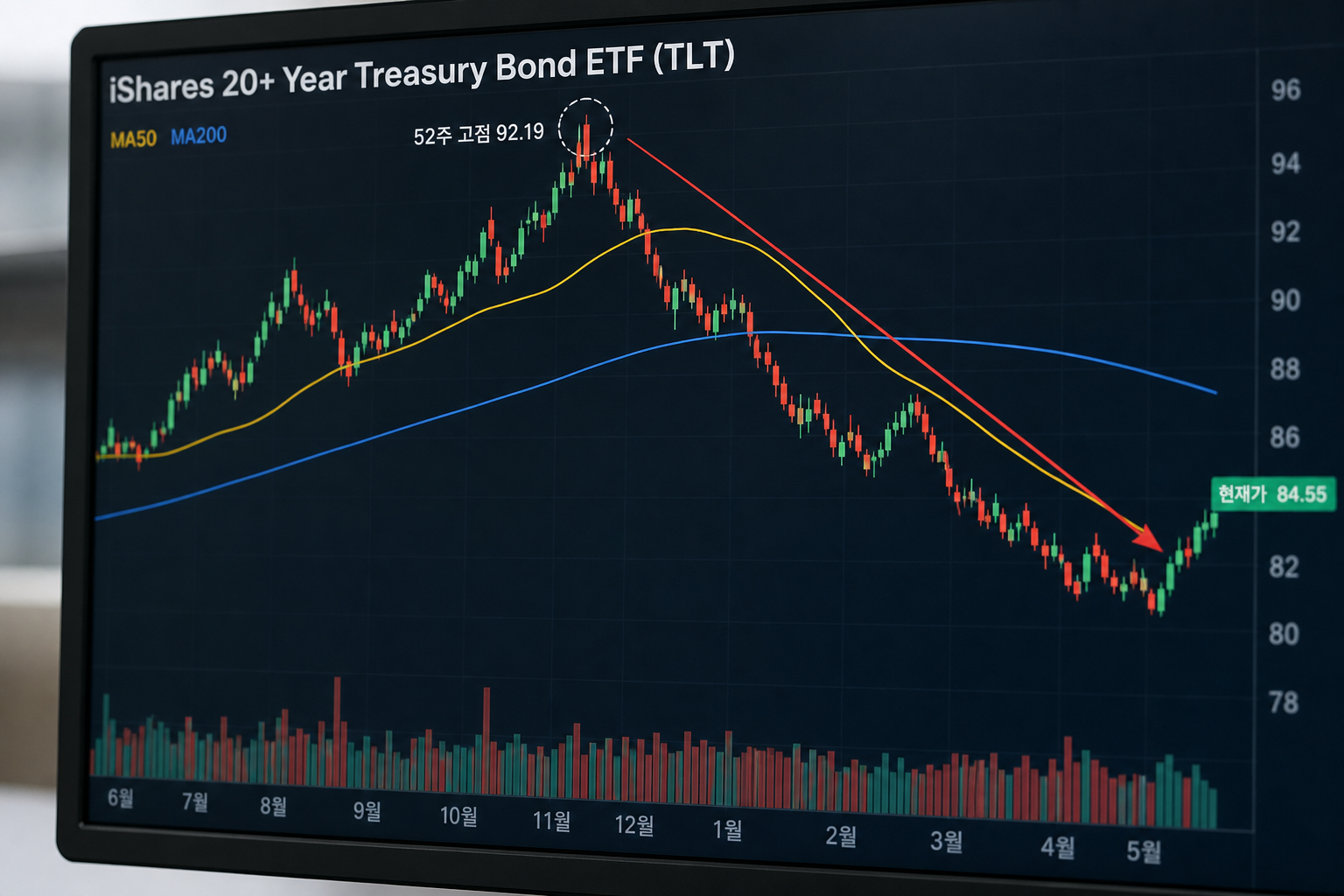
Over the past 52 weeks, TLT moved between a low of 82.77 dollars and a high of 92.19 dollars.
It is currently down approximately 8% from its peak.
In other words, the principal reduced by the share-price decline could be greater than the money received in dividends.
| Item | Figure |
|---|---|
| Current price | 84.55 dollars |
| 52-week high | 92.19 dollars |
| 52-week low | 82.77 dollars |
| Monthly dividend (most recent payment) | 0.32 dollars per share |
| Cumulative dividends over the most recent 12 months | 3.90 dollars per share |
| Dividend yield | 4.61% |
| Average yield to maturity of bonds held by TLT | 5.04% (as of 2026 year 7 month 6 day, iShares official website) |
To receive the dividend, you must purchase before the ex-dividend date. The most recent ex-dividend date was 2026 year 7 month 1 day. The meaning of this date and the next schedule are discussed in detail in the “When is the dividend date?” section.
When is the dividend date, and before what date must you buy to receive it
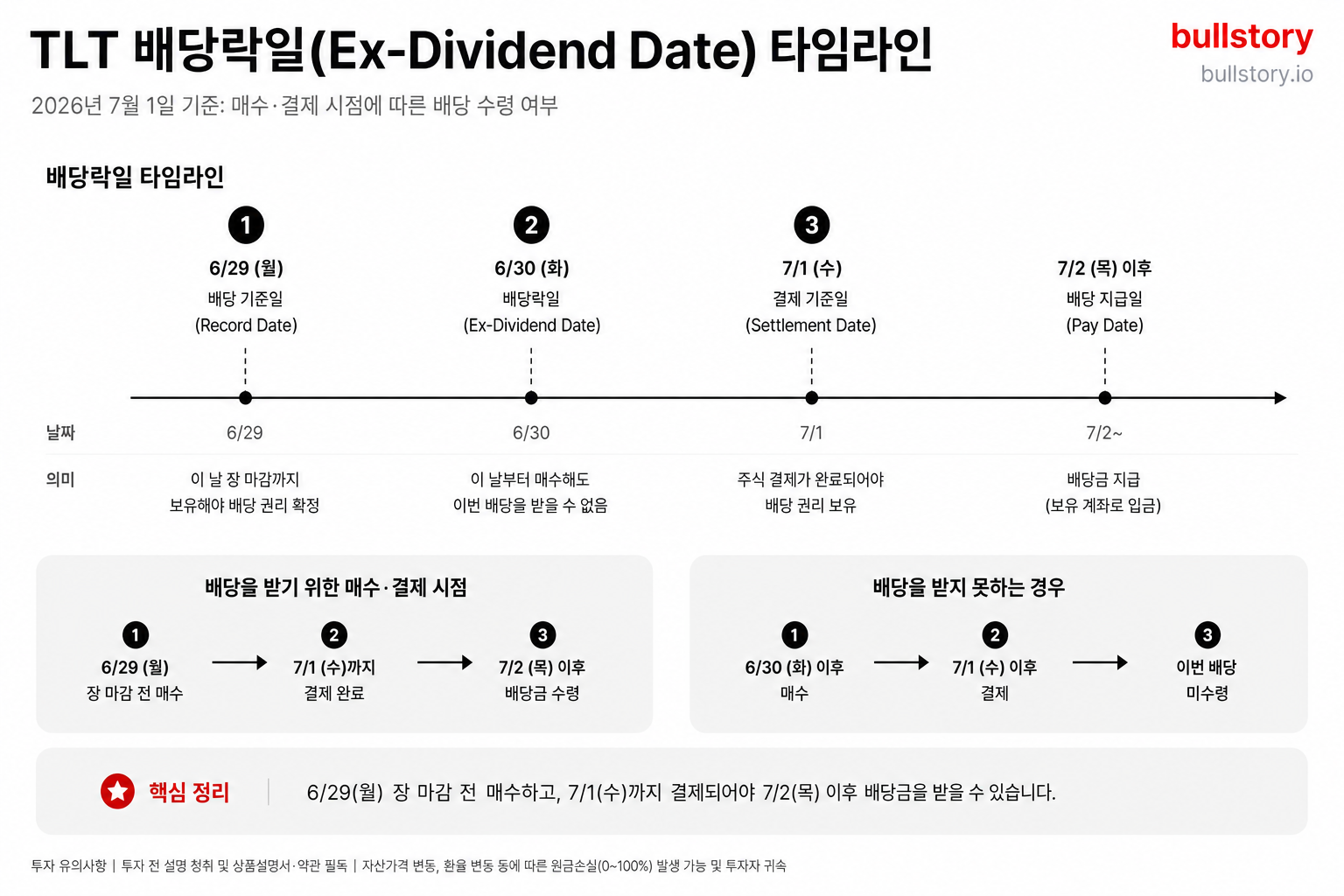
TLT’s monthly dividend is paid once a month. The most recent ex-dividend date was 2026 year 7 month 1 day.
The payment date is 2026 year 7 month 7 day, and 0.32 dollars per share were paid. To receive the dividend on 7 month 7 day, you must already own the shares before the market opens on 7 month 1 day. Buying on 7 month 1 day is too late.
What is the ex-dividend date
The ex-dividend date is the cutoff date: if you buy after this date, you will not receive the dividend for that month. Put simply, it is the deadline.
To sum up:
Buy by the day before the ex-dividend date → receive the dividend / Buy on or after the ex-dividend date → do not receive this dividend
U.S. stocks settle on the business day after purchase. Therefore, you must buy before the market closes one day before the ex-dividend date so that settlement is completed and you obtain the right to the dividend. Many beginner investors mistakenly think they can buy on the ex-dividend date and miss the dividend. A difference of one day determines a month's worth of dividends.
To receive the previous installment (6-month), you had to buy before 2026 year 6 month 1 day, the ex-dividend date. The actual payment was made on 2026 year 6 month 4 day. There is usually an interval of 3~6 business days between the ex-dividend date and the payment date.
2026 year recent dividend schedule (based on confirmed results)
| Ex-dividend date | Payment date | Dividend per share |
|---|---|---|
| 2026year 6month 1day | 2026year 6month 4day | 0.3358dollars |
| 2026year 7month 1day | 2026year 7month 7day | 0.32dollars |
(Source: confirmed based on Investing.com and Stock Events)
[TLT pays dividends 12%EC%5%AD%82%B4-%EC%9B%94%EB%B0%B0%EB%8B%B9-etf-%EC%88%9C%EC%9%C%84-%EB%B6%84%EB%B0%B0%EC%9C%A8%EB%A7%8C-%EB%B3%B4%EB%A9%B4-86%90%95%4-3%4%8%94-9%4%9%0-2026%85%84-5%9%8%0) Looking at the pattern, the ex-dividend date is set on 1day of each month or the first business day around that date. The payment date is usually 4~7 business days afterward.
Is the statement “the share price falls on the ex-dividend date” true?
It is true. Once the right to receive the dividend disappears, it is reflected in the price, so the share price starts lower by the amount of the dividend.
For example, per share 0.32dollars as a dividend, if the share price starts the day down by the same amount, there is neither a gain nor a loss that day. Therefore, a short-term buying strategy aimed only at dividends generally does not perform well.
What to do now to receive the next dividend
7The dividend ex-date in 1has already passed. The next dividend ex-date is typically scheduled for early 8. To receive the dividend for 8you must complete your purchase by the day before the ex-date.
It is safest to check the exact date on the official BlackRock (iShares) website or under Dividend Schedule in your brokerage app. Monthly dividend products such as TLT announce their dates every month, so you should make a habit of checking the ex-date once a month.
If you miss the ex-date, you will not receive the dividend even if you wait a month. The date is everything.
An explanation for those who don't know what TLT is: 1minute explanation
TLT (iShares 20+ Year Treasury Bond ETF) is an ETF that selectively holds only U.S. Treasury bonds with a remaining maturity of more than 20 years. It is managed by BlackRock, and through TLT, investors can buy and sell long-term Treasury bonds issued by the U.S. government on the stock market just like shares. In short, 20-year U.S. Treasury bonds through a single share, with an effect almost equivalent to buying them directly.
Why does the TLT price fall when interest rates rise?
Bonds have a fixed interest rate at the time of issuance. When the interest rates on newly issued bonds or savings products rise, existing bonds become relatively less attractive and their prices fall. Conversely, when interest rates fall, existing bonds look more attractive and their prices rise.
Let’s illustrate it simply. I hold a bond that pays 3% interest, but the market interest rate suddenly rises to 5%. A new bond pays 5%. Since no one will buy my bond, I have to lower its price to sell it. That is why the price falls.
The longer the maturity, the more sharply it fluctuates
Duration(duration) refers to a bond’s sensitivity to changes in interest rates. When interest rates change by 1 percentage point, the bond price can be viewed as moving approximately 1% in the opposite direction per year of duration.1 per year.
TLT’s effective duration is 15.28 years (official iShares data, as of 2026 year 7 month 6 day).
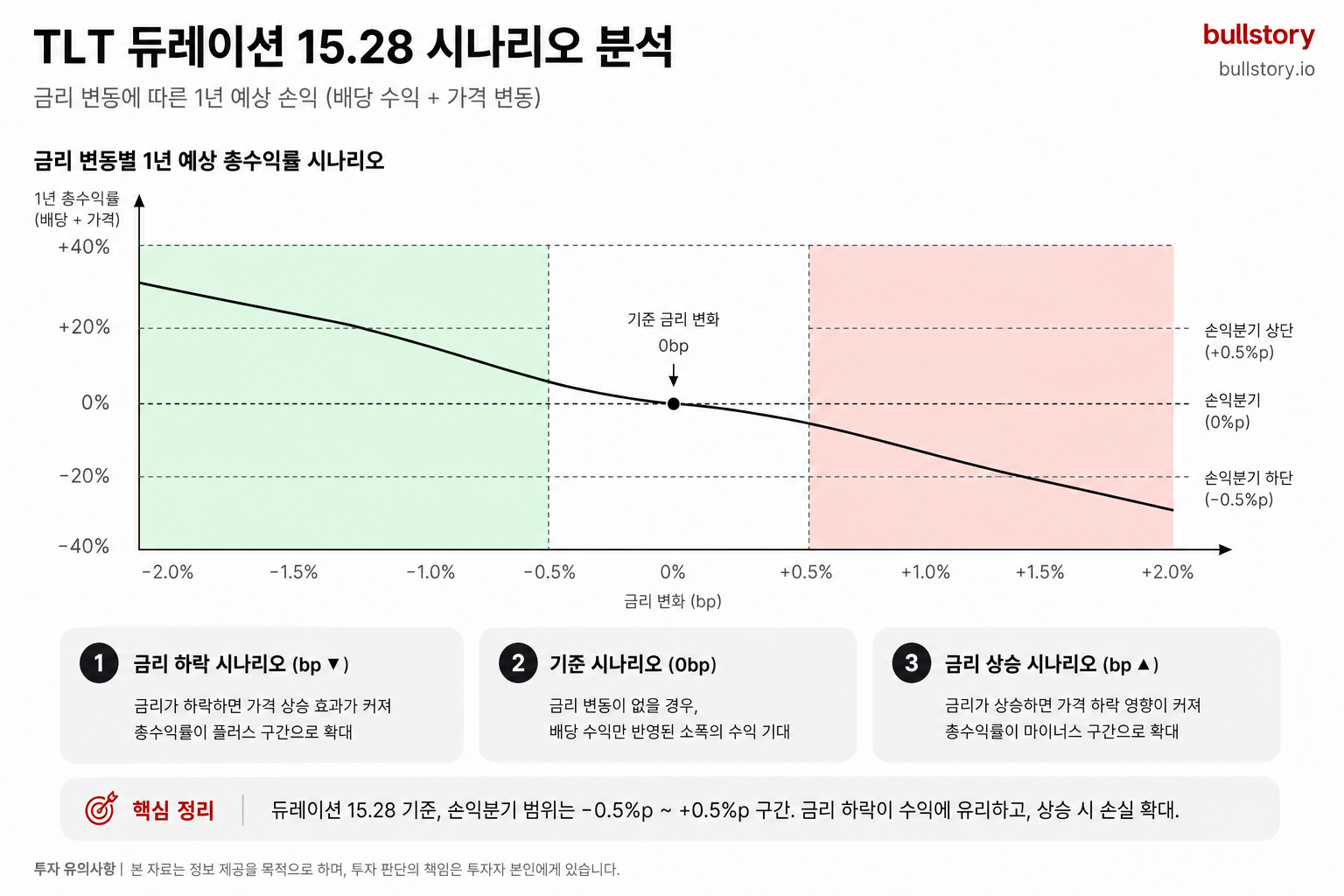
If interest rates rise by 1percentage points, the price of TLT falls by approximately 15%. Conversely, if interest rates fall by 1percentage points, it may rise by approximately 15%.
Short-term bonds are not this sensitive. In the case of short-term bonds with a maturity of 1years, even if interest rates change by 1percentage points, the price moves by only about 1%. Compared with them, TLT shows sensitivity that is 15times greater.
In fact, from the low in 2024year 4month to the period between 9month, during a phase of falling interest rates, TLT rose by 11%. Over the same period, IEF (7–10-year Treasuries) rose by 5%. During the same period, SHY (1–3-year Treasuries) rose by 3%.
This is the first thing you need to know when investing in TLT. Understanding this structure comes before knowing what the dividend yield is.
So where do the dividends come from?
The bonds held in TLT have their principal and interest payments guaranteed by the U.S. Treasury. The fund collects the interest income from these bonds and distributes it to investors monthly as dividends. TLT investors are positioned to seek capital gains when interest rates fall, while also regularly receiving cash flow from the coupon rate.
The next section examines how the amount of money actually received changes when the share price fluctuates while dividends continue to be paid regularly.
Why You Cannot Look Only at Dividends: The Price Fluctuates
TLT's monthly dividend yield is currently 4.61%. It does not look bad based on the number alone.
The problem is that the share price moves much more than the dividend. 52The high was 92.19dollars, and it is now 84.55dollars. It has already fallen 8.3%. Even if dividends are accumulated for the entire period, they amount to only 1years, 4.61%, while the decline in the share price is nearly twice that.
It is a structure in which the principal is reduced while collecting dividends. This is TLT's fundamental dilemma.
"When interest rates fall, bonds rise": Why did the rule fail?
The Fed 2024year 9month 16day, immediately after the peak, cut the policy rate by 0.5percentage points. Even so, TLT fell by 7.4afterward. Rates fell, but bond prices dropped.
The reason is simple. Stronger-than-expected employment data and rising consumer prices overlapped, prompting the market to start pricing in fewer interest-rate cuts ahead.
The market cares more about how far the Fed will cut rates going forward than about how much it has cut rates now. When expectations change, prices move.
2024The decline from the year-high later exceeded 11. The Fed was still cutting rates during this period. It is an example showing that the rule "rate cuts = higher bond prices" does not work so simply in reality.
Why TLT Is Particularly Sensitive: Duration
Duration shows how sensitive bond prices are when interest rates move by 1 percentage points. The larger the number, the more sharply prices fluctuate with changes in interest rates.
TLT’s effective duration is 15.28 years.
If interest rates rise by 1 percentage points, the price falls by approximately 15%. Conversely, if interest rates fall by 1 percentage points, it may rise by more than 15%.
With fluctuations of this magnitude, a dividend of 4.61% provides little cushioning against price movements.
52The weekly low was 82.77dollars. 52The weekly high was 92.19dollars. The difference between the two prices was 9.42dollars.
1The annual total dividend was 3.90dollars per share. Even if you receive dividends regularly, entering at the wrong time can still result in a loss.
The illusion of a high dividend yield
One reason TLT’s dividend yield stands out at 4.61% is that the share price has fallen substantially. The dividend yield is calculated by dividing the annual dividend by the current share price. Even when the numerator (the dividend) is the same, the yield appears higher when the denominator (the share price) is lower.
The current 4.61% is not high because “TLT is attractive,” but in part appears high because “the share price has fallen substantially.” If you invest based only on the dividend and the share price falls further, the loss of principal may be greater than what you earn from dividends.
Then, if you buy TLT now at dollars, how much is the actual return including dividends? The answer varies by interest-rate scenario. We calculate it in the next section.84.55How much return do you actually get, including dividends, if you buy TLT at dollars now? The answer varies by interest-rate scenario. We calculate it in the next section.
Is buying now a loss or a gain? Profit-and-loss simulation by scenario
At a current price of 84.55dollars, TLT's monthly dividend yield is an annual 4.61%.
100With dollars invested, 1per year, 46,100dollars are received as dividends.
That is approximately 3,842dollars per month.
The issue is that whether this dividend becomes entirely my return is a separate matter.
TLT’s effective duration is 15.28 years. The average yield to maturity is 5.04% per year.
A long duration means that if interest rates rise by 1 percentage points, TLT’s price may fall by approximately 15%. It would take 4.61% in dividends accumulated for 3 years to merely break even.
Let’s examine three scenarios
The table below calculates the total return by adding dividend income and price changes under different interest-rate scenarios, assuming TLT is purchased for 84.55 dollars and held for 1 years. Price changes resulting from interest-rate movements were estimated using a duration of 15.28.
| Scenario | Interest-rate change | Price change | Dividend income (4.61%) | 1-year total return |
|---|---|---|---|---|
| ① current level maintained | 0 percentage points | 0 dollars | +3.90 dollars | +4.61% |
| ② 0.5 percentage-point decline | -0.5%p | +approximately 6.46 dollars | +3.90 dollars | approximately +12.25% |
| ③ 0.5 percentage-point increase | +0.5%p | -approximately 6.46 dollars | +3.90 dollars | approximately -3.03% |
(The price changes in the table are estimates based on a simple linear calculation. If the convexity effect is also taken into account, losses on declines will be somewhat smaller, while gains on increases will be somewhat larger.)
Scenario ①: if interest rates remain unchanged
This is the simplest case.
TLT’s dividend yield is 4.61%.
The cumulative dividend over the past 12 months is 3.90 dollars per share.
If interest rates remain unchanged, the price also stays the same, and the dividend of 4.61% becomes the entire return. In a market where deposit rates are in the mid-3% range, that is not a bad figure.
However, the assumption that “interest rates remain unchanged” is itself a scenario that is difficult to create in reality. With the average yield to maturity of the bonds currently held by TLT at 5.04%, the market could change direction at any time.
Scenario ②: if interest rates fall by 0.5% points
This is the moment bond investors are waiting for.
If interest rates fall by 0.5% points, the price of TLT rises by approximately 7~8% due to the duration effect.
Adding a dividend of up to 4.61% brings the total return over 1years close to double digits.
However, there is no guarantee that a rate cut will immediately lead to a decline in long-term interest rates. The Fed’s policy rate and long-term rates on 20-year and 30-year bonds move under different forces. If concerns about fiscal deficits or inflation expectations grow, long-term rates may instead rise. Therefore, the formula “when interest rates fall, TLT rises” does not always hold.
Scenario ③: if interest rates rise by 0.5% points
Even when dividends come in, the principal is eroded more quickly.
If interest rates rise by 0.5% points, the price falls by approximately 7~8%.
Even after receiving a dividend of 4.61%, the combined loss could reach 3~4%.
1On a per-share basis, this means buying at 84.55dollars and selling near 78dollars.
This is the key point. Buying TLT now is not a transaction to receive dividends; it is [a bet on the direction of interest rates.]738fcd9d93f76e1-mpb5rns5-1)
So, is it okay to buy now?
To put it bluntly, 1if the holding period is short term, you should first consider whether you can tolerate losses if your prediction of the direction of interest rates is wrong.
TLT's 52-week range is from 82.77 dollars to 92.19 dollars.
It moved approximately 1 years, by about 11% up or down.
Dividend 4.61% plays only a limited buffering role in the face of this price volatility.
On the other hand, 3 investors who assume that an interest-rate-cutting cycle will arrive while planning to hold for the long term for more than 5% may view the current yield to maturity of around as an attractive entry point.
According to official iShares data (2026 years 7 months 6 days), the average yield to maturity is 5.04%. Interpreted simply, this means that if you buy now and hold until maturity, you can expect a return of 5.04% per year.
An ETF has no maturity date, so the context is not exactly the same. However, it can be interpreted as the expected average return over the holding period.
How the dividend amount itself may change going forward is examined in the next section, “The Real Threat to Dividends.”
The Real Threat to Dividends: Does the Dividend Itself Decrease When Long-Term Treasury Yields Rise?
TLT’s monthly dividend is not fixed. TLT pays dividends every month, and its recent 12-month cumulative dividend is approximately 3.90 dollars per share, but the amount varies slightly from month to month. The reason is simple. The source of the dividends TLT pays is the interest income from the bonds it holds. When bond interest income varies from month to month, the dividend varies accordingly.
Why the Dividend Varies Each Month
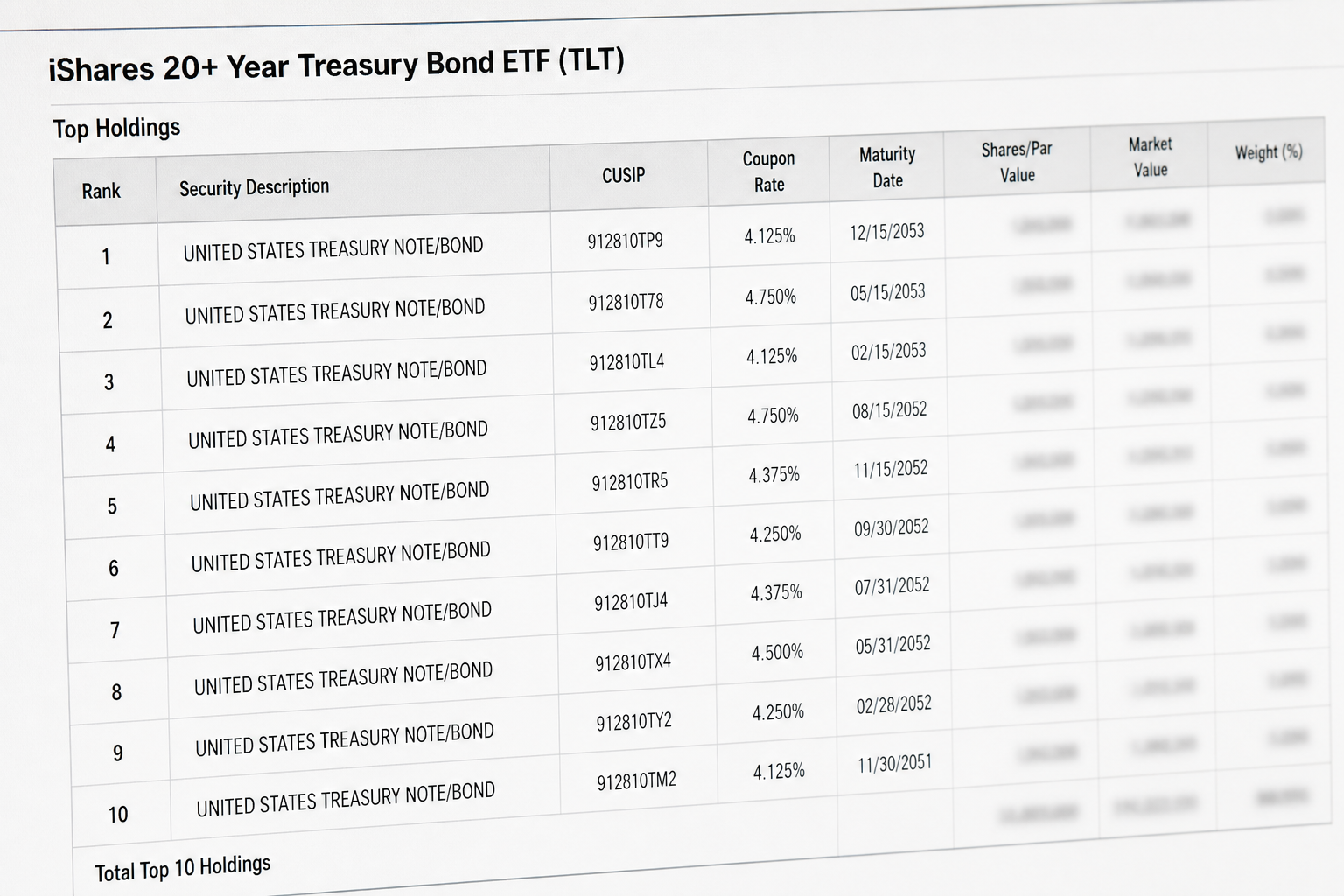
The bonds held by TLT each follow a set interest rate, or coupon. Major holdings include U.S. long-term Treasury bonds with a maturity of 4.125% and a term of 2053 years, and bonds with a maturity of 8% and a term of 4.75 years. The interest paid by these bonds flows into the fund each month, and the money remaining after management fees are deducted is distributed to investors as dividends.2053 years11 months.
TLT is not a static fund. When a bond holding matures or a new bond is purchased, the market interest rate at that time is reflected. Bonds purchased when rates are high have higher coupons, while bonds purchased when rates are low have lower coupons. Each time this mix changes, the monthly dividend moves slightly.
Dividends May Increase When Interest Rates Rise
The result is different from intuition. When long-term Treasury yields rise, TLT’s price falls, but its dividend may increase over the long term.
The reason is the replacement effect. When interest rates rise, the coupons on the bonds newly added to TLT also rise. As time passes and older bonds with low coupons are replaced by newer bonds with high coupons, the fund’s total interest income increases. Since dividends come from interest income, monthly dividends tend to increase after the rise in interest rates has passed.
The actual figures support this. Annual dividends increased from 2022 year 2.66 dollars to 2023 year 3.34 dollars. 2022 was the year in which the Federal Reserve sharply raised its policy rate, and the result was an increase in interest income as high-interest-rate bonds were added to the portfolio.
| Year | Annual dividend (per share) | Change from the previous year |
|---|---|---|
| 2022 year | 2.66 dollars | Baseline |
| 2023 year | 3.34 dollars | +0.68 dollars |
| Most recent 12 months | 3.90 dollars | +0.56 dollars |
Is the current dividend amount stable, then?
TLT’s current annual dividend yield is 4.61%. The payment made in 2026 year 7 month 7 day was 0.32 dollars per share.
The dividend growth rate over the most recent 5 years has averaged 12.30% annually (according to stockinvest.us)—a figure reflecting the shift from low dividends in the low-interest-rate era (2020–2021 year) to higher dividends in the high-interest-rate era.
If interest rates fall significantly going forward, the coupons on newly added bonds will be lower, and the dividend amount will gradually decline. Conversely, if interest rates rise further from their current level, the price will fall again, but the dividend amount will rise again after a lag of several quarters.
There is one more point to be careful about. The dividend yield responds not only to changes in the dividend itself but also to movements in the share price. If the TLT price falls, the yield may appear higher even if the dividend amount remains unchanged; if the price rises, the opposite is true. A signal that “the yield has risen” is not always good news.
Rising interest rates are not an immediate threat to dividends. The real threat is that price losses occur much faster than dividend increases. Comparing the sensitivity of these products numerically makes it easier to determine which one suits your situation. The comparison of TLT vs. IEF vs. TMF in the next section provides the answer.
TLT vs. IEF vs. TMF: What’s the difference?
When looking into TLT’s monthly dividend, natural points of comparison emerge. There is IEF, with a shorter remaining maturity, and TMF, which tracks TLT at a multiple. Although all three products are based on the same U.S. Treasury bonds, their dividend yields and price volatility are entirely different matters. Let’s compare them directly using the numbers to see which product suits your situation.3times
Key metrics for the three products at a glance
Compiled based on the official iShares website and data from each fund manager.
| Item | TLT (20 years+) | IEF (7–10 years) | TMF (3x leverage) |
|---|---|---|---|
| Investment target | Treasury bonds with at least 20 years remaining to maturity | Treasury bonds with 7–10 years remaining to maturity | 3x the daily return of TLT |
| Current price | 84.55 dollars | Approximately 93.70 dollars | Approximately 36 dollars |
| Dividend yield | 4.61% | Approximately 3.90% | Approximately 4.0% |
| Dividend frequency | Monthly | Monthly | Quarterly |
| Expense ratio | 0.15% annually | 0.15% annually | 0.90% annually |
| 52-week price range | 82.77–92.19 dollars | 92.95–98.05 dollars | 31.58–44.24 dollars |
IEF: The “milder” version of TLT
IEF holds 7~10-year Treasury bonds. It has the same management entity as TLT, and its expense ratio is also 0.15% per year. The key difference is interest-rate sensitivity.
According to official iShares data, IEF's 12-month dividend yield is 3.90%. TLT's is 4.61%. Shorter-maturity bonds pay less interest but are less affected by changes in interest rates.
IEF's 52-week price range is from 92.95 dollars to 98.05 dollars.
5It moved about dollars.
TLT's 52-week high and low are 82.77 dollars and 92.19 dollars.
The difference between the high and low is 9.42 dollars.
It is a choice to reduce the stock-price amplitude by nearly half in exchange for sacrificing a little yield. This is why IEF is chosen.
TMF: The essence is betting on direction rather than dividends
TMF is a Direxion-branded product managed by Rafferty Asset Management. The management fee is 0.90%.
The management fees for TLT and IEF are 0.15%, respectively. TMF is 6 times more expensive than these. Even simply holding it costs 0.90% of the return each year.
TMF's dividend yield is approximately 3.99%. The per-share payment over the past 12 months is 1.45 dollars. Dividends are paid quarterly, that is, every 3 months. This differs from TLT, which pays dividends monthly. Buying TMF with the aim of receiving TLT's monthly dividends will not meet expectations.
TMF's 52-week high is 44.24 dollars, and its low is 31.58 dollars.
The difference between the high and low exceeds 12 dollars.
If TLT falls 1%, TMF theoretically falls 3%. Even a slight deviation in interest rates causes the dividend to be overshadowed by price losses.
Recently 3-year average annualized return was -20.0%. 5-year average annualized return was -31.6x daily leverage, 3because leveraged ETFs are structured to reset their multiple every day, compounded losses accumulate when held for the long term. They are tools for short-term directional bets, not for long-term holding to receive monthly distributions.
Criteria for choosing among the three products
Different objectives lead to different choices.
- For the purpose of receiving stable monthly distributions → TLT. A combination of a distribution yield of 4.61%, monthly payments, and an expense ratio of 0.15% is the most balanced among the three products.
- When price stability takes priority even if distributions are slightly lower → IEF. Its 52-week price range is about half that of TLT.
- When you want to make a short-term bet on falling interest rates → TMF. If the direction is wrong, losses are also 3 times greater. You must first face the fact that its long-term holding performance is in the -20% range.
Points to note when buying through a Korean securities firm
The three products are all ETFs listed on U.S. exchanges, so they can be purchased directly through an overseas-stock account at a Korean securities firm. However, do not overlook two things.
Points to note when buying through a Korean securities firm15 percent9 percent94 percent0 percent0 percent8 percent9 percent84 percent8 percent8 percent88 percent96 percent4 percent94 percent94 percent84 percent9 percent82 percent8 percent90 percent83 percent90 percent97 percent90 percent94 percent0The three products are all ETFs listed on U.S. exchanges, so they can be purchased directly through an overseas-stock account at a Korean securities firm. However, do not overlook two things.9- Foreign-exchange costs. When converting Korean won into U.S. dollars, each securities firm has a different spread (foreign-exchange fee). Even when buying the same TLT, the effective return varies depending on the foreign-exchange terms. It is better to use a preferential exchange-rate event or an automatic dollar-conversion service.
- Withholding of dividend income tax. [A dividend paid in the United States is automatically reduced by 82percent4 percent8 percent94 percent0 percent9 percent8 percent9 percent9 percent4 percent99 percent84 percent0 percent84 percent9 percent88 percent8 percent4 percent5 percent4 percent8 percent4 percent.] Dividends credited to the account are already after-tax amounts. The detailed structure is covered in the “Practical Guide for Korean Investors” section of this article.
Practical Guide for Korean Investors: Dividend Tax, Exchange Rates, and Purchase Timing
Before TLT dividends are credited to the account, the U.S. government first withholds 15 percent as dividend income tax.
For example, even if you receive 0.32 dollars per share in dividends, the actual deposit is 0.272 dollars.
Whether the exchange rate and annual financial income exceed 2,000 ten thousand won is also a variable. Organize these three items before buying.
How much dividend tax is withheld
Under the U.S.–Korea tax treaty, the United States withholds 15% at source.
The U.S. tax rate of 15% is higher than Korea’s standard dividend income tax rate of 14%, so there is no additional tax to pay domestically.
TLT’s monthly dividend is deposited into the account after 15% is withheld in the United States. The tax is not deducted twice.
However, there is one exception.
If financial income, combining interest and dividend income, exceeds 2,000ten thousand won annually, the individual is classified as subject to comprehensive taxation on financial income.
In this case,2,000up to ten million won is calculated using the basic tax rate (14%, including local income tax15.4%), and the 15% already paid in the United States is deducted as a foreign tax credit.
For the excess amount, progressive tax rates of 6.6% to 49.5% apply.
The more TLT you hold, the more monthly dividends accumulate.
The dividend yield is 4.61%.
If financial income is no more than twenty million won per year, taxation is completed with the 2,000% withheld at source in the United States, and there is no separate filing obligation.
If that threshold is exceeded, you must file a comprehensive income tax return yourself in 15 of the following year.5 month.
The hidden cost of foreign-exchange losses
TLT dividends are paid in dollars. The share price is also denominated in dollars. For Korean investors, the exchange rate is a second lever that can reverse returns.
This is advantageous when the dollar is strong. When an economic crisis occurs, demand for dollars increases and the value of the won falls, generating additional returns when converted into won.
Conversely, when the dollar weakens, the account balance converted into won decreases. Even if you receive an annual 4% from dividends, if the exchange rate falls by 5%, your actual return becomes negative.
Using a currency-hedged product can reduce risk, but it incurs hedging costs. TLT itself is not currency-hedged.
Dividend ex-date purchase checklist
TLT’s ex-dividend date is the 1th of each month.
The payment date is within approximately 7days of the ex-dividend date.
A recent example was an ex-dividend date of 2026 of 7, followed by a payment date of 1 of 2026, 7 and 7.
A payment of 0.32 dollars per share was made.
To receive TLT’s monthly dividend, you must hold the shares in your account by the day before the ex-dividend date. If you buy on or after the ex-dividend date, you will miss that month’s dividend.
The following summarizes points that are easy to miss in practice.
| Item | Details |
|---|---|
| Ex-dividend date | Every month 1day (if you buy after this day, there is no dividend for that month) |
| Payment date | Within approximately 7days of the ex-dividend date |
| Tax withholding | Automatically deposited after 15% is deducted in the United States (based on the U.S.–Korea tax treaty) |
| Additional domestic tax | None if annual financial income is no more than 2,000ten thousand won / comprehensive taxation applies if it exceeds this amount |
| Currency exposure | Dollar assets; the won–dollar exchange rate directly affects returns |
Practical checks before buying 3 items
If you have decided to receive TLT monthly dividends, check the following three items in order.
-
Check the ex-dividend date: You must buy just before 1day of each month to receive that month's dividend. If you buy on 1day, forgo that month's dividend.
-
Calculate your total financial income: Estimate whether your annual total exceeds 2,000ten thousand won by adding not only TLT dividends but also deposit interest and dividends from other stocks. If it exceeds the threshold, you must file a comprehensive income tax return in 5 of the following year. (Under Article 62 of the Income Tax Act; this can be confirmed through the financial income withholding receipt on the National Tax Service's Hometax.)
-
Currency timing: If you buy when the won–dollar exchange rate is high, the dollar is relatively expensive. Conversely, if you buy when the dollar is weak, the purchase price in won is lower.
TLT has a simple tax structure. In the United States, 15% is withheld and that is the end of it. The complicated parts are the exchange rate and the aggregation of financial income. If you calculate just these two things in advance, the actual amount received and the estimate will not differ significantly.
Glossary
I selected only the terms in this article that might make you pause when you first see them. There are five.
- Ex-Dividend Date: If you buy TLT after this date, you will not receive that month's dividend. It is the reference date on which the right to receive the dividend is finalized.
For example, 2026 year 7 month’s dividend was 0.32 dollars per share.
The ex-dividend date was 7 month 1 day. Investors who bought after that day are excluded from this month's dividend.
-
Dividend yield: This is the ratio of the annual total dividend to the stock price. TLT’s current price is 84.55the dividend yield in dollars is 4.61%.
The point to note is that when the stock price falls, the yield figure rises even if the dividend amount remains unchanged. The formula “a higher yield = better to invest in” does not hold. Dividend yield is meaningful only when considered together with how much price volatility risk must be accepted to receive the dividend. -
Duration: This is a figure indicating how sensitively a bond’s price moves in response to changes in interest rates. The greater the duration, the more strongly it responds to interest-rate changes.
According to official iShares data (as of 2026, 7 / 6), TLT’s effective duration is 15.28 years.
Put simply, if interest rates rise by 1 percentage points, TLT’s price can be regarded as falling by approximately 15%.
Even if interest rates rise by just 0.5 percentage points, the price falls by roughly 8%.
Even if the monthly dividends are collected diligently for 1 full years, they amount to only about 4.6%, yet a single spike in interest rates can wipe that out overnight.
-
Long-term Treasury bonds: Among bonds issued by the U.S. government, those with a maturity of 20years or more remaining. TLT is an ETF that selects and holds only these long-term Treasury bonds. The longer the maturity, the higher the duration and the more strongly it responds to changes in interest rates. 1-year short-term Treasury bonds should be viewed as a completely different asset.
-
Withholding tax: This is the method by which taxes are automatically deducted from dividends before they enter my account. For TLT dividends, under U.S. tax law, 15percent is deducted first before the payment is deposited. Although I do not need to file a report directly, I should be aware that the amount I receive is less than the announced dividend amount.
Frequently asked questions
How much is TLT’s monthly dividend?
The most recent payment was 0.32dollars per share. The cumulative dividend over the most recent 12months was 3.90dollars per share, allowing the dividend trend to be assessed.
When do I need to buy TLT to receive the dividend?
You must buy by the market close on the day before the ex-dividend date to receive the next dividend. In the United States, settlement is completed on the business day after the purchase.
What is the ex-dividend date?
The ex-dividend date is the cutoff date: if you buy after this date, you do not receive the current dividend entitlement. Literally, it is the closing time.
What is the recent TLT dividend schedule (payment date and amount)?
The most recent payment date was 2026year 7month 7day, and 0.32dollars per share were paid for that period (based on confirmed results).
Why does TLT’s dividend amount vary each month?
TLT collects the interest received from the bonds it holds and distributes it as a monthly dividend. The dividend amount also varies because the bond interest income varies.