Bullstory Research November 17, 2026
Anthropic IPO: Should You Buy?
Key takeaways
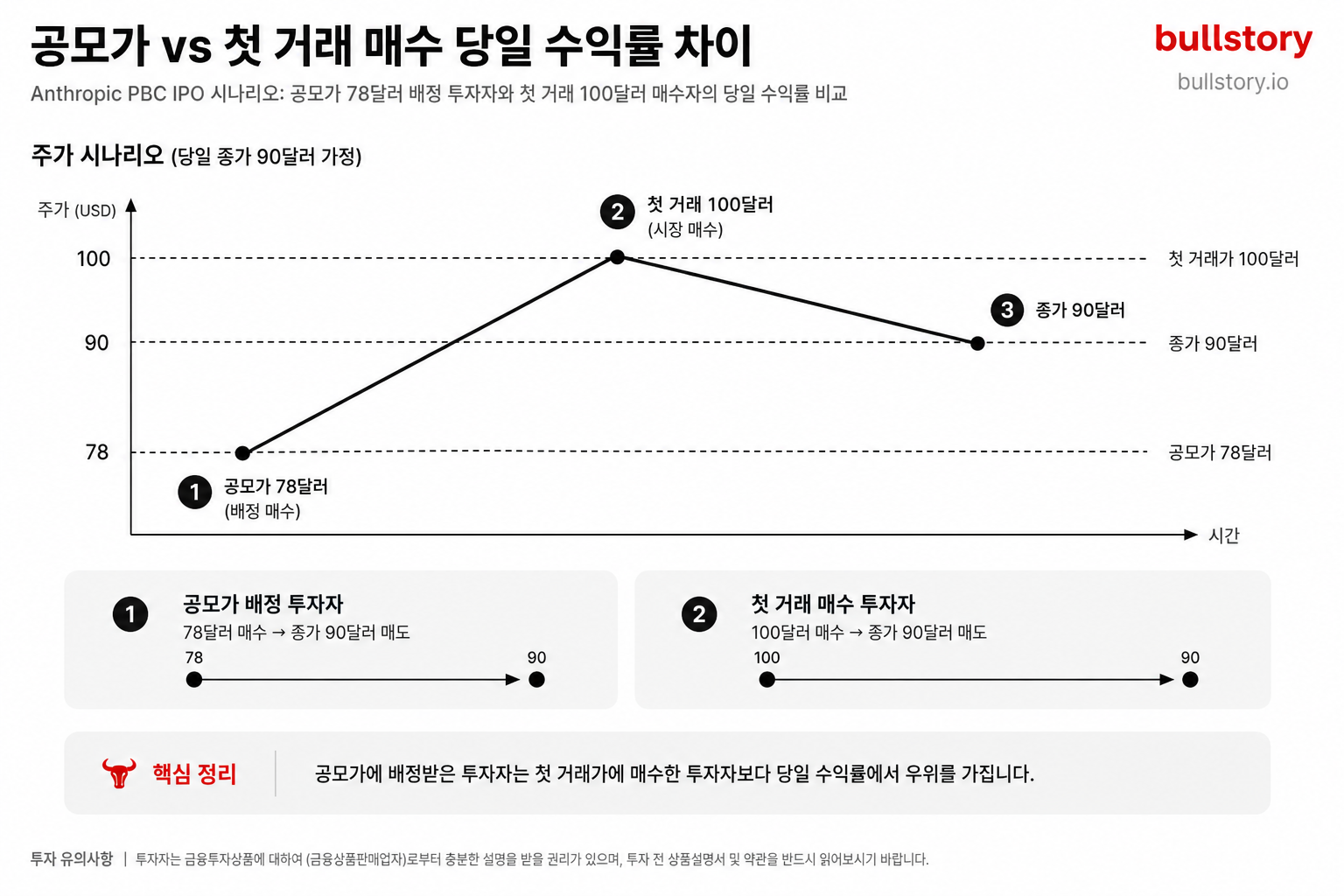
Diverging first-day returns: Anthropic rose on its first day of trading by 15.4%, but my account could show a loss of 10%. This would be the case assuming an offering price of 78 dollars, a first trade at 100 dollars, and a closing price of 90 dollars. This article is a scenario analysis based on the stated listing terms and assumed performance; it does not represent confirmed IPO information or actual trading results. 78 dollars is a gain for someone allocated shares at 90 dollars, but 100 dollars is a loss for someone who bought at 78 dollars. That is because the percentage increase from the offering price uses the
Diverging first-day returns
Anthropic rose on its first day of trading by 15.4%, but your account could show a loss of 10[IPO price]3%5%8%0%80) 78dollars, first trade at 100dollars, and closing price at 90dollars. That is what would happen under this scenario. This article is a scenario analysis based on the stated listing conditions and performance, and does not represent confirmed IPO information or actual trading results.
78dollars is a gain for someone allocated shares at that price, while 90dollars is a loss for someone who bought at that price. The percentage gain relative to the IPO price uses the 100dollar price as its starting point, while my return uses my actual purchase price as its starting point. Even when holding the same stock on the same day, the results can be diametrically opposed.78The results can be diametrically opposed.
So, for domestic retail investors, it may be worth [holding off on chasing a first-day surge]83%81%9%5-%9%3%9-%7%8%97%90-%0%98%86%0%7%89-%82%9%-3%5%8%3-%99%9%98%80%82%98) . The amount it has already risen is not a gain I have made, but the price difference I would have to bear if I entered now. Before asking whether Anthropic is promising, first consider the price at which you are starting your investment.
Buying on the open market instead of applying for shares
If domestic sales are conducted through a private placement and there is no general subscription for individual investors, it is difficult to expect an allocation through a public offering via a general subscription.0%B0%EC%A0%95
It comes down to whether investors who intended to use this route will buy shares at the price set by the market after listing. Being interested in an [IPO] is different from being able to buy at the offering price.-2)
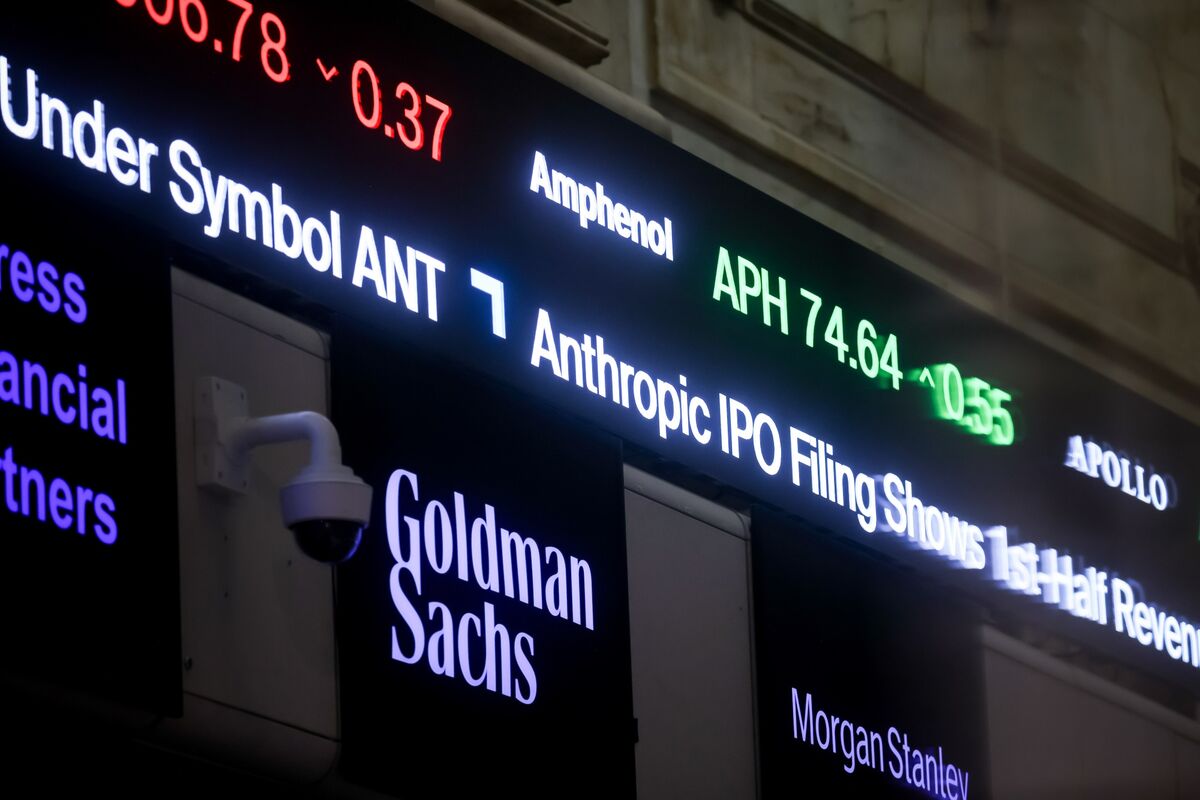
This scenario uses 2026 as the analysis date. The indicative offering price is 11 to 17 dollars, with the offering price set on 70 U.S. local time and trading under the ticker ANT scheduled to begin on Nasdaq on 78. Here, the indicative offering price, the final price set, and the trading price after the market opens must each be distinguished.18nd19d
The fact that the top of the indicative range is 78 dollars does not mean my order after listing will be executed at that price. If the first trade is at 100 dollars, the investment I should consider is not ‘Anthropic allocated at 78 dollars’ but ‘Anthropic bought for 100 dollars.’ Even an investment that looked attractive at the subscription stage needs to be reassessed if the market price changes.
The Price Tag on Institutional Orders
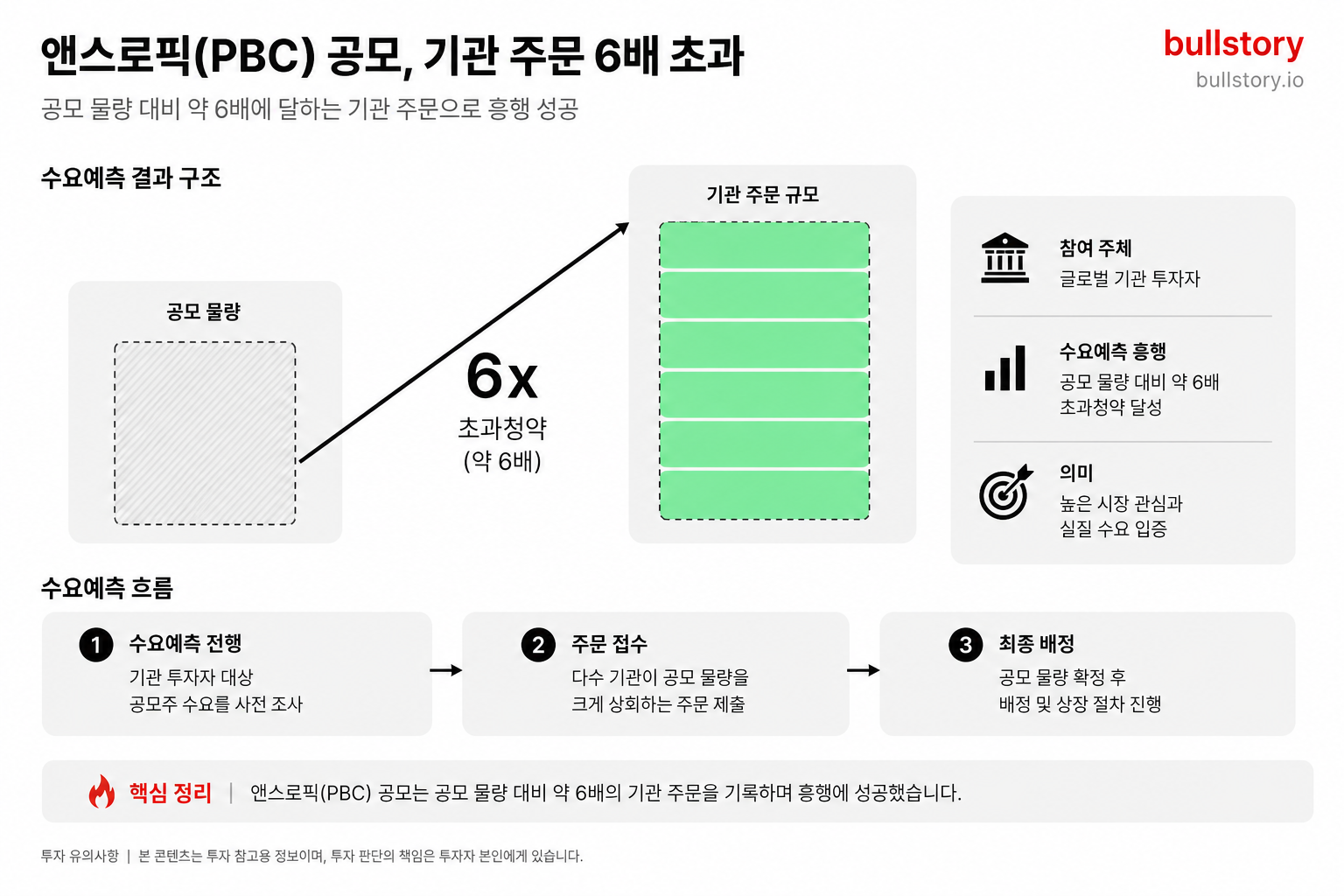
How, then, should we interpret reports of heavy institutional orders? 11 as of 12, orders were about 6 times the offering size. This could point to a possibility that the shares will open above the offering price. If institutions that did not receive as many shares as they wanted try to buy more on the market, that could push up the initial price.
However, placing an order during the offering and buying at a high price after listing are different decisions. 78Even an institution that would have wanted to buy at that dollar price 100may reduce the number of shares it orders or wait at that dollar price. The fact that institutions have shown interest alone does not mean I have a reason to pay a higher price.
Oversubscription is a clue to initial demand, not a number that guarantees a first-day gain. If the final offering price rises, the appeal at the time of the order may diminish, and if trading opens with a sharp jump, investors who were considering buying more may also step back. So don’t stop at asking how much demand there was; consider whether that demand will persist at the price I would pay now.
![Infographic visualizing institutional orders (oversubscription) amounting to approximately 6 times the number of shares offered]https://bullstory.io/blog-images/aigen-48d54fe3-7441-4c69-9d97-6908652a6a1a.png)
Expectations reflected in the offering price
Even if buying pressure is strong on the first day, what ultimately supports that price over the long term is the money the business earns. The company valuation estimate in this scenario is approximately 1 trillion 3 hundred billion to 1 trillion 4 hundred billion dollars. This figure takes into account not only the shares currently issued but also shares that may be added in the future.
If we assume that this valuation already reflects substantial growth, the offering price cannot simply be viewed as “cheap because the company is not yet listed.” Add a first-day premium on top, and you are paying more for the future of the same business. A rise in the share price does not mean the outlook for the company’s revenue and earnings has improved by the same amount.
To justify a high price, subsequent results need to show changes that support those expectations. We need to consider whether rising Claude revenue alone is enough, or whether the cost burden also needs to ease. When expectations are elevated, the share price can fall even after revenue sets a new record if profitability falls short of what the market was looking for. So the next figures to watch are not just the size of revenue.
The costs that came with growth
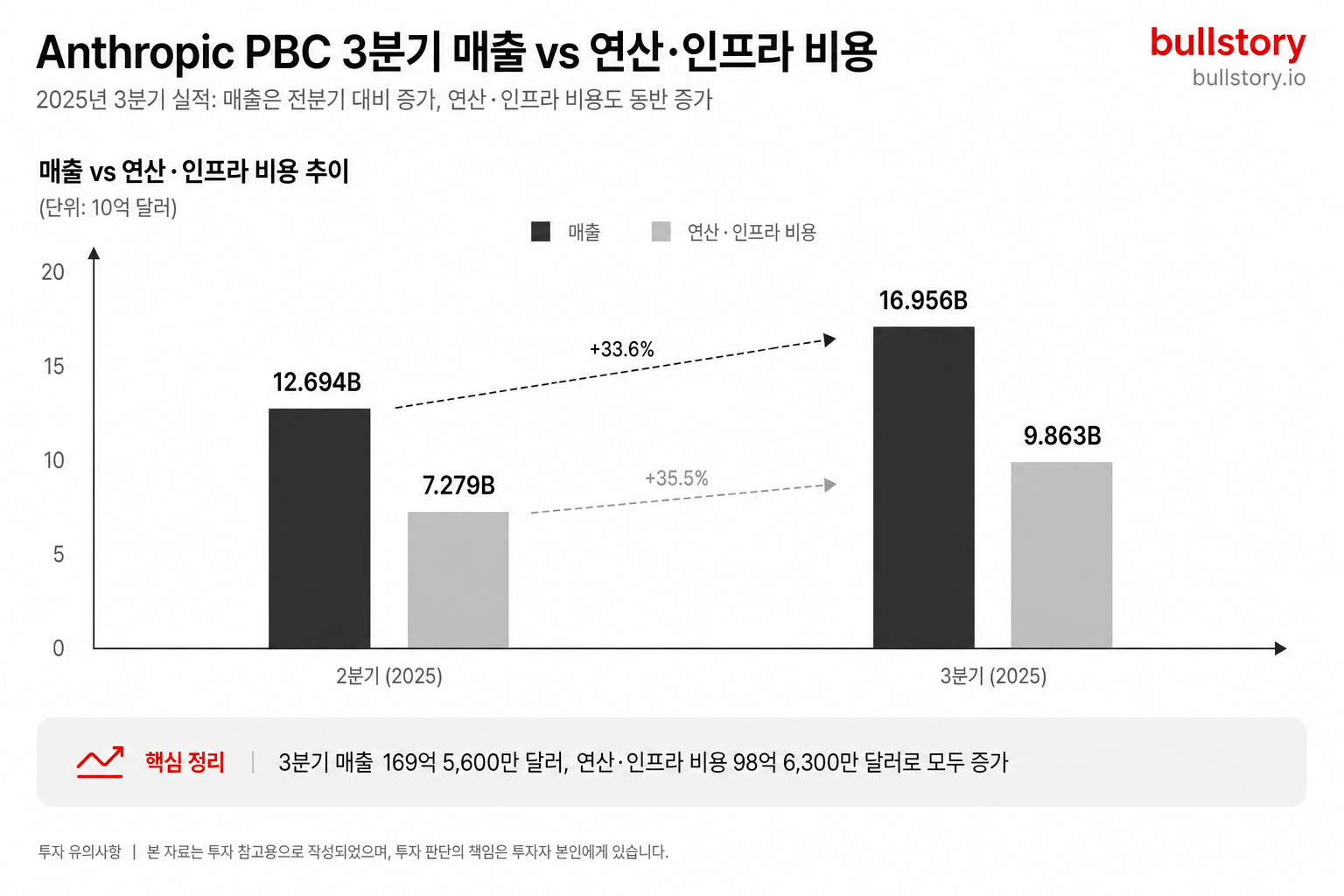
3Quarterly revenue of 169 billion 5,600 million dollars, up about 47% from the previous quarter, points to a rapid pace of growth. But compute and\ninfrastructure costs 2quarter at 55 billion 5,800 million dollars rising to 3quarter at 98 billion 6,300 million dollars would mean an increase of about 77%. In other words, costs for training models and operating services grew faster than revenue.
Using each quarter’s revenue as the basis for the calculation, these costs per revenue 100dollar rise from about 48dollars to 58dollars. Add to this the condition that operating income shifted from 2quarter operating income of\n9 billion 7,400 million dollars to 3quarter operating loss of 5 billion 6,700 million dollars, and the figures suggest that expanding revenue did not immediately\ntranslate into higher profits.
This does not mean that growth itself is bad. It shows what needs to change next to justify a high purchase price. We need to watch whether costs become a smaller share as revenue grows rapidly, and whether that change leads to an improvement in the company’s overall operating results.
My target purchase price
Taken together, these conditions leave room to consider it as a medium- to long-term investment candidate when the first trade is near the confirmed offering price. That is because you can invest in Claude’s growth without paying a substantial premium over the offering price. However, being near the offering price does not by itself mean that a stock is undervalued. If that price already reflects high growth expectations, the same standards for assessing costs and earnings still apply.
offering price 78dollars, first trade 100dollars, the price I would pay has already changed, but the results the company has demonstrated are the same. You should be able to answer for yourself whether you are optimistic enough about future growth and profitability to accept this difference.
The conditions to watch while waiting are also clear. If revenue growth continues in the next earnings results and computing costs make up a smaller share, that would strengthen the case for considering a higher price. Conversely, if growth slows while the cost burden increases, you should be more cautious about buying even if the share price falls. The question is not simply whether it has become cheaper than on the first day, but whether the business fundamentals supporting that price have improved.
Watching the first day is not a decision to deny Anthropic’s growth; it is a choice about how much to pay for that growth. If you place an order after the listing, compare the confirmed offering price with the price at which your order would execute now. No matter how spectacular Anthropic’s first-day gain is, your return starts with the second number.