Bullstory Research June 30, 2026
If you invest in stocks, memorize this: the difference between ETFs known only by the top 1%
Key takeaways
For ETFs listed in Korea, you can receive tax-free benefits through ISA up to 200and for overseas direct-purchase ETFs, you need to make sure to claim the basic deduction of 250every year. Passive ETFs track an index as it is at low cost, while active ETFs involve the possibility of excess returns depending on the manager’s selection, along with higher fees and risks.
There are many different kinds of ETFs. Which ones should you include in your account? In today’s article, following the flow of the card news, we will neatly cover everything from the basic concept of ETFs to their pros and cons, differences, practical picks, exchange-rate hedging strategies, and tax-hedging strategies to maximize returns.
1. ETF Concept Explained: A "Complete Gift Set" for Stock Beginners
An ETF (exchange-traded fund) is, simply put, a product that bundles the stocks of multiple companies belonging to a specific theme or index into one basket, making it easy to buy and sell on the stock market.
When you are unsure which stocks to buy, simply purchasing one ETF can give you the effect of diversifying across dozens or even hundreds of promising companies in the basket. Depending on which stocks are placed in that basket and by what criteria, ETFs are divided into two types: passive ETFs and active ETFs.
2. Passive vs. Active: Pros and Cons and Practical Investment Strategies

Passive ETF: Riding the market’s wave
S&P 500or Nasdaq 100replicate market indices as they are, aiming to deliver returns equal to the market average.
-
Advantages: There is no fund manager intervention, so management fees are very low. You can enjoy long-term upward momentum without being swayed by negative news about individual companies.
-
Disadvantages: It is difficult to expect a big windfall above the market average.
Active ETF: An aggressive bet on excess returns (alpha)
The fund manager actively selects promising themes and leading stocks and adjusts their weightings to aim for returns that far exceed the market average.
-
Pros: If you ride the trend well, you can achieve explosive excess returns.
-
Cons: If the manager’s judgment is wrong, you may suffer large losses (risk), and the management fee is relatively high.
Practical tip: Before reaching seed money 1at the hundred-million-won mark?
Until you have accumulated 1a meaningful seed capital of hundred million won, rather than being tied up only in very safe assets, it is advantageous to manage assets by increasing the share of risky assets with higher expected returns (such as active ETFs) to speed up asset growth.
When evaluating active ETFs or individual stocks, assess the company’s monopoly power, originality, and growth potential in equal measure across these three factors. If even one of them is overwhelmingly attractive, it is worth investing in. Also, combining strategies such as adding weight when the price is clearly rising (pyramiding in) and cutting losses when the trend turns can do an excellent job of controlling the risks of active investing.
3. Practical deployment! Representative ETFs worth considering for my account
If only the correlation among the assets you invest in differs, an increase in the number of stocks in a portfolio is by no means a risk. Build your own portfolio by combining passive ETFs and active ETFs that follow different trends.
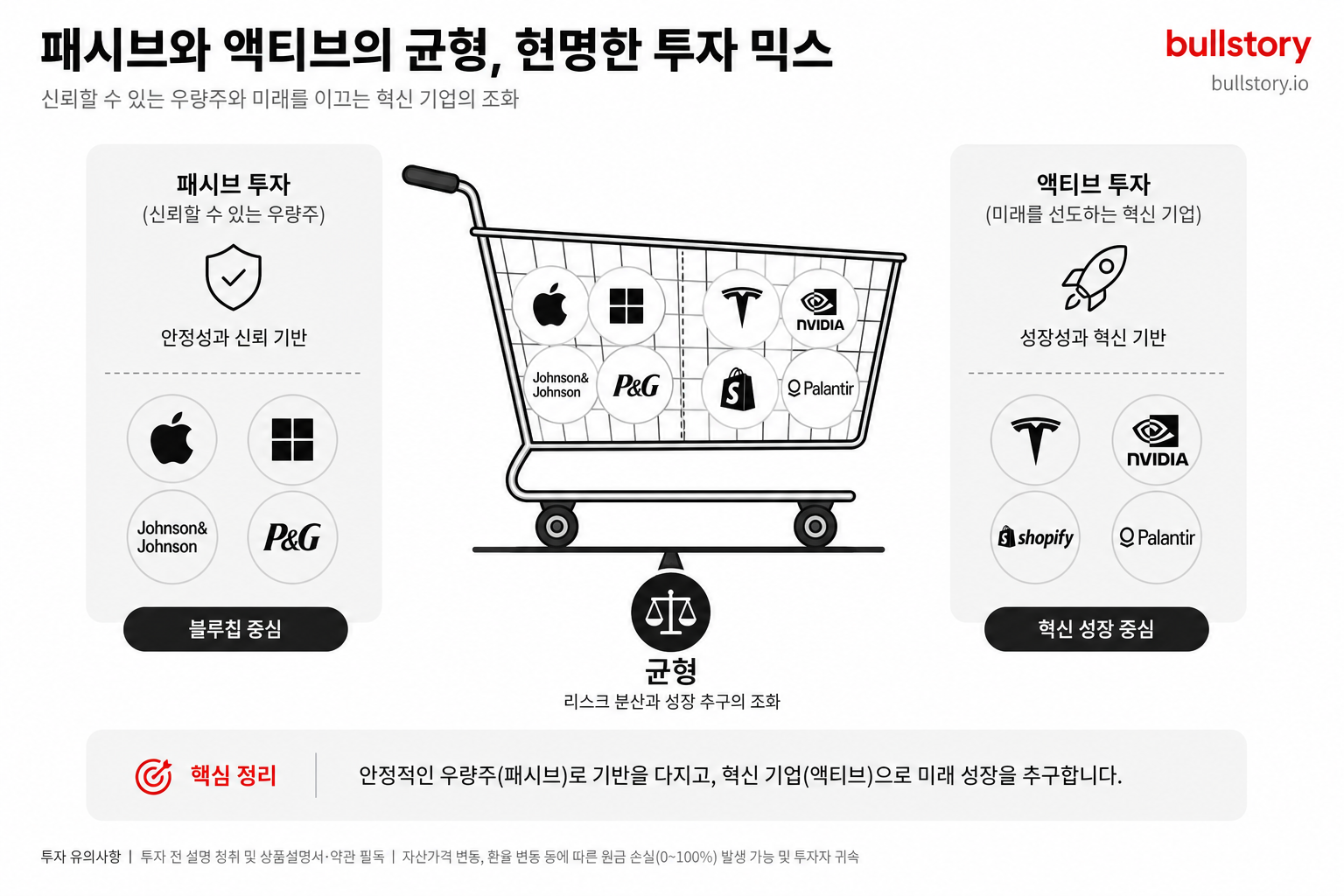
Representative 'Passive ETF' 3Selection
-
VOO (listed in the U.S. / tracks the S&P 500five hundred): The classic way to invest, praised highly by Warren Buffett, S&P500. It diversifies into 500high-quality companies in the U.S. and has extremely low fees.
-
QQQ (listed in the U.S. / tracks the Nasdaq 100): It concentrates investment in 100high-growth U.S. Nasdaq stocks with overwhelming technology and ideas that lead the world, offering high expected returns.
-
KODEX 200 (listed domestically / tracks the KOSPI 200): It is the most symbolic domestic passive ETF, diversifying into 200blue-chip stocks that represent the South Korean stock market.
Representative 'active ETF' 3choice
-
ARKK (U.S.-listed / disruptive innovation theme): The flagship product of Cathie Wood. It boldly concentrates on innovative companies with disruptive ideas that could change the world, such as artificial intelligence and robotics.
-
KODEX Robot Active (domestically listed / dominance of a specific ecosystem): It invests in companies with irreplaceable monopoly power in the robot market and in leading stocks at the center of the theme.
-
TIGER Korea Tech Active (domestically listed / Korean stock market ): It seeks excess returns by focusing on leading stocks with standout strength in the domestic market, such as Samsung Electronics and SK Hynix.
4. A major recent talking point, the 'exchange rate' defense strategy: currency exposure vs. currency hedge (H)
As volatility in the won/dollar exchange rate has recently increased, the exchange-rate trend has emerged as a key variable for investment returns, not only for stocks. When buying U.S.-listed overseas ETFs on domestic accounts such as ISA accounts (for example, TIGER U.S. S and P 500 and others), you must be sure to check the letters attached to the end of the product name.
-
Currency hedging (H): Ignores exchange-rate fluctuations and reflects only stock-price movements in the return. It is advantageous when the exchange rate is expected to fall in the future.
-
Currency exposure (no alphabet): Reflects both stock-price movements and fluctuations in the dollar exchange rate in the return.
Practical tip: Currency exposure is strong in a crisis Generally, when a crisis hits the global economy or the stock market crashes, the value of the dollar, a safe-haven asset, tends to surge. Therefore, if you normally buy currency-exposed products, even if stock prices fall sharply, the rise in the exchange rate offsets the losses and plays an excellent cushioning role in defending the maximum drawdown (MDD) of my account.
**5. Completing returns with 'tax savings' (ISA & overseas stock account setup)
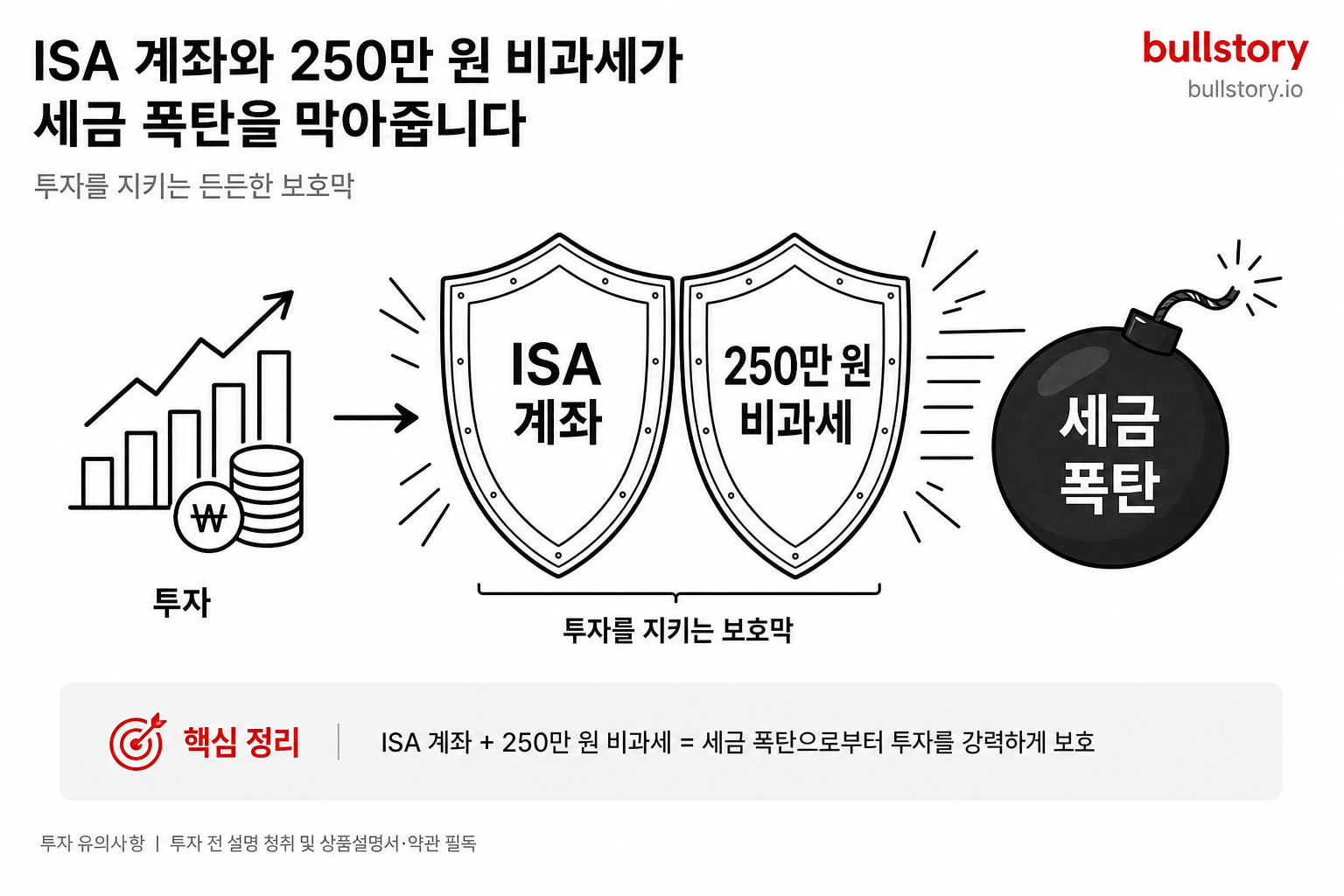
Domestic-listed ETFs should always be held in an 'ISA (Individual Savings Account)'
TIGER U.S. Nasdaq 100When trading ETFs listed on the Korean Exchange (KRX), such as these U.S. stocks, use an ISA account.
- Key benefit: It offsets total gains and losses generated within the account and, on net profits, offers a 200ten thousand won (for the basic type, 400ten thousand won) tax-free benefit. Even profits above the tax-free limit are 15.4not 9.9%, but are taxed separately at a low rate of %.
U.S.-direct-purchase ETFs: 'annual 250ten thousand won basic deduction' 100% use
In the case of a general overseas stock account that directly buys VOO, ARKK, QQQ, and others listed in the U.S. market, capital gains tax of 22% is imposed on trading profits.
- Key benefit: Capital gains from overseas stock trading are subject to a basic deduction (tax-free) of 250won each year. Before year-end, sell part of the positions that have gains to lock in 250won in profits, then buy back immediately so you can make the most of the annual tax-free benefit.
The best synergy: a 'ISA + 250won deduction' two-track strategy
The smartest and most efficient tax-saving setup is to run these two benefits at the same time. In your U.S. direct investment account, lock in profits only up to the annual tax-free limit of 250won, and direct any investment funds beyond that into your ISA account to focus on buying domestically listed ETFs. If you cleverly combine the tax-saving limits of both accounts, you can completely block the tax leakage that occurs while growing your seed money.
In closing
Understand the difference between 'passive,' which tracks an index, and 'active,' which is armed with overwhelming originality, and combine them according to your target return. Add a currency strategy that can cushion volatility, and if you use the ISA account and the 250won tax-free system as two wings to also block tax leakage, your seed money will grow much faster than you think!
Frequently asked questions
What are the disadvantages of ETFs?
If an ETF tracks an index, it is hard to expect a windfall. For active ETFs, the weaknesses are the manager’s poor judgment and the high management fee.
What is the difference between an ETF and common stock?
An ETF is a basket product that groups multiple securities, so you can achieve instant diversification simply by trading, while an individual stock is directly exposed to the rise and fall of a single company.
What is an ETF? Please explain it in one line for a stock market beginner.
An ETF is a listed product that puts multiple stocks from a specific index or theme into one basket, diversifying across dozens or hundreds of securities at once.
What is the practical strategy difference between passive ETFs and active ETFs?
Passive aims to pursue the market average by holding for the long term with low fees. Active aims for excess returns by betting on themes and leading stocks, while controlling risk with stop-losses.
Which should I choose between a currency-unhedged ETF and a currency-hedged ETF?
If the dollar is expected to strengthen during a crisis, currency unhedged exposure helps cushion some of the decline. If you expect the exchange rate to fall, currency hedging is advantageous.
How should ISA and an overseas stock account be combined?
For direct U.S. purchases, first use the annual basic deduction of two million won, and for overseas ETFs listed in Korea, place them in an ISA to receive the benefits of tax exemption and separate taxation at a low rate.250.}},