Bullstory Research June 17, 2026
A portfolio designed to sleep well even in a falling market
Key takeaways
SGOV is 0~3a short-term U.S. Treasury with a maturity of months that pays about 3.85% interest each month and serves as a cash shield in sharp market drops. The VOO·SCHD·SGOV combination is the classic portfolio for lowering volatility, while a higher QQQ allocation is an aggressive approach that aims to lift returns. Expanding the SOXX allocation increases return potential, but it also deepens losses when prices fall.
ETF? Portfolio? What is that? (A 1-minute summary for stock beginners)
Before diving into the main strategy, let’s very simply go over the two most important concepts for people who have just started investing in stocks.
1. ETF (exchange-traded fund): "a mixed snack gift set in the stock world" When you first start investing in stocks, you run into the question, "What on earth should I buy?" Analyzing individual companies one by one is too difficult for beginners, and if that company goes under, your money can disappear with it.
That is exactly why ETFs were created. Put simply, think of them as a "gift set." Products like a 'set of the best-performing 500U.S. companies,' or a 'set of high-quality companies that pay good dividends,' are baskets of dozens to hundreds of solid companies gathered by experts around a specific theme. We can easily buy and sell one basket in the stock market. Even if one or two companies in the basket fluctuate, the whole thing does not collapse, so it is much safer.100.
2. Portfolio (Portfolio): "the lineup of the starting eleven on my account" Think of a national soccer team. What would happen if you filled it with only 'forwards' like Son Heung-min, all out to score goals? The attack would look dazzling, but it would collapse at once from a single counterattack by the opponent. You absolutely need reliable 'defenders' and a 'goalkeeper.'11 players
Investing is the same. Combining 'growth stocks (forwards)' that can generate strong returns and 'safe assets/dividend stocks (defenders)' that can keep your account from falling apart, in a way that fits my own style. The process of building the lineup for my account like this is called 'constructing a portfolio.'
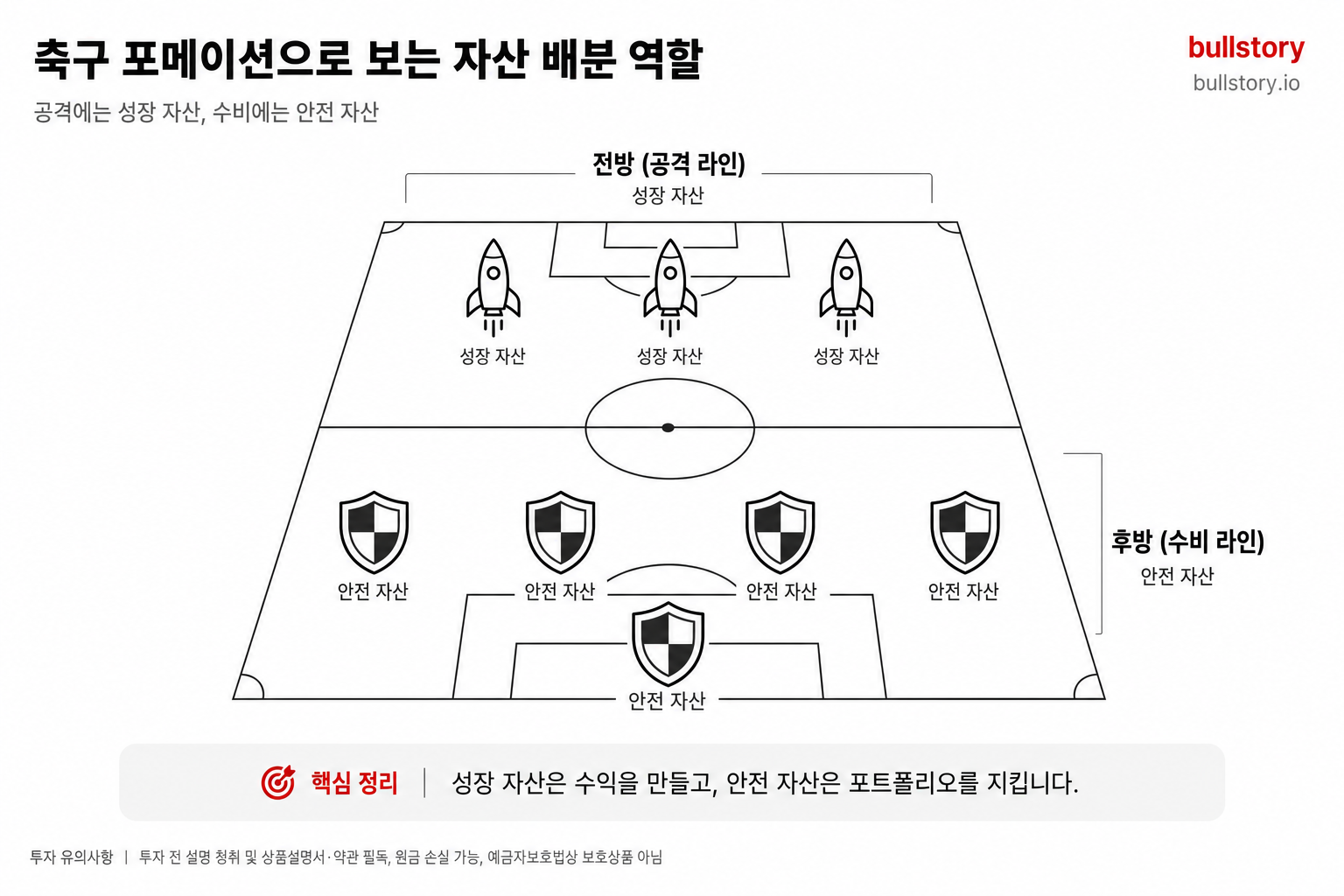
Safe assets? Isn’t that what gives you FOMO?
Many beginner investors misunderstand defenders (safe assets) as a “coward’s choice that eats away at returns.” But true investing experts make mixing assets with completely different correlations 1the principle of portfolio construction. The reason is clear. It is precisely for MDD (Maximum Drawdown, peak-to-trough decline) defense.
A portfolio made up only of attackers cannot control downside and turns into gambling rather than investing. There are not many strong-minded people who can hold on when the account is -30%, -40% and melting away. In the end, you end up panic-selling stocks at the bottom in “impulsive trading.”
Safe assets are not merely passive shields that simply reduce losses. When the market falls into panic selling, they serve as “strategic cash flow (Dry Powder)” that lets you pick up quality stocks at bargain prices whenever you want. In other words, only with a reliable defender can attackers run toward scoring with peace of mind.

5Top Core ETF: Understand Your Portfolio Lineup
Knowing why I am buying this ETF, and in what situations this asset comes into its own, is the starting point of design.
1. SGOV: The Absolute Shield in My Account (U.S. ultra-short-term Treasuries)
-
Role: Essentially a risk-free asset excluding FX losses, for defense in sell-offs and cash parking (goalkeeper)
-
Feature: 0invests in short-term U.S. Treasuries with maturities of 3 months. Price volatility from interest-rate changes is almost zero. Even on days when the stock market crashes, SGOV's value does not shake. On top of that, it pays roughly 3.85% interest every month in dollars, providing both the psychological and physical stamina to hold on in down markets.
2. SCHD: The Pillar of Dividends That Holds Firm Even in High Interest Rates (U.S. dividend growth)
-
Role: Maintain balance, generate steady cash flow (a reliable defender)
-
Features: Rather than simply companies that pay high dividends, we carefully select only financially solid blue-chip stocks that continue to earn profits even when interest rates rise and 10years or more have steadily increased dividends 100companies. SCHD’s real value lies in its low correlation with tech stocks. When the Nasdaq undergoes a correction, it quietly holds steady and keeps the center of the account anchored.
3. VOO: the classic approach to investing (S&P 500)
-
Role: Track the market’s average return, a core asset that does not shake easily (midfielder)
-
Features: This is an S&P 500tracking ETF made famous by Warren Buffett’s will to his wife. It diversifies into 500 blue-chip companies known as the heart of America. Rather than trying to beat the market, it serves as a base camp that faithfully and steadily follows the upward trend of capitalism.
4. QQQ: a powerful engine set to dominate the future (Nasdaq 100)
-
Role: Drives overwhelming capital gains and portfolio expansion (ace striker)
-
Features: Big tech that dominates the world, such as Apple, Microsoft, and the soon-to-join SpaceX, is gathered here. It richly captures the market’s overwhelming monopoly power, technical originality, and endless growth potential. If you need to lift expected returns in order to quickly reach seed money 1billion, this powerful engine is essential.
5. SOXX: The standard of the AI era, high risk high return (U.S. semiconductors)
-
Role: Maximizing excess returns, momentum-based trend following (joker striker)
-
Features: It invests heavily in the global semiconductor value chain, which is central to the AI revolution and includes companies such as Nvidia and Micron. In an uptrend, it rises more overwhelmingly than any other index, but when it turns down, the decline is also very deep. It is an ETF like a fierce wild horse that you ride without hesitation in a clear bull market.
️ Practical assembly method: 3portfolio strategy tailored to my style
How you mix these components completely changes the character of the account. Choose the allocation to fit your own investing style and psychological comfort.
Model 1. Pyramid-like solidity (VOO 40% + SCHD 40% + SGOV 20%)
-
Goal: Minimize volatility, the magic of compounding without being shaken up
-
Strategy: Build the core with VOO, which buys the American capitalist market, and layer on defense against declines with dividends and dollar interest (SCHD, SGOV). No matter how severe the crash, it dramatically lowers the portfolio's MDD.
-
Recommended: A standard, ideal mix that is perfect for office workers who cannot check stock charts often, or for anyone who wants the most peaceful nights without the stress of losing principal.
Model 2. Major upward-trend type (QQQ 50% + SCHD 30% + SGOV 20%)
-
Objective: Achieve a high expected return, rapid expansion of seed capital
-
Strategy: Put half of the account (50%) into the monopoly power of major Nasdaq growth stocks to rapidly grow the pie. However, to keep your mindset from being shaken by the wild volatility of tech stocks, the remaining 50% is firmly supported by uncorrelated safety buffers (SCHD, SGOV).
-
Recommended: Suited to smart aggressive investors who want to maximize expected returns and grow their initial seed capital as much as possible, while avoiding a mental breakdown.
Model 3. Extreme barbell strategy (SOXX 40% + SGOV 40% + SCHD 20%)
-
Goal: Maximize excess returns and cut off downside risk at the source
-
Strategy: Place the most fiercely rising ultra-high-risk asset (SOXX) and the safest asset (SGOV) equally at both extremes. In an uptrend, it aggressively “rides the wave” to squeeze out excess returns, and if there are signs that the trend is breaking, it is an active tactic that instantly locks in mental peace by moving into safe assets.
-
Recommended: Optimized for strategists who want the thrill of thematic investing but want to completely control the fear of their entire account melting away.
Investing is meant to enrich life
The reason we invest in stocks is not to spend every night clutching our smartphones and trembling with anxiety. If each asset has a different role and the correlations are clearly separated, having more and more holdings in your account is by no means a risk. It is the safest and most scientific ark for riding the waves of the market.
If you have set an orbit that suits your temperament, all that remains is steady recurring purchases and quiet patience.

Now close the MTS and sleep soundly and peacefully. Even while you are asleep, your account will expand on its own. Good Night!
Frequently asked questions
When starting a portfolio with ETFs for the first time, which ETF should I buy first?
Beginners should use VOO as the core, secure dividend flow with SCHD, and start holding cash with SGOV. Understanding the role of each ETF comes first.
When is SGOV, a safe-haven asset, especially useful?
During market crashes, its value hardly fluctuates, and it pays interest in dollars monthly 3.85at around % , providing a cash substitute and the capacity to buy more on dips.
Which should have a larger allocation, QQQ or VOO?
The investment objective is the deciding criterion. If the goal is to expand seed capital quickly, increase the allocation to QQQ; if you want steady compounding performance, make VOO the core holding.
Which investors is SOXX suitable for?
It is suitable for investors who are betting on the semiconductor cycle and AI momentum to seek excess returns and who can tolerate volatility. Trend-following management is essential.
What is the best way to decide portfolio allocation?
Decide based on your profile and goals. The core principle is to clearly separate the roles of core (VOO), defensive (SCHD·SGOV), and aggressive (QQQ·SOXX).
How much safe assets is appropriate to defend against MDD (maximum drawdown)?
It depends on the target MDD and your psychological tolerance. For beginners, the portfolio's 20% should be kept in ultra-short-term government bonds such as SGOV.