Surging valuations derail and delay a string of major M&A deals
As domestic and international uncertainty has grown this year, a string of high-profile mergers and acquisitions (M&A) deals that had raised expectations have fallen through or been delayed. Uncertainty over earnings and interest rates stemming from the war, along with valuation gaps between buyers and sellers, have emerged as the main causes.
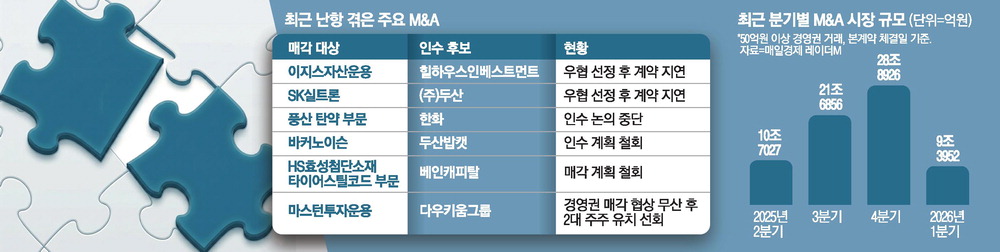
As domestic and international uncertainty has grown this year, a string of major mergers and acquisitions (M&A) deals that had attracted market interest have fallen through or been delayed. Several cases have been reported in which major deals stalled during early-stage negotiations or shifted to renegotiations. Deal cancellations and schedule delays have occurred frequently since the start of the year.
Earnings uncertainty caused by the war and interest-rate volatility are affecting deal sentiment. When earnings prospects are uncertain, buyers take a cautious approach to valuing acquisitions. Interest-rate uncertainty brings changes to financing costs and discount-rate calculations.
Surging valuations are becoming an obstacle to closing deals. Sellers are increasingly demanding high prices. Buyers are unable to accept the asking prices and are halting or postponing negotiations.
The price gap between buyers and sellers is widening. Because of the gap, negotiations are underway to restructure some deals by changing the equity structure or adding performance-based payment terms. Some deals have failed to reach an agreement despite restructuring.
The roles of financial institutions and advisory firms are also changing. There are more cases of stricter terms for acquisition financing or guarantees. Some advisory firms are taking a more conservative approach to considering deals and adjusting the scope of their involvement.
As a result, deals have repeatedly fallen through or been postponed in the M&A market so far this year. The main causes are a combination of geopolitical tensions, interest-rate uncertainty, and higher valuations. This is changing the timing and structure of major deals that were originally planned.
Sources: 매일경제 증권
Bullstory synthesized this report from the linked sources. AI may have assisted the writing process. Check the original reports for factual confirmation.