Bullstory Research July 1, 2026
Payment giants’ coup d’état, Circle has collapsed
Key takeaways
2026year 7month 1day after the news of the Open USD launch, Circle (Circle) stock plunged 17.55% in New York and closed at 62.63dollars. Payment companies such as Visa, Mastercard, and Stripe waived fees and jointly distributed U.S. Treasury interest income, dealing a direct blow to USDC’s deposit-based interest model.

Get free Circle Internet Group email updates.
Bullstory sends one daily email when new analysis or important company news is available.
"Distributors with overwhelming distribution networks pushed out the manufacturers that had been monopolizing margins and began printing money themselves."
2026year 7month 1day, a huge earthquake occurred that would permanently overturn the power structure of the global fintech and cryptoasset markets.
Global financial powers held by Visa, Mastercard, BlackRock, and others have united to announce the official launch of 'Open USD (OUSD),' a new digital dollar infrastructure.
This news is extremely devastating for Circle, which had been the dominant force in the existing stablecoin market. So the market immediately showed a violent wave of selling. We take an in-depth look at the essence of this event, in which Wall Street and Silicon Valley joined forces to destroy the existing stablecoin business model rather than merely issuing a new coin.
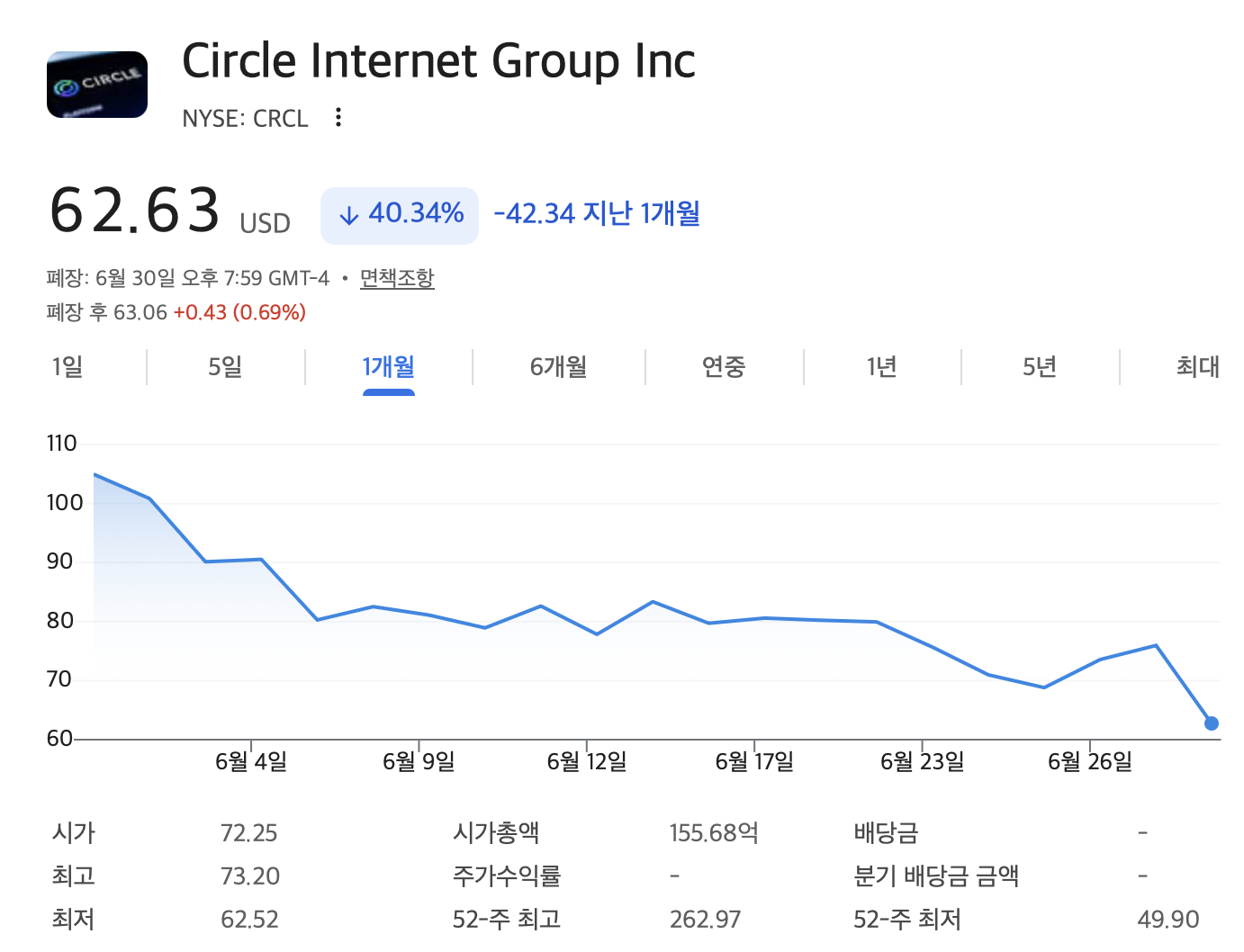
1. Circle, which crashed, saw its fortress fall
'Open USD' launch news was announced, and immediately after, Circle Internet Group (Nas: CRCL)'s share price on the New York stock market 13.33dollars(17.55%) plunged by 62.63dollars at the close.
-
This is the lowest level recorded since the end of 2around 4months ago.
-
In particular, this is a shocking figure, having been cut in half by as much as 5since the weekly peak recorded in mid-52month, a drop of 55%.
The reason the market reacted so extremely is clear. Circle's core revenue source, the dollar stablecoin (USDC) business model itself, was dealt a fatal blow. It has been pushed into an unprecedented crisis in which distribution channels are blocked and the core margin structure is being eroded.
Honestly, Circle is over now.
2. Circle's fatal blunder: "The bear did the work, and Circle pocketed the interest"
To understand the crisis Circle has faced, you need to understand the “margin structure” of the existing stablecoin business. Circle issues USDC based on dollars deposited by customers, and then invests those dollars in U.S. Treasury bonds and similar assets to generate enormous interest income.
The problem was the dissatisfaction of the very parties that had helped drive USDC’s payment volume higher.
-
Under the existing structure, payment giants such as Visa, Mastercard, and Stripe were nothing more than simple “distribution agents” that connected Circle’s USDC to their own payment networks.
-
Even though they provided massive payment networks and boosted volume, the largest profit in the stablecoin business—“interest income from U.S. Treasury bonds based on deposits”—was entirely monopolized by Circle.
This imbalance in profits ultimately sparked a deadly rebellion: “the independence of the owners who control the distribution network.”
3. And, the overwhelming destructive power of the “Open USD” consortium
The lineup of the coalition gathered to pass Circle, “Open Standard,” is nothing less than the best team in the global economy.
-
Founding partners: Visa and Mastercard, the world’s largest payment networks; American Express; global payments platform Stripe; Coinbase, the largest crypto exchange in the United States, and BlackRock, the world’s largest asset manager, were on the list.
-
Traditional finance & big tech join: On top of that, as many as 140 companies, including Google Cloud, IBM, BNY Mellon, Standard Chartered, and DBS Bank, joined in large numbers.
The person leading this project is also symbolic. 2024When Stripe acquired 11billion dollars (about 1trillion 7hundred billion won) with a huge outlay, Jack Abrams, co-founder of stablecoin infrastructure company Bridge, which drew attention at the time, has taken the helm as interim CEO.

4. The business model that upended the playing field: fees 0 won, interest at one over N1
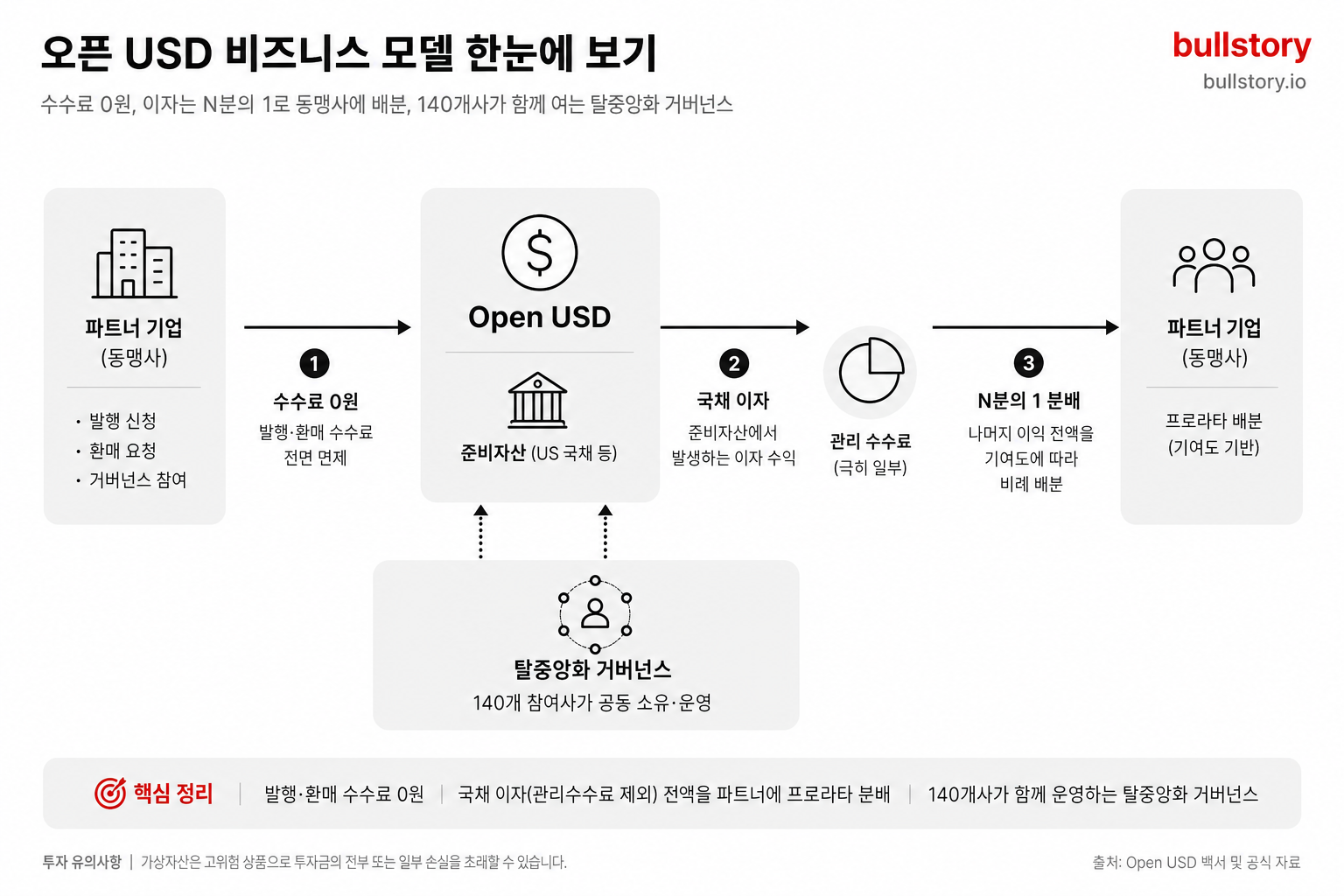
The truly terrifying thing about Open USD for Circle is the disruptive profit-distribution policy they put forward.
-
Zero fees:
Open USD fully waives stablecoin issuance and redemption fees for participating consortium firms. -
Full distribution of Treasury interest:
After excluding only a small management fee from the U.S. Treasury interest income generated by the reserve assets, the entire remaining profit is distributed as is according to each consortium firm’s contribution. -
Decentralized governance:
Governance rights are not monopolized by a single company such as Circle; 140it adopts an Internet standard protocol model jointly owned by the participating firms.
In other words, the reason companies with payment networks had to use Circle’s USDC has completely disappeared. They have adopted Open USD as their base currency, become direct “issuance shareholders,” and completed a structure in which they directly take the Treasury interest income corresponding to the payment volume they generate.
Jack Abrams, the interim CEO, said it in a way that perfectly captures their philosophy.
"Existing stablecoins are excellent, but for global conglomerates to fully adopt them for large-scale business, they needed a new network that was thoroughly open, low-cost, and aligned with their economic interests."
5. Circle (USDC) vs Open USD (OUSD): who will be the ultimate winner?
So will Circle, the long-standing incumbent, simply be left helpless? By comparing the 'core weapons' of both camps, a clear view emerges of how the stablecoin battle for dominance is likely to unfold.
- Open USD's overwhelming advantage: 'real-world payment network' and 'profit sharing'
In the current landscape, the structural advantage lies overwhelmingly with the Open USD coalition.
That is because the fundamental power of money comes from where it can be used (the distribution network).
-
Distribution network monopoly: Visa, Mastercard, and Stripe are the “endpoints of real-world payments,” controlling tens of millions of merchants and billions of cards worldwide. The moment they announce on their own payment terminals or APIs that they will cut fees if merchants use Open USD instead of USDC, well… it’s over.
-
The lock-in effect of profit sharing: Until now, even when companies adopted stablecoins, the benefit, or yield, went to Circle. But in the Open USD ecosystem, yield is distributed in line with the contribution made to the ecosystem, namely generating payment volume. In a capitalist market, no company would reject an incentive this strong.
- Will Circle stand still? ‘DeFi liquidity’ and ‘regulatory breakout experience’
Circle still has two fortresses that will not be easily broken. They are the ‘crypto-native ecosystem’ and ‘regulation’.
-
The absolute ring of the DeFi ecosystem: USDC has, over the past several years, become the reserve currency most deeply rooted in the decentralized finance ecosystem of the virtual asset market. Countless smart contracts, lending protocols, and liquidity pools operate on the basis of USDC. Even if Open USD dominates the ‘real economy,’ it is difficult to seize the massive liquidity inside the ‘virtual asset ecosystem’ overnight.
-
Complex regulatory barriers: Circle has spent years in intense dialogue with U.S. regulators and with Europe, including MiCA, building a regulatory moat as ‘the safest and most lawful stablecoin.’ By contrast, 140the giant Open USD consortium formed by major companies is likely to face immediate antitrust scrutiny from the U.S. Department of Justice and strong pushback from the SEC. The inherently slow decision-making of a large coalition is also a weakness.
- So which of the two is more favorable?
In the short term, Circle will hold out by using its entrenched position in the crypto (DeFi) market as a shield. But in the medium to long term, the balance of victory will inevitably tilt toward "Open USD".
That is because the ultimate goal of stablecoins is not trading among coin investors, but replacing everyday payments for people around the world and cross-border remittances (B2B). What controls this "real-world pipeline" is not Circle, but Visa and Stripe.
To survive, Circle will have to abandon its existing model of "earning interest on dollar deposits (B2C/B2B issuance)' and make an extremely difficult business shift into a "white-label software company" that only provides infrastructure so that other banks or companies can easily issue stablecoins.
Conclusion and Investment Insights
Wall Street is characterizing this event not as a simple new coin launch, but as a "major shift in the fintech power structure".
Stablecoins have now evolved from the stage of a 'private asset' in which individual private companies (Circle, Tether, and others) monopolize enormous seigniorage (profit from money creation), to the stage of an 'internet-standard public good' used as infrastructure, with global financial institutions and big tech sharing the profits294; .'
This rebellion led by Visa, Mastercard, and Stripe is highly likely to succeed. 화because the lifeblood of money ultimately depends on 'where it can be used (distribution network).' Existing single-stablecoin issuers, including Circle (CRCL), are at risk of losing their long-term growth engine unless they fundamentally revise their revenue model.
Now investors' attention is rapidly shifting to payment platform companies that have joined the Open USD consortium and are equipped with a new pipeline for U.S. Treasury interest income (Visa, Mastercard, Stripe, and others), asset managers that will manage this vast flow of dollars (BlackRock), and exchanges that provide infrastructure (Coinbase)94%EC%9D%B8%EB%B2%A0%EC%9D%B4%EC%8A%A4-%EC%A3%BC%EA%B0%80-%EC%A7%80%EA%B8%88%EC%9D%B4-%EB%B0%94%EB%8B%A5%EC%9D%B8%EA%B0%80-%EB%B0%98%EB%93%B1-%EC%A1%B0%EA%B1%B4-3%EA%B0%80%EC%A7%80%EC%99%80-2030-%EC%8B%9C%EB%82%98%EB%A6%AC%EC%98%A4to move quickly. This is a turning point where the history of finance is being rewritten once again.
Frequently asked questions
What are the direct risks that Circle’s collapse poses to USDC stablecoin holders?
The main risks are a reduction in USDC’s use cases and weakening of the redemption and yield structure. As it leaves payment networks, liquidity and utility may decline.
What opportunities does the Circle situation create for the market power of payment companies like PayPal, Stripe, and Visa?
Payment companies gained the opportunity to secure their own stable payout and interest distribution structure and take revenues directly. Their distribution advantage can drive rapid adoption.
How should Korean investors check the crypto and stock-related risks to which they may be exposed because of the Circle situation?
Check your holdings of USDC and stablecoin exposure, positions in related stocks such as Circle, and DeFi liquidity exposure, and set up an immediate redemption and diversification plan.
What impact will a reduction in USDC supply have on crypto market liquidity and stablecoin interest rates, and what investment response strategy is there?
A supply reduction could lead to lower DeFi liquidity and higher short-term stablecoin rates. The response is to diversify positions and secure the ability to redeem immediately.