Bullstory Research July 7, 2026
Reasons for Micron's stock plunge, the background to its intraday drop tonight and how retail investors in U.S. stocks should respond7%
Key takeaways
Micron (MU) fell 27% from its peak, and on 7month 7day during trading it was quoted between 915~935dollars. The reasons were profit-taking after the rally, concerns about capital moving around due to SK Hynix's Nasdaq listing, disappointment with Broadcom's guidance, and a class-action lawsuit filed on 6month 25day.

Get free Micron Technology email updates.
Bullstory sends one daily email when new analysis or important company news is available.
<!--close-update:end-->U.S. market close update (2026-07-07): Micron closed at 938.38 dollars (-4.71%). The key figures in this article have been updated based on the close.
What is happening with Micron now
Micron (MU) has fallen 1~2% from its peak over the past 27 weeks. The year-to-date return is in the +190% range.
Today (7 month 7 day), during intraday trading, Samsung Electronics’ preliminary earnings announcement added to the shock. The KOSPI closed down 4.91% to 7,656.31 as of the previous day at the close. The intraday low was 7,389.22.
Where is it trading now.
7 month 7 day, at night (during the U.S. session), Micron is trading between 915~935 dollars.
52The weekly high was 1,255 dollars. 52The weekly low was 103.38 dollars.
From the high to now, it has fallen by more than 325 dollars.
The decline began on 7 month 1 day.
7 month 1 day, on the New York market, Micron plunged 10.57%.
Two days later, on 7 month 2 day, there was another drop.
7 month 2 day, it fell 5.49% during the day. The intraday low was 950.28 dollars and the high was 1,064.64 dollars.
The intraday range exceeded 12%.
The shock from Samsung Electronics was layered on top of that.
The background to the semiconductor sector being shaken at the same time is simple. It was widely perceived that Samsung Electronics' tentative quarterly results failed to beat market expectations. After the earnings were confirmed, profit-taking spread across the semiconductor industry as a whole.
Senior researcher Kang Jin-hyuk of Shinhan Investment Securities said that a sell-off followed Micron's recent earnings release, and that investors with peak concerns brought forward profit-taking orders.2/blog/%EB%B
| Indicator | Figure |
|---|---|
| 52high price | 1,255dollars |
| decline from peak to current | -27% |
| return since the start of the year | +190% range |
| 7month 1day single-day drop | -10.57% |
| 7month 2day drop | -5.49% |
| recent 5trading-day drop | -14% |
Micron has fallen 5% over the recent 14trading days. This is not a one- or two-day issue.
That does not mean the business itself has collapsed.
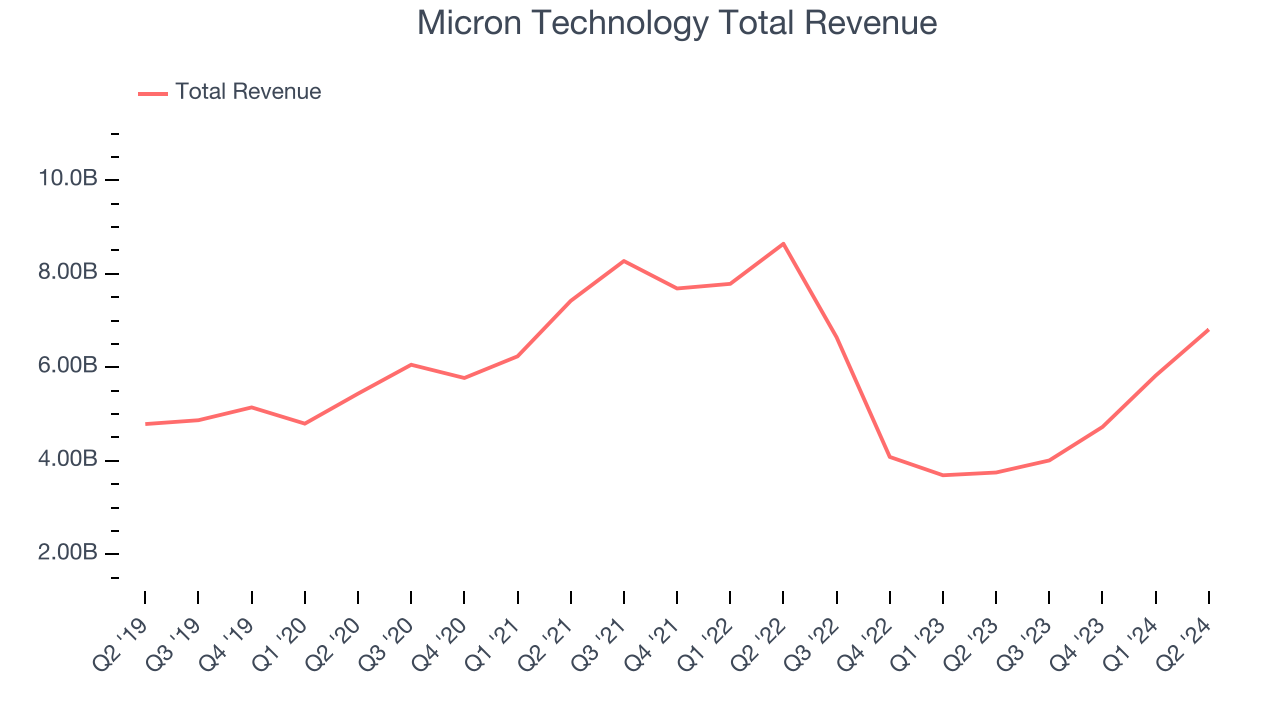
Micron's 2026 fiscal year 3quarter (2026year 5month 28day ended) revenue reached a record high of 415hundred million dollars was recorded.
1one year ago 93hundred million dollars to 4it more than doubled.
The situation is one in which the reasons the stock price is falling and the reasons the business results are good coexist. The cause of that split is examined in the next section.
Why did it suddenly sell off? The direct cause of this decline 3came in three waves
Micron (Micron Technology)'s sharp drop was not the result of a single event. After last week's rally, profit-taking was already in the air, and three negative factors hit at once: a class-action lawsuit, concerns about fund flows tied to SK Hynix's Nasdaq listing, and disappointment with Broadcom's guidance. A stock that would have been shaken by just one of these was hit by all three at the same time, and over the short term it fell by more than 7%.
Cause ① SK hynix Nasdaq listing (SKHY), where will the money go?
7In 10 the planned Nasdaq listing of SK hynix, which is set to begin trading on the 294-billion-dollar scale, is heightening investor concerns about capital moving elsewhere. This is not simply a matter of a new stock appearing.
De Zhou, portfolio manager at Sonberg Investment Management, said, "This offering is aimed at investors who currently cannot access the Korean stock market," and added, "SK hynix's Nasdaq listing provides direct, frictionless access to one of the most attractive pure plays on the AI memory cycle."
The question is whether the stock price is expensive or cheap relative to earnings.
SK hynix is 12 times expected earnings, or PER (how many times the stock price is to earnings). Micron is currently 6.2 times, but as recently as last month it was more than 7 times. Both companies are riding the same AI memory cycle, so a lower PER means it is relatively cheaper. For Micron shareholders, it is an uncomfortable comparison.11.
Kim Forrest, CIO of Bokeh Capital Partners, said, "It can draw into the market investors who do not hold anything in this sector." While Forrest said she herself would not participate because of governance differences, she said she expects many fellow investors to take part. There is concern that some of the money that should have gone into Micron could flow to SKHY.
Cause ② Broadcom guidance disappointment, "good results" are not enough
Another trigger for the decline was the market reaction to Broadcom's earnings release. Broadcom posted strong quarterly results, but it did not raise its long-term outlook for AI semiconductor revenue. That cautious stance led to profit-taking across AI-related semiconductor stocks.
In numerical terms, it looks like this.
| Item | Actual | Market consensus |
|---|---|---|
| 3quarterly AI chip revenue guidance | 160billion dollars | 172billion dollars |
| annual AI semiconductor revenue outlook | 560billion dollars | 575billion dollars |
| 2027year AI revenue guidance | "1,000billion dollars or more" (unchanged) | expected upward revision |
On performance alone, there was nothing to criticize, but the market reaction was cold.
Broadcom announced 3quarterly AI semiconductor revenue of 160billion dollars, but that fell short of market expectations of 172billion dollars.
This 160billion dollars represents an increase of 208percent from the same period last year.
In the end, the market wanted not "good results" but "perfect results." Micron had been a company that had delivered steady results in the semiconductor sector. During periods of growing market uncertainty, it is vulnerable to profit-taking. As Broadcom stumbled first, Micron was pulled down as well.
Cause ③ class-action lawsuit directly targets the argument Micron was most confident in
6The class-action lawsuit filed on the 25th claims that Micron, Samsung, and SK Hynix secretly restricted memory chip supply, driving prices up by as much as 700%.
The core claim of the lawsuit is that 2022since 3they reduced production of conventional memory (DDR4, DDR
According to data cited in the complaint, about 25% of DRAM wafer capacity was shifted to HBM production.
The reason this lawsuit is especially serious is clear. 'Pricing power' was the basis on which the industry maintained high profitability. If the plaintiffs prove that the supply-restriction collusion violated antitrust law, the court's remedy could weaken the supply discipline itself that supports today's high memory prices.
Micron's share price reached a weekly high of 6on the 25th, the day the complaint was filed, at 52 dollars.1,255.
But 7as of 1the stock closed at 1,032.28dollars. After the lawsuit was filed, 5trading days later 16.01% had fallen. The drop was 196.72dollars.
Micron denied the lawsuit, saying it was "complying with all applicable laws and competing fairly." Most of Wall Street still appears not to be placing much weight on the lawsuit. Antitrust cases often have limited impact on short-term business, even if they drag on for years unless there is a court order.
If you organize how the three causes differ, it looks like this.
| Cause | Nature | Impact on the actual business |
|---|---|---|
| SK Hynix SKHY listing | Concerns about fund flows | No direct impact, psychological factor |
| Broadcom guidance disappointment | Sector-wide selling | Not a direct negative for Micron |
| Class action lawsuit (6 as of 25) | Legal risk | Long-term litigation, minimal short-term business impact |
All three are different from the claim that "earnings deteriorated." It is the result of overlapping investor sentiment, sector mood, and legal uncertainty rather than the business itself. So where do the company's actual operating results and financial condition stand now? In the next section, we look at its current position relative to the peak.
A stock that has already fallen 27% from its peak. Where is it now?
Micron has fallen 27% from the peak it set right after its earnings release. Even so, its year-to-date return is still in the +190% range. To pinpoint where this stock stands now, you need to look at both numbers together.
Where was the peak, and how much has it fallen?
Micron’s all-time high was 2026year 6month 25day, at 1,255dollars per share. After the earnings release, the price reversed sharply, and it is now 27% below the peak.
The current share price is around 920dollars. As of 2026year 7month 7day, it was the lowest level since 6month 11day, and it took exactly 2weeks to fall from the peak to this level.
| Reference | Share price | Note |
|---|---|---|
| 52-week low | 103dollars | 2025year 8month 1day |
| Current share price | about 920dollars (intraday) | 2026year 7month 7day |
| All-time high | 1,255dollars | 2026year 6month 25day |
| Decline from peak | -27% | about 2weeks |
"Even so, will a return of +190% year to date" be any comfort?
It can. And it can’t. It depends on the context.
This year, 2in just one quarter, 240surged by more than %; the pullback after the peak looks closer to a classic profit-taking pattern.
52The weekly low was 103dollars. An investor who bought at that price has now seen nearly 9times their money.
By contrast, an investor who jumped in near the monthly high in 6currently has a return of -27%. It is the same stock, but a completely different reality.
52The weekly range was 103dollars to 1,255dollars. Within a single year, the stock moved more than 12times. This one figure shows just how extreme Micron’s price volatility was.
What position is this place in historically?
Micron has not experienced for the first time a post-earnings drop of more than 20% from its peak.
This is the sixth time, and 2025 year 4month is the sharpest multi-session decline since the tariff shock.
The repeating pattern is, in fact, the more important signal. Micron has shown a structure in which the better its earnings, the more its share price surges, and after that surge, profit-taking selling appears all at once. This time is not far from that pattern either.
The results for the previous quarter beat guidance on revenue by 24% and on profit by 31%.
Revenue increased year over year by 346% 410billion dollars. On a non-GAAP basis, gross margin rose to 85%.
The company’s actual business strength is at an all-time high. However, the stock ran ahead even faster than that.
In one sentence, it comes down to this. The business is at its peak, but the stock price is cooling off. Both of those are true at the same time.
So what was the direct trigger behind this decline? Three things hit at once.
Why the Korean stock market fell more sharply
7month 7day, the KOSPI closed down 4.91% on the day at 7,656.31.
Intraday, it fell as far as 7,389.22.
Compared with the Nasdaq’s decline of only 1% on the day, the bad news in U.S. semiconductors was amplified in the Korean market by 4 to 5 times.
Samsung Electronics closed at 6.92% lower, at 29won 6,000.
SK hynix 6.06 fell by 220billion 1,000won.
The preliminary results from Samsung Electronics set off the trigger
At the center of the sharp drop that day was weakness in semiconductor stocks after Samsung Electronics announced its preliminary results. Samsung Electronics’ 2quarterly results were seen as beating market expectations, but the view spread that they had not surpassed the heightened bar. After the results were confirmed, profit-taking selling emerged, spreading pressure across the semiconductor sector.
"There are also reactions like, ‘Why is the stock price falling when the results are outstanding?’" This is where investor sentiment comes in. The stock market looks more at how much expectations were exceeded than at good results themselves. When results are confirmed after expectations have already been largely reflected in the share price, it often becomes a time to sell.
Structural reasons why the KOSPI fell more sharply
The reason the Korean stock market is unusually sensitive to negative news from U.S. semiconductors is simple. Samsung Electronics and SK Hynix are so large a share of the total KOSPI market capitalization that their weight is excessive. As the two stocks weakened together, the KOSPI index fell to 53%. Samsung Electronics and SK Hynix account for about 7,500. When the two move sharply together, the index itself follows suit.
The U.S. Nasdaq is spread across thousands of stocks. Even if one semiconductor sector drops by 7%, other industries provide support. The KOSPI has no such buffer.
Leverage products amplified the decline
Kiwoom Securities researcher Han Ji-young said that after Samsung Electronics' preliminary earnings, the view that the event should be approached as a sell-on-good-news move, where the share price falls after earnings are announced, prevailed in the short term, and that supply and demand distortions from single-stock leverage products also acted as a factor accelerating the decline in the stock price.
Leverage products are derivative instruments designed to incur losses when stock prices fall by 1 to 2 percent. When these products are forcibly liquidated early in a downturn, the volume floods into the market and triggers additional declines.3.
Foreign investors and individuals moved in different directions
Foreign investors dumped large-scale sell orders, dragging the index lower. On KOSPI, foreigners 2trillion 9,298won in net selling.
Institutions also 3,092billion won.
In contrast, individual investors bought 3trillion 1,343won, helping defend the crash. When overseas retail investors were holding Micron, Korean retail investors were buying up Samsung Electronics and SK hynix.
Circuit breakers were triggered as well
Market-stabilization measures were also activated one after another.
In the morning 10o'clock 23a sell-side sidecar was triggered in the securities market.
This year’s number of KOSPI sidecar activations was 32.
At 1:51p.m., the 1stage circuit breaker was triggered and trading was suspended for 20minutes. This circuit breaker was the 6of the year and the 12in history.
A circuit breaker is a mechanism that forcibly stops trading itself when stock prices fall too quickly. It is activated when the market is judged to be in a panic. This single record shows how volatile the Korean stock market was in 2026.
| Item | Decline |
|---|---|
| Micron (MU, intraday) | -7.04% |
| KOSPI (close) | -4.91% |
| Samsung Electronics (close) | -6.92% |
| SK Hynix (close) | -6.06% |
| Nasdaq (on the day) | -1.3% or so |
The reason the Korean stock market falls even more sharply is simple. Half of the KOSPI is concentrated in two semiconductor names, leveraged products amplify the decline, and the moment foreign flows lean in one direction, the entire index swings. When a semiconductor negative shock breaks out in the U.S., the impact returns to Korea doubled. This is not just Micron’s problem.
Is SK Hynix’s Nasdaq listing (SKHY) good or bad for Micron?
In the short term, it is a negative. As SK Hynix 7month 10day begins trading on Nasdaq under the ticker SKHY, U.S. institutional investors will be able to access, for the first time, the direct competitor to Micron in HBM 1-focused companies. Concerns about capital outflows already appear to be reflected in the share price.
However, the medium-term scenario is different. As the entire HBM sector comes into Wall Street’s spotlight, Micron could also be re-rated.
SKHY listing: what changes
There are four key numbers in this listing.
- Expected listing date: 7month 10day
- Ticker: SKHY
- Maximum new shares to be issued: 1,779ten thousand shares
- Expected amount to be raised: 294hundred million dollars (about 45trillion 4,500hundred million won)
Bloomberg viewed this listing as the largest new share issuance in the history of foreign companies.
SK Hynix aims to raise 294 billion dollars (about 45 trillion 4,500 billion won).
Bloomberg said the size exceeds 2014 the amount raised by Alibaba in 250. Comparable deals also include Saudi Aramco’s 2019 in 256 billion dollars.
Until now, investors outside Korea had found it difficult to buy SK Hynix directly. 7From 10 this restriction will be lifted. Both institutional and individual investors in the United States and Europe will be able to buy SKHY through a regular brokerage account.
Capital outflow scenario: from Micron to SKHY
| Item | SK Hynix (SKHY) | Micron (MU) |
|---|---|---|
| HBM market share | about 58% | about 21% |
| 2026-year forward P/E | about 7.4x | about 9.4x |
| Operating margin (2026year 1quarter basis) | 72% | about 50~55% |
SK Hynix’s share in the HBM market is 58%, and Micron’s is 21%. U.S. institutions have now been able to compare these figures directly.
According to a Seoul Economic Daily report, SK Hynix’s 2026-year forward P/E is 7.42x.
Micron’s 2026-year forward P/E is 9.44x.
In the HBM market, 3Micron, which ranks 1, is trading at a higher valuation than SK Hynix, which ranks . The moment SKHY is listed, this inverted structure will be laid bare on Wall Street’s screens.
Stock price revaluation scenario: the entire sector rises
There is also a counter-consensus logic. If SK Hynix is listed on Nasdaq, the keyword HBM itself will draw more attention in the U.S. market.
A Nasdaq listing raises the likelihood of inclusion in major U.S. indices. If index inclusion becomes a reality, there could be fund inflows from global passive ETFs that track those indices.
The key basis is HSBC analysis. HSBC analysts said Micron had traded at an average premium of 13 over SK Hynix for the past 35 years.
The reason HSBC identified for that premium was access for U.S. investors. That access barrier would disappear with this SKHY listing.
HSBC raised its target price for SK Hynix’s Korean shares from 29 won to 40 won.
The increase is 38%.
If SK Hynix rises, Micron could also rise alongside it. This is a scenario in which money flows into both sides of the same HBM sector.
In a situation where the shortage of AI memory supply is expected to continue for several years, there is also a view that holding both SK Hynix and Micron could be more effective than choosing only one.
So what about now?
Short-term pressure is real. Still, it is too early to be optimistic that the stock price will rise immediately after the ADR listing.
Given domestic supply-and-demand conditions, there is also a view that SK Hynix’s stock price will be hard-pressed to rise straight to Micron’s level.
TSMC is often mentioned as a comparison point. Some analysts point out that TSMC’s U.S. ADR often trades well above its home-market shares and believe it is difficult to expect a simple convergence in prices.10. It's not easy to expect a simple price convergence.
The opening price on the first day of listing matters. In the U.S. market, several leveraged products based on SK Hynix ADR as the underlying asset are waiting to be launched. If the opening price is strong, demand for leveraged products could pile in as well, and Micron outflows could become a reality. If it starts weakly, it could be a signal that the entire HBM sector is expensive, adding pressure on Micron.
If you hold Micron, 7on 10day, be sure to check SKHY's opening price and first-week trading volume.

Check the SEC filing: executives have already sold
2026year 7month 1day, April Arnzen, Chief People Officer of Micron Technology, sold 40,000common shares.
The trade price was 1,077 to 1,096dollars per share. The total sale amount was 4,336ten thousand dollars (about 599billion won).
At that time, the stock price was nearing 1,255dollars at its peak. When this filing was posted on SEC EDGAR on 7month 6day, the already shaky stock price came under additional downward pressure.
This sale was a "preplanned" one. What does that mean?
This sale was executed according to Arngen's 2025 year 12 month 19 day preadopted Rule 10b5-1 trading plan. Rule 10b5-1 plan means a system in which an executive files in advance with the SEC, before obtaining material nonpublic information, about when, how many shares, and at what price they will sell. It is a device to prove that they did not know inside information at the time of the actual sale.
So it is hard to conclude that they "sold while knowing inside information." The time when the plan was set is 7 months earlier.
There is still a reason the market reacted. It is that several people sold at the same time, not just one person.
The CEO also sold. How large was it?
CEO Sanjay Mehrotra sold common shares of 2026 year 6 month 26 day, 28,506 shares.
The total sale amount is 3,276thousand dollars (about 452billion won). The sale details can be confirmed in SEC Form 4 filing.
Merotra’s sale was also under Rule 2026adopted on 1month 30day. At that point, the stock price was less than half of what it is now. That plan was carried out near the peak.10 plan.5-1:
Board director Lynn Dugle also sold shares on 6month 30day. The sale volume was 1,300shares, and the transaction price was 1,150dollars per share.
Arngen, Merotra, and Dugle. At least three executives sold shares at the same time.
| Executive | Title | Sale date | Shares sold | Total amount |
|---|---|---|---|---|
| April Arngen | EVP, Chief Human Resources Officer | 7month 1day | 40,000shares | 4,336thousand dollars |
| Sanjay Merotra | CEO | 6month 26day | 28,506shares | 3,276thousand dollars |
| Lynn Dugle | Director | 6month 30day | 1,300shares | 150thousand dollars |
How should this be read?
It is hard to view insider selling as either an "automatic red flag" or something to simply dismiss as "a planned sale."
One thing is clear. After this sale, Arngen’s holdings fell to 85,737mainly reduced. The share price fell 14% over the following week. After selling, the stock dropped. It was said that the timing was good.
That said, 40,000that scale of sale is not unusual among Micron executives.
2025In 10there was a case where two other executives sold stock on a large scale. One sold 82,000shares, and the other sold 126,000shares.
Insider selling is one reference indicator. There is no direct evidence that they sold because they knew the stock would move lower. Still, the fact that executives reduced their stock almost simultaneously near the peak 3is data that makes us reconsider the current price level.
In the next section, setting all of these negative factors aside, we look directly at the earnings figures to see where Micron’s business stands.

Micron fundamentals: where is the business standing while the stock price falls
The share price has fallen by 27% from its peak, but the business itself remains solid. 2026in 3the quarter (3to 5month) revenue was 414billion 6,000million dollars, and the gross margin reached a record high of 84.9%. HBM 2026years' worth of volume has already sold out, and HBM3E and HBM4 are both booked through 2027.
Securing HBM demand (2026and beyond)
Micron announced that it had completed pricing and volume contracts for all HBM volume for 2026year. The contracts were finished before the production lines even left the factory.
Management said that as of the first half of 2026it already had preorders lined up through 2027, 2028, and 2. Considering that the memory semiconductor industry has been a sector where prices swing on a quarterly basis, delivery contracts locked in years ahead carry significant meaning.
CEO Mehrotra said on the conference call that the memory supply shortage, driven by AI demand and structural supply constraints, will continue even after 2027. In reality, the customer demand Micron can currently satisfy is only 50 to 67% of the total. That means it is only able to sell about half, yet quarterly revenue is still hitting an all-time high.
Long-term contract 16deals are changing revenue into a 'booked' structure
Micron has signed long-term contracts (SCAs) with data center operators and automakers, among others, 3to 5years of volume guarantees, in 16deals. This is a signal that the business model is shifting from cyclical trading to a subscription-like model.
| Item | Details |
|---|---|
| Number of deals signed | 16deals |
| Contracted share of DRAM volume | about 20% |
| Contracted share of NAND volume | about 33% |
| Total minimum guaranteed contract revenue | 1,000billion dollars |
| Advance payments received from customers | 220billion dollars |
These 16deals lock in 20% of DRAM volume and 33% of NAND volume. The total minimum guaranteed revenue is 1,000billion dollars, and customer advances are 220billion dollars. (Source: Micron Technology Q3 2026 earnings release SEC Form 8-K, 2026year 6month 24day)
4Quarterly guidance and market expectations
The key is how much the 4quarterly outlook presented by management at the earnings release beat market expectations. Management guided revenue to 500billion dollars (±10billion dollars). Non-GAAP earnings per share were 31dollars (±1dollars), and the gross margin was about 86%.
This sales forecast was65 hundred million 5,000ten thousand dollars above the Wall Street consensus at the time, and earnings per share were 5dollars 57cents above consensus. Because of this gap, the stock surged by nearly % in after-hours trading. The business itself did not weaken; rather, external headwinds overlapped with strong results. This distinction is the starting point for the current assessment.15. The business itself did not weaken; rather, external headwinds overlapped with strong results. This distinction is the starting point for the current assessment.
HBM4: rapid ramp-up and initial sales
HBM4 the mass-production ramp-up speed is twice as fast as the previous-generation HBM3E. Cumulative HBM4 sales have already exceeded 10 hundred million dollars.
HBM4 is shipping in large volumes to key customer platforms. The next generation of HBM, HBM4E,4 is targeting mass production in 2027.
Micron also disclosed how it sees the HBM market. The company sees the market in 2025 at 350 billion dollars, and 2028 at 1,000 billion dollars. This assumption is based on annual average growth of 40%. Micron is targeting a 20 to 25% share in HBM. By calculation, revenue from HBM alone could reach 2028 at 200 to 250 billion dollars. (Source: Micron 2026 earnings call IR materials for 1)
Cash strength: not weighed down by debt
First, look at whether the company’s cash flow is solid. 3quarter operating cash flow was 253 hundred 9,000 million dollars. Adjusted free cash flow hit a quarterly record of 183 billion dollars. Net cash was 244 billion dollars.
Management beat guidance for 7 consecutive quarters. Customer deposits were 220 billion dollars. Net cash, as noted above, was 244 billion dollars.
The reason the stock price fell lies outside the business. It is hard to say the business itself has collapsed. One question remains: how much shadow can SK hynix's Nasdaq listing and short sellers cast over these results.
Overseas retail investor practical response scenarios
What to do with Micron (MU) now falls into exactly three categories: already holding it, wondering whether to buy now, or simply standing aside and watching. The criteria for judgment differ for each person. 7Month 10day SK hynix (SKHY) has a common event: Nasdaq listing, and the stock reaction right after the listing gives all three types a hint for the next move.
If you are holding Micron now: should you sell?
There is no reason to sell right away. However, it is necessary to check your position size.
Micron rose 2more than 240during the quarter. It hit an all-time high of 1,255dollars, and is now 27% below that peak.
If you are an investor with plenty of gains still left, set in advance not "why to sell" but "how much to take."
Even if three negatives line up, the business is not broken. Fundamentals remain intact thanks to AI-driven memory demand and high margins. The problem was price. The stock’s rise of more than 2in the past 40weeks left it vulnerable to any bad news ahead of earnings. Even without the negatives, some profit-taking would likely have emerged at the peak.
The real risk for holders is one thing. This class action directly hits pricing power, one of the industry’s key arguments. If an alleged supply-restriction conspiracy is recognized as a violation of antitrust law, the remedies ordered by the court could weaken the supply discipline that supports current high memory prices. As the class action proceeds, that shadow remains over the stock.
Response direction:
- If the position is at or below 10% of the total portfolio, simply holding is reasonable.
- If it exceeds 10%, 7month 10day, watching Micron’s stock reaction immediately after SKHY’s listing and trimming some exposure is also an option.
- Check the progress of the class action at least once every quarter.
If you are thinking about buying Micron now: is this price an opportunity?
Leave room for the possibility of further short-term downside, and first check the price action during the week after the SKHY listing.
Micron fell by 14% last week. 3It was the worst drop since 27% off its peak, the price does look cheap.
The story changes when you look at the price-to-earnings ratio (PER, an indicator of how many times earnings the share price represents). SK Hynix currently trades at a PER of 6.2times. Micron is now around 7times, and a month ago it was above 11times. That means the two companies are growing earnings at a similar pace, but Micron is more expensive.
7in 10day, the Nasdaq listing of SK Hynix, scheduled to begin trading, raises concerns about investor fund flows. A direct competitor that holds about 60% of the HBM market is about to appear before U.S. institutional investors.
There is also a counterargument. A chief investment officer at one asset management firm said that many investors do not hold anything in this sector, so the SKHY listing could draw those who have not yet invested into the market. In that scenario, instead of taking money away, SK Hynix brings new investors to the entire memory sector. In that case, Micron also rises.
Which side is right will be shown by the week after SKHY’s listing.
| Decision criteria | Buy signal | Warning signal |
|---|---|---|
| Micron stock price after SKHY’s listing | Moves up together (sector premium expands) | Falls on its own (capital outflow confirmed) |
| Gap between SKHY PER and MU PER | Both rise as the gap narrows | Only SK Hynix rises, while Micron is flat or falls |
| Status of the class action lawsuit | Toward withdrawal of the suit or settlement | Court hearing schedule is announced; merits proceedings move forward |
Conclusion: If fundamentals remain solid, a correction phase may instead create an opportunity. However, rather than putting in everything now, 7month 10day onward, confirm whether Micron moves together with SKHY, and approach it in tranches.
If you are staying completely on the sidelines: when should you look again?
It is a frustrating place to miss out on and a frightening place to enter. That instinct is right. As profit-taking and institution portfolio rebalancing overlapped, memory-chip-related stocks lost their short-term direction.
There are two events worth watching for observers.
-
7month 10day SKHY Nasdaq listing: If SKHY rises sharply above the offering price right after listing, it signals that the entire memory sector is being re-rated. Cornerstone investors said they intended to buy up to 70 billion dollars. UBS estimated that passive funds of 35 billion dollars would flow in in the short term due to index inclusion. Early strength in the listing could spill over to Micron.
-
Micron’s next earnings release: Investors should use this earnings guidance to check whether demand can continue for at least 2 years going forward. HBM 2027~2028years of preorders are maintained, the current decline is likely to end up as noise.
If you are an observer, it is not a loss to avoid moving hastily before these two events. 7month 10day onward, the situation becomes much clearer.
How should the stock price reaction after the SKHY listing be read?
7The month 10the day is not simply a new share listing. Unlike TSMC, which was listed on the New York Stock Exchange and excluded from the Nasdaq100 inclusion target, SK hynix's Nasdaq listing 12monthly regular rebalancing opens the door to pursuing Nasdaq100 index inclusion. UBS sees cumulative passive inflows of about 100hundred million dollars by the time Nasdaq150 index inclusion could be reached, it said.
There are two possible scenarios from Micron investors' perspective.
Scenario A (sector expansion): If SKHY rises sharply, it becomes a signal that “the entire AI memory sector is undervalued.” IBK Investment & Securities said, “Because SK Hynix can directly compare whether the price Micron receives is expensive or cheap relative to its earnings, the ADR can be valued more highly than domestic shares.” In this case, Micron’s current P/E 7multiple can be interpreted as being at a similar level to SK Hynix’s, and the two sides rise together.
Scenario B (capital outflow): If SKHY is strong while Micron is flat or weak, that confirms that capital is actually moving. At that point, it is natural to reduce the Micron position and consider SKHY.
Since listing, 3the direction of the stock price on trading days separates the two. Once that direction becomes clear, the judgment becomes much easier.
Glossary: Unfamiliar terms in the main text 5 terms
This article contains unfamiliar terms for beginners in semiconductor and stock investing. Each is summarized in one line below.5.
-
HBM (High Bandwidth Memory): A special memory that sits next to AI accelerators and exchanges data at extremely high speed; its data paths are hundreds of times wider than those of ordinary DRAM, reducing bottlenecks during AI computation. Micron and SK Hynix share most of global production.
-
ADR (American Depositary Receipt): a certificate that makes it possible to buy and sell shares of a foreign company in U.S. exchanges in dollars. This is exactly how SK Hynix is 7listed on Nasdaq on the 10day of the month under the ticker SKHY. It is linked to the common shares listed on the Korean exchange, but U.S. institutional investors can invest only through ADRs.
-
Class Action: a lawsuit filed jointly by a large number of investors or consumers who have been harmed. Because it costs less than an individual lawsuit, on the U.S. stock market it is often filed within several days after a sharp stock drop. A lawsuit is not a final judgment, but legal expenses and uncertainty act as a short-term burden on the share price.
-
Rule 10b5-1: a stock-sale plan that executives prefile with the SEC to prevent suspicions that they traded using inside information. When the plan is set up, there must be no inside information, and afterward the actual sale is automatically executed according to the plan. Under this rule, April Anzen’s chief human resources officer 2026year 7month 1day sold a total of 4,336ten thousand dollars' worth.
-
Guidance: the forecast a company announces on its own for next quarter results. It is not a legal obligation, but Wall Street analysts adjust target prices based on these numbers. If guidance is below market expectations, the share price can fall even when actual results are good, and this Broadcom case was such an example.
Frequently asked questions
Today (7month 7day), why is Micron's stock falling?
Because of profit-taking and a series of negative factors. 7month 1·2day, profit-taking orders were joined by disappointment with Broadcom's guidance, concerns over SK Hynix's listing, and a class-action lawsuit.
What was behind Micron’s intraday plunge of 7%?
It was due to multiple short-term headwinds hitting at the same time. A shock from Samsung’s provisional earnings intensified selling sentiment toward the KOSPI and semiconductors, triggering further declines.
What impact will SK hynix’s Nasdaq listing have on Micron?
The key concern is capital rotation. 294If some investment money flows into SK hynix through a listing on the scale of billions of dollars, demand for Micron could weaken.
What role did Broadcom’s guidance play in Micron’s decline?
The market reacted to guidance that fell short of expectations. Broadcom’s 3quarterly AI guidance 160was below market expectations of 172.
Is Micron’s earnings performance decent?
The business performance is solid. 2026In 3quarterly revenue hit an all-time high at 415billion dollars, and the year-to-date return is +190%.
How should Korean retail investors in U.S. stocks respond to this sharp drop?
A strategy of staggered buying and selling, along with rebalancing, is recommended. Compare Micron’s P/E at 7times with SK hynix’s 6.2times, and keep monitoring litigation and listing schedules.