Bullstory Research August 3, 2026
U.S. PPI release timing and schedule, 3What is behind the %p bill to break the CPI relief rally
Key takeaways
Tonight 21at 30the U.S. 6PPI release for the month will be out. In the previous 5month, wholesale prices were about 3percentage points higher than consumer prices, and the key is whether this gap will erode margins or be passed through to consumer prices. The main question is whether core PPI slows month over month.
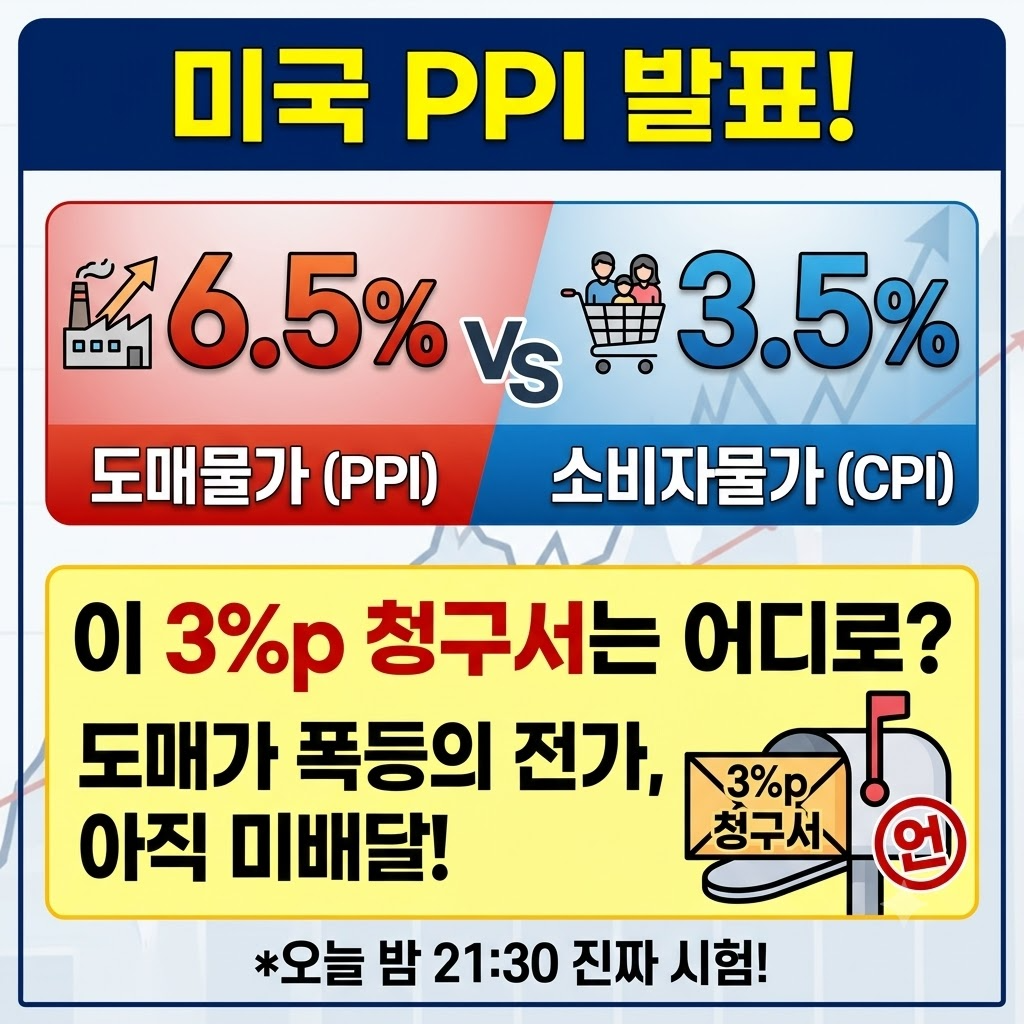
Yesterday, consumer prices cooled sharply, and the market breathed a sigh of relief. But wholesale prices are still 6.5%. The gap with consumer prices of 3.5%, about 3pp, has not yet been delivered.
That bill arrives tonight. At 21:30a.m. Korean time, the U.S. Bureau of Labor Statistics will release the 6month PPI (Producer Price Index). Tonight will determine whether the CPI relief rally is real or fake.
The PPI is an indicator that measures prices at the wholesale stage, where companies sell goods. It is known as a leading indicator for the Consumer Price Index. That is because prices that rise at the wholesale stage are passed on to consumer prices a few months later.
The Producer Price Index measures prices at the wholesale stage where companies sell goods and is a leading indicator for the Consumer Price Index.
Consensus is a slight slowdown from 5month on month. But first, we need to review what that 5month was like to get a sense of tonight’s numbers.
5Monthly PPI rose month over month by +1.1%, and year over year by +6.5% for the largest increase since 2022 and 11. Final-demand goods rose by +2.8% in a month, marking the largest increase since statistical records began in 2009. Energy +10.7%, gasoline +23.4% led the gain. Core, excluding food, energy, and trade services, core also rose month over month by +0.8% for the largest since 2022 and 3.
Jacks’s Mark Vickery said, "5month [PPI](9ppi-%EB%6.5%, and core 5.1% suggest inflation pressure is spreading beyond energy," and pointed to the moderation in the annual figure in this release.
3basis points of the wedge, unpaid bills still not yet delivered
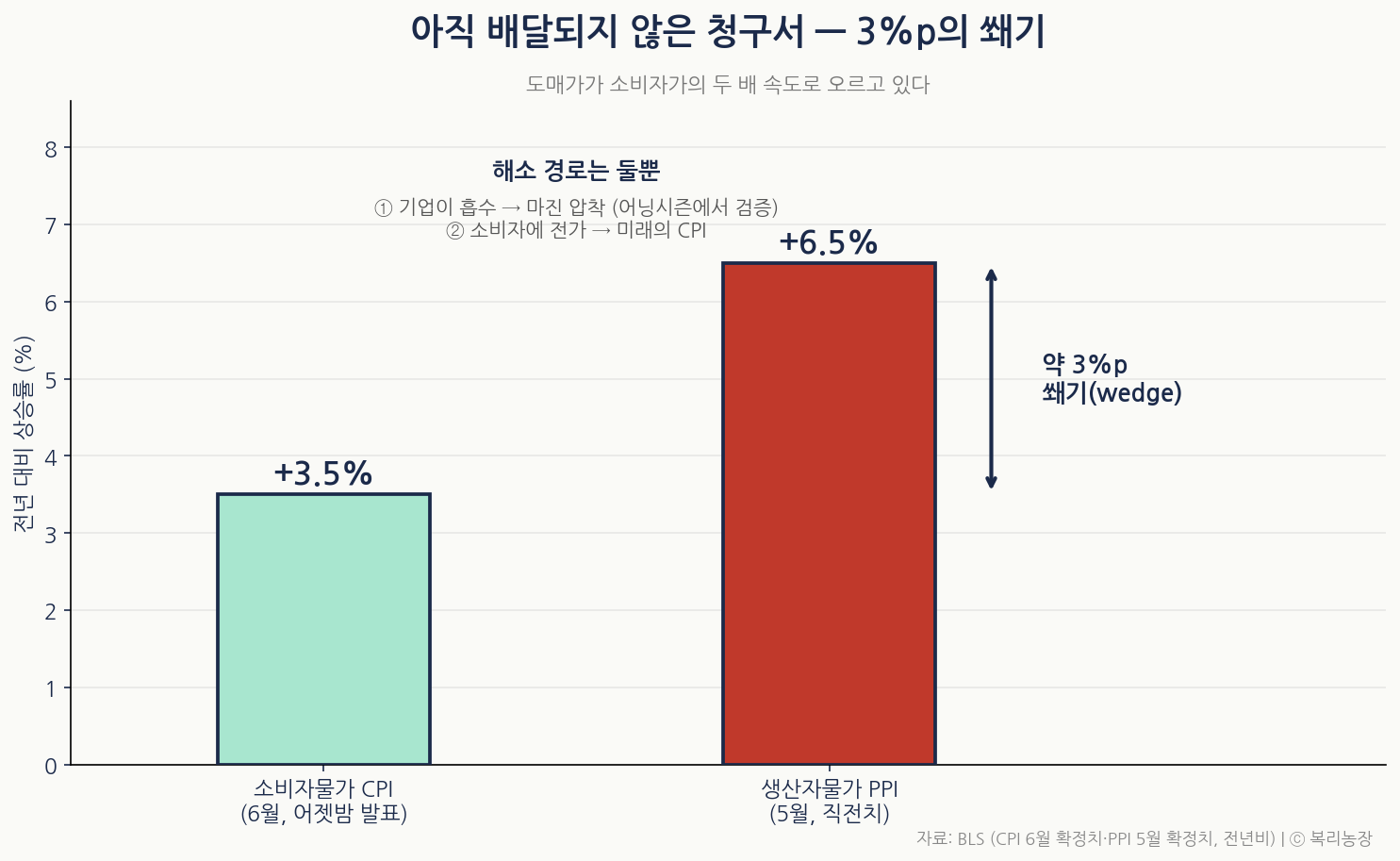
This is the point that today’s articles do not cover well. The consumer price index confirmed last night is up year over year by 3.5%, but wholesale prices are running nearly twice as fast at 6.5%. This gap of about 3basis points does not disappear for free.
There are only two physical ways for it to resolve. If companies keep absorbing costs, it is margin compression; if they start passing them on to consumers, it becomes future CPI. If auction prices in the wholesale market are rising while neighborhood supermarket price tags stay the same, the difference is coming out of merchants’ pockets or has already been booked into next month’s price tags.
A clue that compression is already underway is also in the 5month details. The margin on wholesale machinery and equipment fell by 1.9% in a month.
Kicking off this week with the big banks such as JPMorgan and Bank of America, 2the quarterly earnings season has begun. How much this gap has eaten into corporate profits, and the results over the next few weeks will lay out the answer sheet. Tonight’s PPI is, in a sense, the trailer for that answer sheet.
The Remaining Half of Waller’s Equation
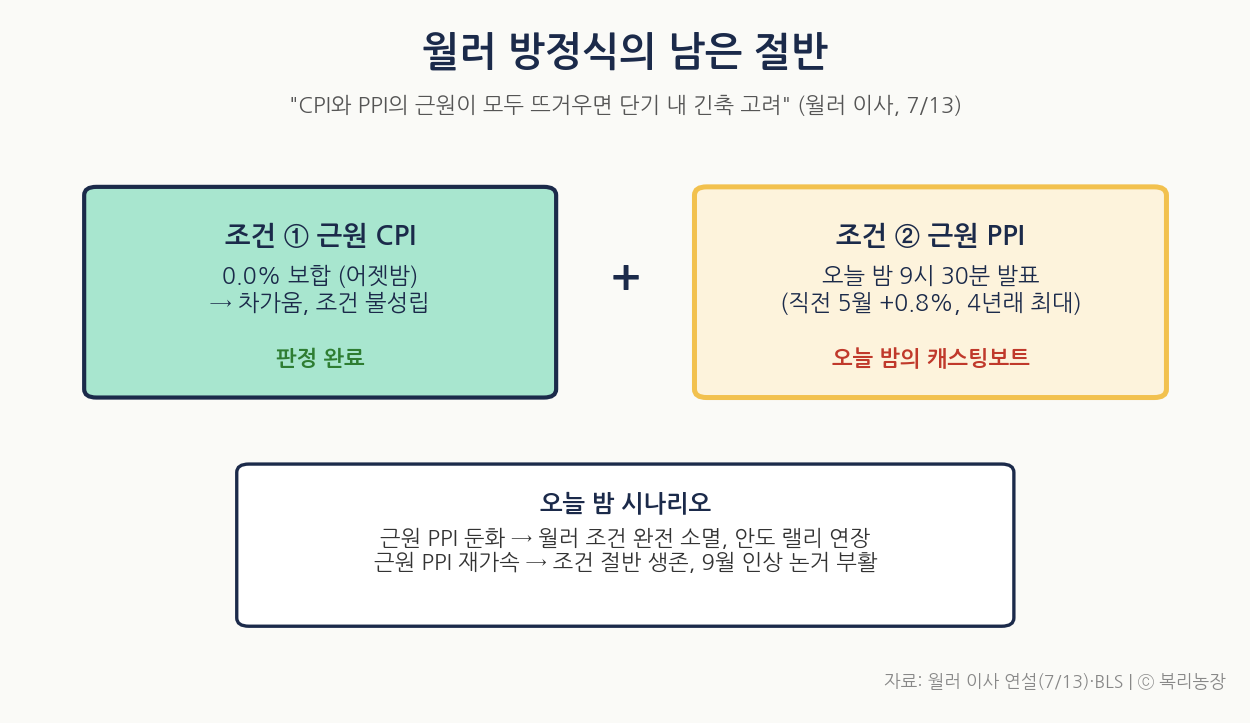
You will remember the condition that Governor Waller set the day before yesterday. "If the core components of CPI and PPI both heat up again, the FOMC should consider tightening in the near term."
The first term of this equation was settled last night. Core CPI 0.0%, flat, cold. The remaining term is tonight’s PPI. If core PPI clearly slows from 5% in +0.8, Waller’s condition disappears entirely, and the relief rally gains grounds to extend.
Conversely, if it re-accelerates, the condition survives in part, and the argument for a rate hike from 63%, which fell to 9yesterday, comes back to life. This is a structure in which one remark turned this week’s two inflation readings into the tiebreaker. Tonight is that second vote.
The 1second gate of AI inflation
Tonight matters. Apple’s device price increases take time to show up in consumer prices, but component prices such as memory and electronic parts show up first in producer prices.
5In the monthly PPI, intermediate demand processed goods rose +3.5% to 2021the highest increase since 3 in 40more than +4.8% of the increase in services came from portfolio management fees (linked to rallies in asset prices) (%). This could be a fingerprint that the AI cycle leaves in inflation statistics.
That said, it should be read cautiously. 5Because a large part of the monthly increase came from energy contributions, tonight we need to separate whether goods prices excluding energy are still rising in order to determine the validity of this hypothesis.
And apply the same discipline today as yesterday. 6The monthly PPI headline will also 6reflect the drop in oil prices in -25, so it is likely to come in soft. If yesterday the message was, “Do not take comfort even if CPI is soft,” then today the right stance is, “Do not overinterpret a soft PPI headline for the same reason.”
This benchmark is about the core and the pipeline, not the headline. Moreover, WTI has already 85recovered above dollars. As Kay Herrig of Goldman Sachs Asset Management put it, "a tame CPI lowers pressure for an early hike, but the chance of a hike has by no means ended because of the renewed hostilities in Iran."
The way to read it alongside earnings season 3clo
If you look at PPI only as an interest-rate indicator, you are using only half of it. In periods when the gap between wholesale and consumer prices widens, profits diverge between companies with pricing power and those without it. There are two questions for portfolio review. Is the company you hold one that passes on costs, or one that absorbs them? And can the position you added in yesterday’s relief rally withstand the possibility that tonight’s core PPI comes in hot?
- Core PPI, excluding food, energy, and trade services, month over month: 5month +0.8% slowdown versus, the deciding vote under Waller’s conditions
- Intermediate-demand processed goods: whether pipeline pressure is sustained, a preview of inflation next quarter
- Goods prices excluding energy: check whether the fingerprint of pressure from AI and memory shows up (conditional interpretation)
Three-line summary
- Tonight 9 o’clock 30 minutes later, the PPI for 6 month is released. The previous 5 month was +6.5% year over year, the largest since 2022 month, and goods saw the biggest increase since statistics began
- Wholesale 11% vs consumer 6.5% — a 3.5percentage-point gap — means margin compression or tomorrow’s CPI
- The key watchpoints are not the headline, but core PPI month over month, intermediate demand processed goods, and goods excluding energy.3,
One indicator to watch: core PPI month over month. 5At +0.8%, how much it cooled from the previous month will determine whether yesterday’s relief rally gets a longer shelf life or an earlier expiry.
Frequently asked questions
How will the U.S. PPI release affect yesterday's CPI relief rally, and what numbers should investors watch?
PPI is a leading indicator for CPI. Today, focus on whether core PPI slows month over month and on intermediate demand processed goods and goods excluding energy.
If the PPI due out tonight comes in above expectations, what immediate reaction could we see in U.S. Treasury yields and tech stocks?
If the PPI comes in above expectations, the case for rate hikes is revived, Treasury yields rise, and growth and technology stocks come under downward pressure.
What is the difference between the PPI and the CPI, and which indicator should be prioritized to help with stock investing?
The PPI is wholesale-stage prices, while the CPI is consumer prices. For stock investing, the PPI gives an earlier signal of future costs and margin changes.
What practical defensive strategy should a Korean individual investor take in their portfolio before and after the PPI release?
Check the pricing power of the companies you hold. If they cannot pass costs on, profits will fall. During earnings season, confirm whether they are absorbing costs.
In the market, the claim that "if PPI comes in low, CPI expectations weaken"—what is the basis for that, and through what path does it actually affect stock prices?
The basis is that PPI serves as a pipeline at the production stage that is passed through to CPI. A slowdown in PPI is favorable for stock prices because it eases pressure on interest rates.