Bullstory Research September 3, 2026
Why you should buy ETFs before individual stocks — if you get the order wrong, you learn losses first
Key takeaways
Order to buy first: index ETF → sector ETF → dividend and bond ETF → theme ETF. Building with index funds first helps avoid the risk of your account shrinking from volatility before anything else, and it increases your ability to stay in the market for a long time.
Individual stock investing is not a matter of "just buying a good company." You have to look at company results, competitors, interest rates, exchange rates, and even how much the market is already expecting from that company. If you skip this process, you do not learn investing first; you learn losses first.
ETF is a structure that bypasses this problem. It is automatically diversified, and even if one specific company goes bad, the whole does not get shaken. What a beginner needs is not the ability to pick the right stocks from the start, but the ability to stay in the market for a long time. That is why an ETF is a better starting point.
However, there are many kinds of ETFs, and how you combine them is more important than which one you buy. If you do not know the order, even if you buy ETFs, you will end up investing like you would in individual stocks.
What is an ETF?
An ETF, or exchange-traded fund, is a product in which you buy and sell a basket containing multiple stocks like a stock. It invests across multiple assets like a fund, but it can be traded in real time during market hours like a stock.
For example,500 buying an S&P ETF is similar to investing all at once in major U.S. companies such as Apple, Microsoft, Nvidia, Amazon, and Google 500companies. If you buy a single stock, you are shaken by the fate of that one company, but if you buy an S&P500 ETF, you invest in the overall trend of major U.S. companies.
The reason ETFs make sense for beginners is simple. It is difficult to predict "which company will be the winner in 10 years." But it is relatively easier to judge broad directions such as whether the U.S. economy has the potential to grow over the long term, or whether industries like AI, semiconductors, and healthcare are likely to keep expanding. An ETF is a tool for investing in that broad direction.
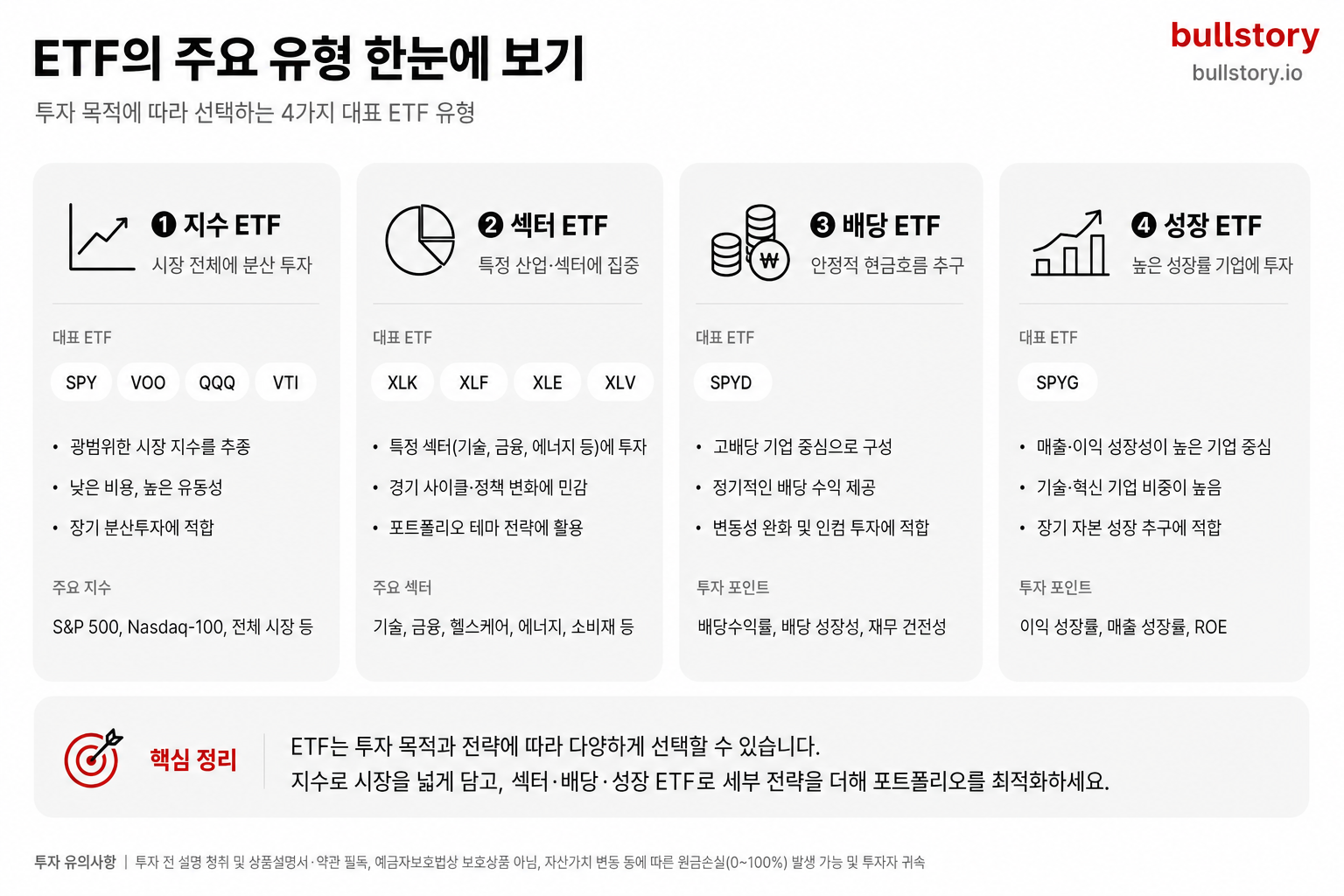
ETFs are broadly divided into 5 types
1. Index ETF — the staple of a portfolio
Tracks the overall market or a representative index. This is the first area a beginner should look at.
| ETF | Tracking target |
|---|---|
| SPY / VOO | S&P500 |
| QQQ | Nasdaq100 |
| VTI | Entire U.S. stock market |
| SPYG | S&P500 growth stocks |
| SPYD | S&P500 high-dividend stocks |
Index ETFs serve as the core of a portfolio. No matter how good AI, semiconductors, or robotics may look, if the entire portfolio is made up only of themes, volatility becomes too high. If you have side dishes without rice, it is not a meal.
2. Sector ETF — focused on a specific industry
Rather than the whole market, it selects only specific industries. It is one step safer than individual stocks and one step more aggressive than index ETFs.
| ETF | Sector |
|---|---|
| XLK | Technology |
| XLF | Financials |
| XLV | Healthcare |
| XLE | Energy |
| SMH / SOXX | Semiconductors |
"Sector ETFs are useful in a situation where you think the semiconductor industry looks good, but do not know which company will be the ultimate winner." Buying SMH or SOXX has the effect of spreading your investment across the entire semiconductor value chain, not just Nvidia, but also TSMC, Broadcom, AMD, ASML, and Lam Research.
3. Theme ETFs — future stories, but caution is needed
They capture future-oriented themes such as AI, robots, electric vehicles, space, and clean energy. The more impressive the name, the more it tends to attract beginners.
What matters in investing is not whether the future looks good. It is how much of that good future is already reflected in the price.
In particular, 3leveraged ETFs such as SOXL and TQQQ are not products for long-term investing. Because they are structured to track daily returns by a multiple, 3the ETF price can be severely damaged in markets where the underlying index moves sideways or is highly volatile. Theme ETFs are less the core of a portfolio and more like a small seasoning added on top.
4. Dividend and covered call ETFs — cash flow, but beware of illusions
A structure that brings in cash every month provides psychological comfort.
| ETF | Features |
|---|---|
| SCHD / VYM / DVY | Traditional high-dividend ETFs |
| JEPI / JEPQ | Covered call ETFs |
| QYLD / XYLD / RYLD | Monthly-dividend covered call ETFs |
Covered call is a strategy in which you give up part of the upside potential in exchange for current cash flow. When the market rises strongly, it lags behind index ETFs in returns. It should not be viewed as a "high-dividend product no matter what," but rather as a "product that gives up some upside potential in exchange for cash flow."
5. Bond and commodity ETFs — a shield for the account
ETFs are not just a tool for buying stocks. You can also invest in bonds, gold, silver, and commodities.
| ETF | Target |
|---|---|
| TLT | U.S. 20-year-or-longer long-term bonds |
| SHY | U.S. short-term bonds |
| BIL | ultra-short-term U.S. Treasury bonds |
| GLD | gold |
| SLV | silver |
This area is there to prevent the portfolio from collapsing into one side, rather than to maximize returns. That said, long-duration bond ETFs such as TLT are not unconditionally safe either. Bond prices move inversely with interest rates, and the longer the maturity, the more sensitive they are to changes in rates.
The essence of ETFs is not picking, but combining
"Which ETF is the best?" is the wrong question. The right question is, "What role does this ETF play in my portfolio?"
If you do not understand this, even when you buy ETFs, you will end up investing like you do with individual stocks. You see others buying SOXL and follow them, buy JEPI because monthly dividends look good, buy BOTZ because AI looks promising. It is FOMO with different names.
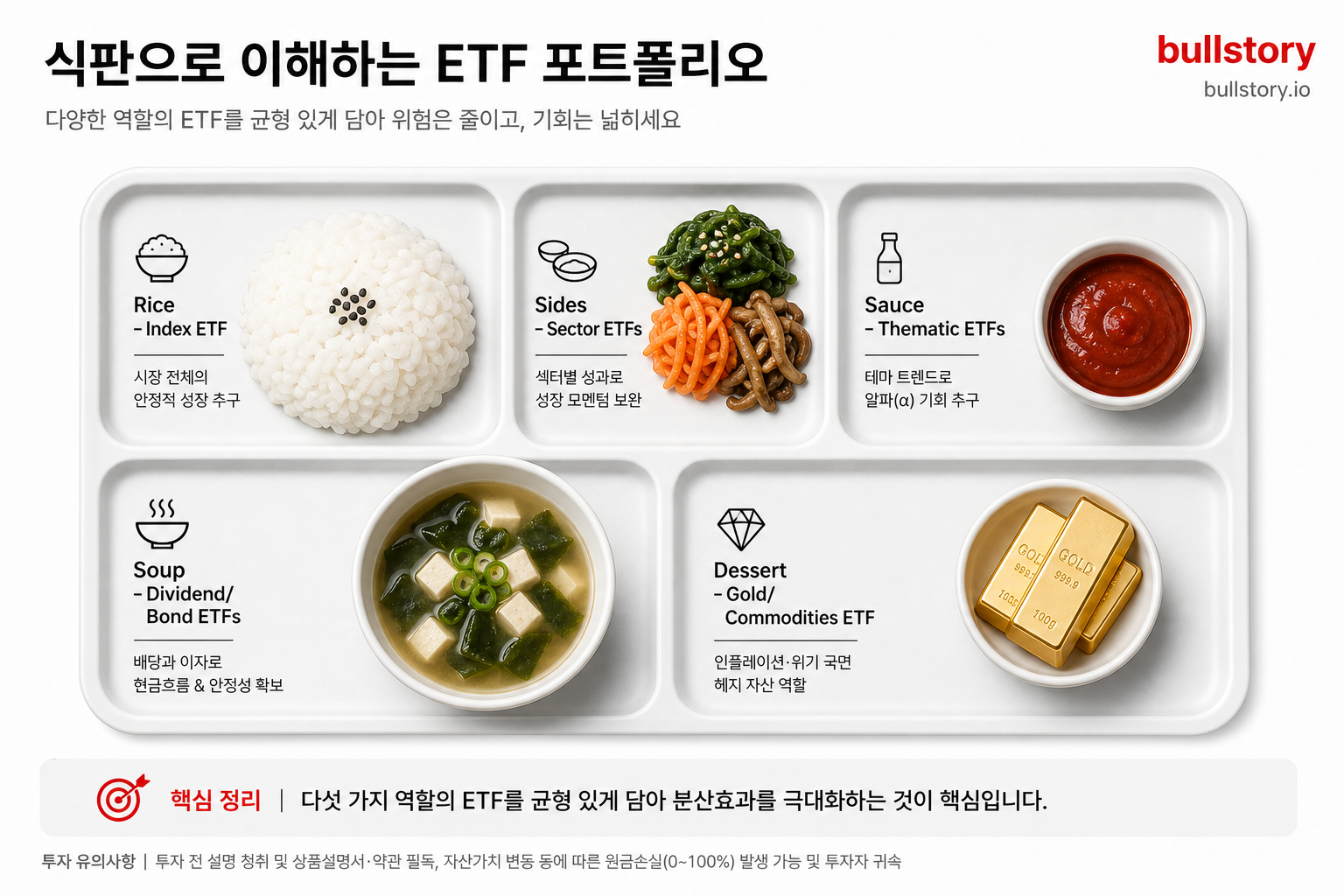
If you think of it like a meal tray, the structure becomes clear.
- Rice : broad-market index ETF
- Side dishes : sector ETF
- Seasoning : thematic ETF
- Soup : dividend and bond ETF
- Dessert : gold and commodity ETF
Lay the market as a whole as the base, add the industries you like on top of it, and balance it with dividends, bonds, and gold. This is the basic structure for using ETFs.
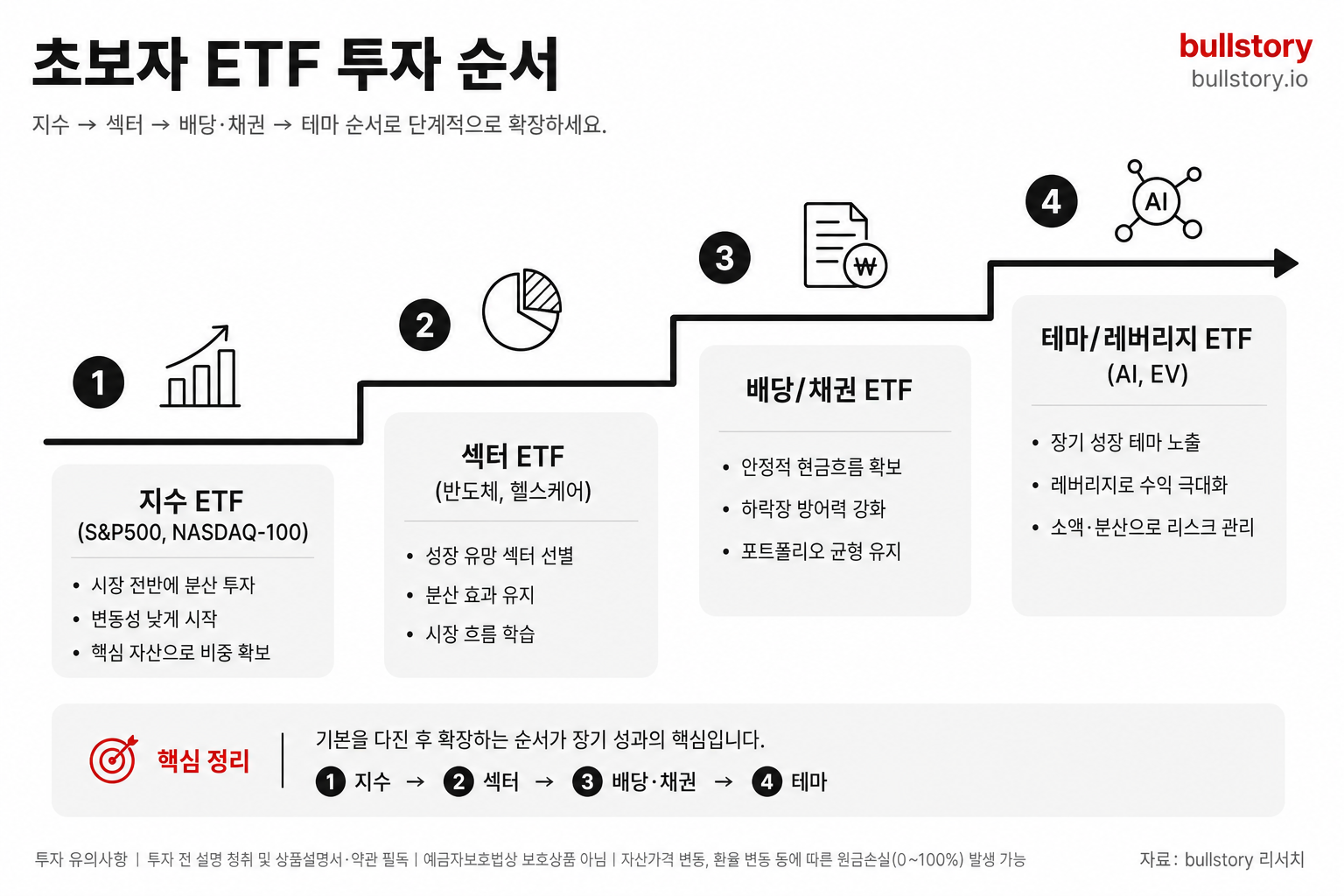
If you are a beginner, you can approach it in this order
1Step: index ETF. S&P500, Nasdaq100, and U.S. total market ETFs to first experience the market’s basic movement.
2Step: sector ETF. Gradually add industries I can understand, such as semiconductors, technology stocks, and healthcare.
3Step: dividend and bond ETF. Understand the roles of cash flow and defensive assets.
4Step: thematic ETFs. Products such as AI, robotics, and leveraged funds are approached in small amounts at the end.
The most common mistake beginners make is skipping index ETFs because they seem boring and going straight to SOXL and TQQQ from the start. That is less like building investing skill and more like handing your account over to volatility.
It is fine if it is not exciting at first. Stimulating investments usually do not last long.
Conclusion
It is not that individual stocks are bad and ETFs are good. It is a matter of order.
If you understand ETFs, you learn something more important than a single stock: how the market moves, how industries are divided, and what role assets play. An ETF is not just a simple investment product; it is a map that lets beginners learn the structure of the market.
The key is not to buy a lot, but to combine things according to their roles. And for beginners, the most important thing is not to make a big profit all at once, but to stay in the market for a long time.
Frequently asked questions
What are the specific reasons beginners should buy ETFs before individual stocks?
ETFs hold multiple securities at once and automatically diversify. Because a single company’s failure is less likely to shake the account significantly, beginners can more easily build the experience of staying in the market for a long time.
If you buy ETFs first, how can you reduce risk when moving into individual stocks?
Starting with ETFs lets you experience market and sector trends first and build your understanding of industries. As that understanding grows, you can test individual stocks in small amounts to lower risk.
When choosing ETFs first as the investment sequence, how should you begin building a portfolio?
Place index ETFs at the center of the portfolio, then add sector, dividend, and bond ETFs, and include thematic ETFs in small amounts. Set each ETF’s role and manage the allocation.
If you hold ETFs during a sharp market decline, what protective effect do they have, and when is the right time to switch to individual stocks?
ETFs reduce the downside by diversifying the impact of shocks to specific companies. Switch to individual stocks in small amounts when the portfolio’s role is clear and you understand the relevant industry.
What mistake is made when investing in an ETF like a single stock, and how can it be avoided?
It is the mistake of overallocating to theme and leveraged ETFs based only on their name or popularity. Set each ETF’s role and allowable weight to control chasing behavior.
What role do dividend and covered call ETFs play for beginners?
Dividend and covered call ETFs provide regular cash flow and offer psychological comfort. However, they give up some upside, so use them sparingly as a defensive tool.