Bullstory Research June 18, 2026
The reason to look at shipbuilding again, 5is the same as semiconductors were years ago.
Key takeaways
2026years 6as of the month, K-shipbuilding docks are sold out, and the order backlog is 100% reserved. Supply bottlenecks, the shift to eco-friendly fuels, and U.S. MRO demand are 5creating a profit structure similar to the semiconductor supercycle from years ago. Ship prices are hitting record highs every month, and shipbuilders' profits are rising faster than revenue.
There is no investment strategy as powerful as identifying the shift in leading sectors in global capital markets. 2026If one were to pick the sector showing the most dramatic fundamental turnaround in the domestic stock market as of now, it is unquestionably shipbuilding. The stigma of being a "heavy smokestack industry," weighed down for more than 10years by massive losses, recession, and restructuring, has already been completely washed away.
The way Yeouido and global asset managers view K shipbuilding is different from the past, when it was simply a sector that cranked out large numbers of ships during the boom years of 2007now. The market is reading in shipbuilding a dejà vu of the "semiconductor supercycle" that, exactly 5years ago in 2021one year, broke historical record highs amid unprecedented supply shortages and a paradigm shift.
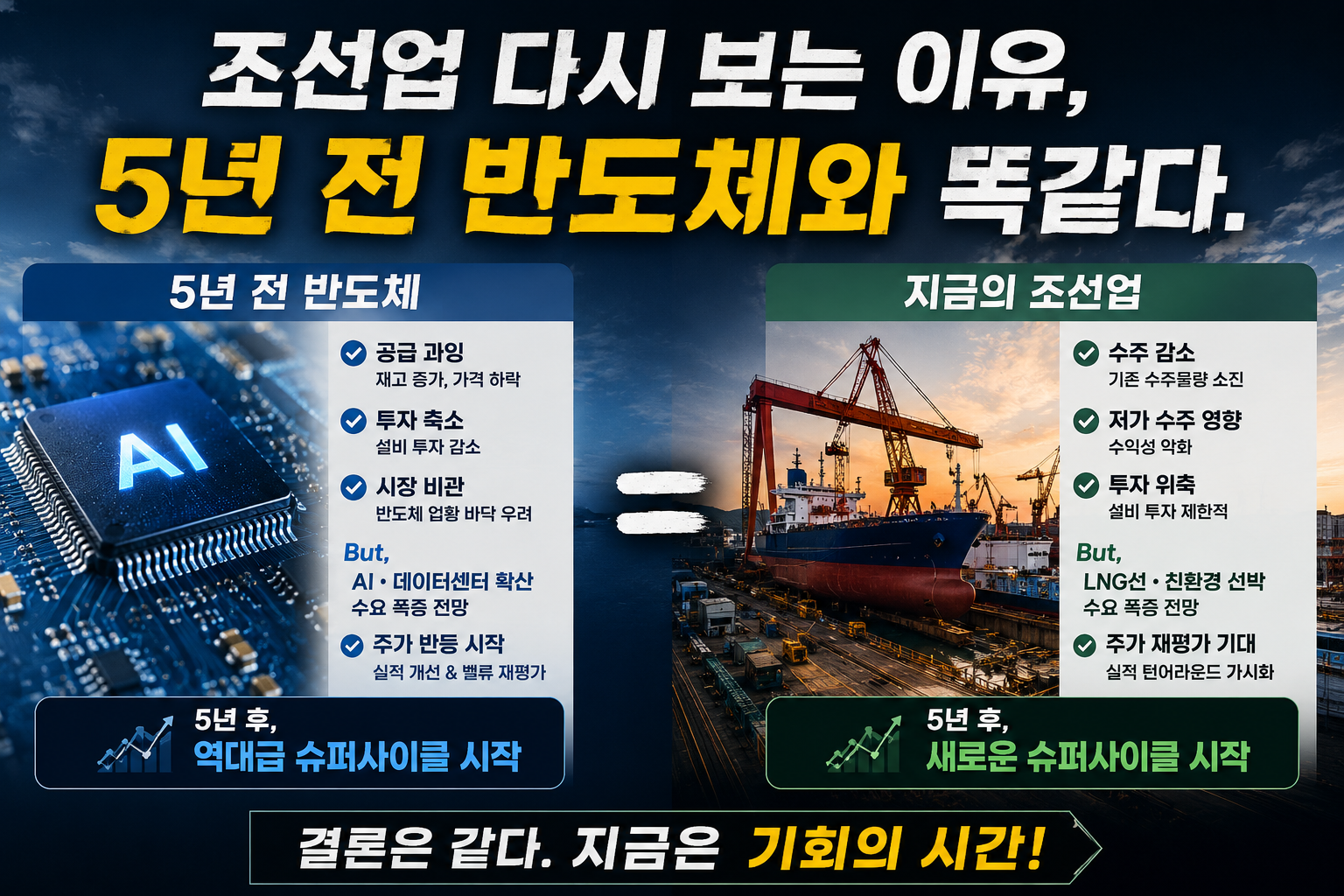
5years ago, the supply chain limits, technological paradigm shift, and geopolitical realignment that ignited the semiconductor market are 3major core logics, and we conduct an in-depth analysis of how they are being applied to shipbuilding as of 2026now.
1Complete control of the supply chain: 2021The parallel theory of foundries in 2026one year and docks in
5The starting point of the semiconductor rally years ago was "supply shortage."
After COVID-19 IT device demand exploded, but the fine-process foundry (contract manufacturing) plants that could produce them were extremely limited worldwide, mainly to TSMC and Samsung Electronics.
Even when the plants were run at 100% capacity, they still could not keep up with the flood of orders, so semiconductor makers seized full pricing power and brought about a margin revolution through 'ASP (Average Selling Price) increases'.
The supply-chain structure of K-shipbuilding now matches the advanced foundry plants of that time perfectly.
-
A fatal reduction in supply capacity: Through the 2010Great Depression era, 50a huge share of the world's small and midsize shipyards went bankrupt or shut down. Once dismantled, shipbuilding infrastructure and skilled labor are nearly impossible to restore in the short term. The absolute number of 'docks' around the world capable of building ships has fallen sharply compared with the past.
-
3More than years of fully sold-out orders: Meanwhile, freight volumes are rising and replacement cycles for aging vessels are converging, so demand is exploding. 2026As of 6year 3month, the docks at domestic large shipbuilders are already fully booked, with reservations for 2027the second half of 2028production through 100year already filled.
-
Maximizing margins through selective orders: Shipbuilders no longer bow to global shipowners who come with cash in hand. Instead, they are pursuing a 'selective order-taking' strategy, choosing only the expensive ships with the highest profit margins to sign contracts for.294**20As a result, the Newbuilding Price Index, the gauge of new ship prices, is 2035; the structure in which semiconductor chip prices were whatever the market would bear years ago is being reproduced on the sea right now.
2. Technical paradigm shift: from PC/mobile to AI, from diesel to eco-friendly ships
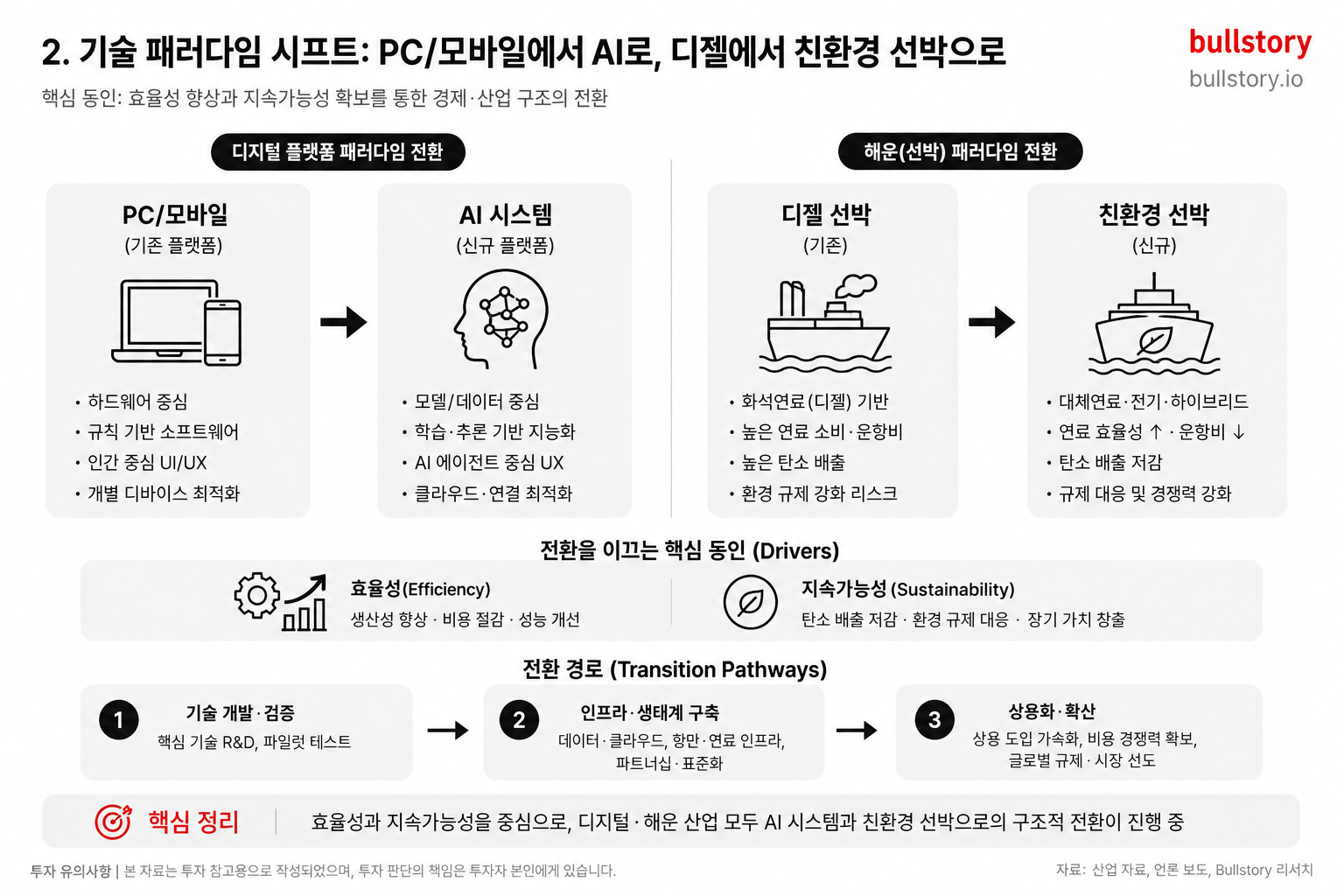
The driving force that allowed the semiconductor industry to level up in the past was changes in downstream industries.
As memory that once went only into PCs and smartphones expanded into huge new high-value markets such as AI data centers and autonomous vehicles, chip prices and demand rose exponentially.
Shipbuilding, too, is moving beyond simple cargo ships to 'eco-friendly high-end vessels'774; is passing through the strongest technological inflection point in history.
-
The harsh environmental regulations of the IMO (International Maritime Organization):
As global carbon-emission regulations take full effect, ships that use conventional low-cost diesel fuel (bunker C oil) can no longer enter major ports around the world or must pay massive carbon taxes. Shipowners now face a forced transition period in which, for survival, they must scrap their existing ships entirely and switch to advanced eco-friendly propulsion vessels that use LNG (liquefied natural gas), methanol, and, further ahead, ammonia and hydrogen as fuel. -
20The great replacement cycle, arriving after many years: \ The usual lifespan of cargo ships is about 20years. The service lives of ships that were mass-produced in the mid-2000s (2004~2008)—the peak boom years of Korean shipbuilding, the greatest boom since the founding of the nation—have arrived exactly now. Environmental regulations and aging vessels overlap, opening a huge forced-buying cycle.
-
The technological monopoly of Korean shipbuilding: \ In fact, the only country that can reliably and without defects implement this demanding eco-friendly cargo tank technology and high-pressure gas engine control technology is the Republic of Korea. Chinese shipyards, relying on low-cost labor, are catching up, but in the field of gas carriers with extremely high explosion risk, such as large LNG carriers and ammonia carriers (VLACs), global shipowners are ultimately turning to Korean shipyards because of frequent delivery delays and technical problems. In a sense, K-shipbuilding has built, with its eco-friendly technological capabilities, the entry barriers of semiconductor fine processes.
3. The butterfly effect of geopolitical great-power competition: the discovery of U.S. Navy MRO as a new continent
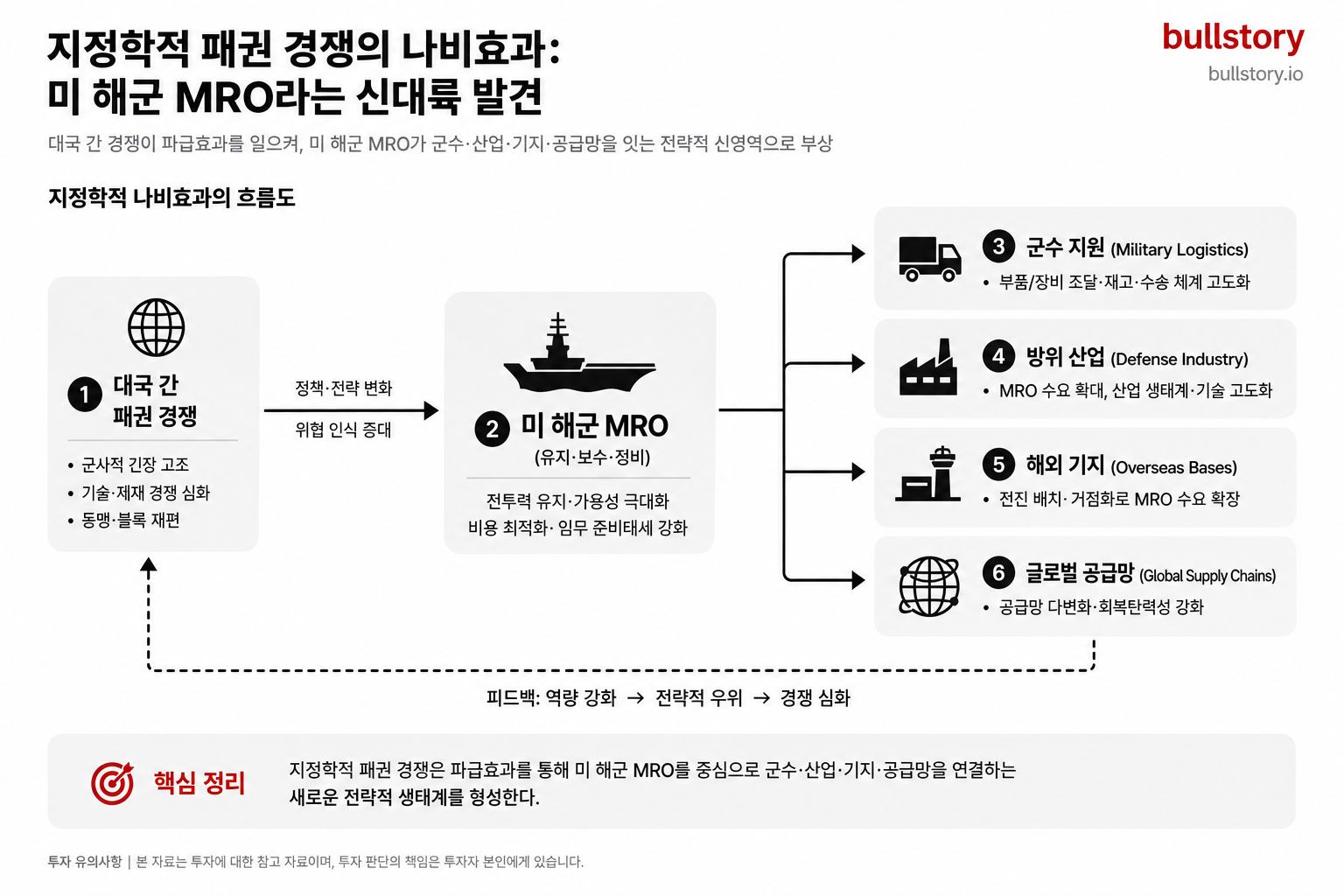
The U.S.-China competition for hegemony and supply-chain bloc formation completely changed the landscape of the semiconductor industry 5 years ago. The moves by the U.S. government to keep advanced technologies within its own ecosystem gave rise to numerous subsidies and beneficiary companies. 2026As of this year, the arrow of this geopolitical supply-chain reorganization is pointing squarely at the 'shipbuilding and security' sector.
-
Collapse of shipbuilding infrastructure in the United States:
At present, the United States is the world’s 1number-one military power, but, ironically, its domestic shipbuilding industry infrastructure has completely collapsed, making it impossible to build and repair warships at home. Because of the paradox of the Jones Act, which allows only U.S.-built ships to sail along American coasts, American shipyards lost competitiveness and shut down. As a result, the U.S. Navy faces a serious security risk, with damaged warships and submarines left idle at bases because they cannot be repaired in time. -
An SOS from the United States to K-shipbuilding:
The Trump administration, which must stop China’s explosive expansion of its navy on the Pacific front, eventually turned to South Korean shipyards, the world’s best in construction capability among its allies. The door has opened for Korean companies in the MRO (Maintenance, Repair, and Overhaul) business that maintains, repairs, and overhauls U.S. vessels. -
A new market opening worth tens of trillions of won a year:
Major domestic shipbuilders have begun entering this market in earnest by acquiring local shipyards in the United States, such as Philly Shipyard, or by obtaining the Navy’s ship maintenance certification, MSRA. This is not simply a business of selling a one-time merchant vessel. Once an order is won, it creates a defense-industry-type lock-in effect that secures stable maintenance revenue and high margins for decades, and it is a key trigger that levels up the valuation of K-shipbuilding by one stage.
4. Structural leverage: recognition based on delivery and the explosion of ‘dock margin’
If you understand the unique accounting structure of the shipbuilding industry, you can see why earnings are bound to surge now. From ordering a ship to actually building it and delivering it to the shipowner, there is usually a gap of 2years to 3years.
In other words, the sales and operating profit that appear on shipbuilders’ current financial statements are not from ships contracted now, but from ships contracted 2~3years ago, when the industry was still in the tail end of losses or in the era when low-price order competition remained.
-
**2026In the year, in the midst of the full reflection of the high-priced cycle:
2026At this point in the second half of the year, shipbuilders are beginning to selectively win orders in earnest, and the period from 2023to 2024is when the high-value volumes are being recognized as revenue in earnest. -
Maximizing the fixed-cost effect:
Shipbuilding is an industry with a very high share of fixed costs because it must maintain massive cranes and docks. In periods when order prices were low, there was nothing left after fixed costs, but in a state where ship prices have surged, the 'operating profit leverage effect', in which operating profit grows several times faster than revenue, is being 00; maximized. 5Years ago, when semiconductor plants wrote off all depreciation expenses and as soon as they passed the break-even point (BEP), operating margins 30%, 40rose to %; that phenomenon has begun to be proven in the quarterly results of domestic shipbuilders.
5. Core K-shipbuilding value chain that must be included in the portfolio
To achieve the best returns in this shipbuilding supercycle, a barbell strategy is needed that strategically combines the 'large shipbuilders' that build completed ships and the 'key equipment and materials' companies that fill the interior of ships with full order backlogs.
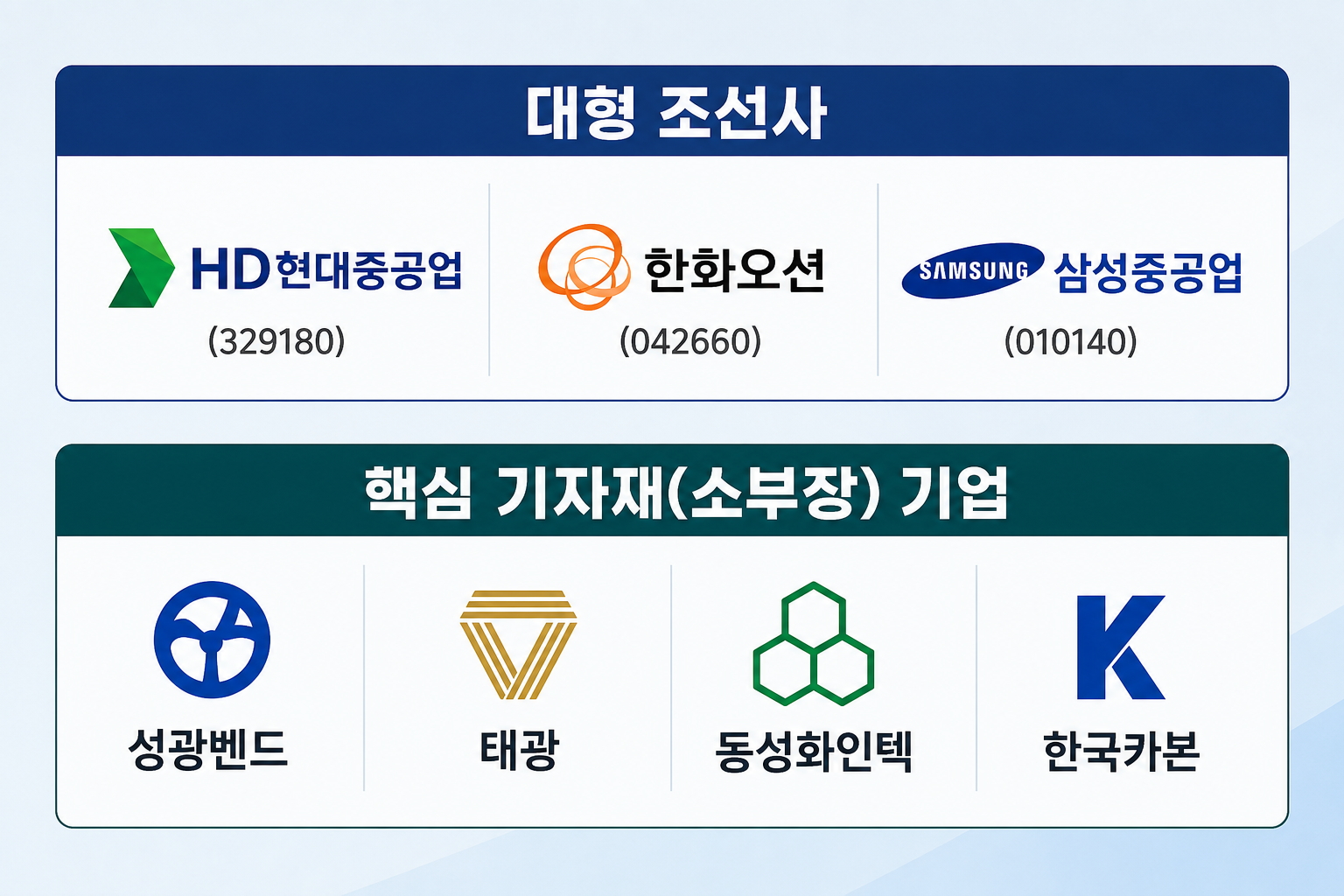
①HD Hyundai Heavy Industries (329180): a globally recognized 1leader and the industry benchmark
A blue-chip stock with the largest construction capacity in the world, beyond Korea, and unmatched production efficiency.
- Core competitiveness: One of the few companies in the world that can manufacture the "marine engine," which determines the core margins of the shipbuilding industry, in-house. It has secured an effective monopoly on eco-friendly large engine licenses, fully capturing the highest margins from large vessel orders. It is a stock that shows the strongest earnings visibility in the industry.
②Hanwha Ocean (042660): The frontier in U.S. Navy MRO and special-purpose defense vessels
After being incorporated into the Hanwha Group, it completely improved its financial structure and fully transformed its business from a merchant-ship-centered portfolio into "ocean defense".
- Core competitiveness: It has unparalleled technological capabilities in the special-purpose vessel sector, including warships and submarines, and by acquiring the entire stake in the Philly shipyard in the United States, it was the first to establish a foothold in the U.S. Navy MRO and U.S. government vessel construction markets. With a massive defense momentum combined with a turnaround in merchant-ship earnings, its share-price responsiveness is among the strongest in the sector.
③Samsung Heavy Industries (010140): The leader in LNG carriers and high-margin offshore plants (FLNG)
It boasts world-class margins in the construction of large LNG carriers and dominates the FLNG (floating liquefied natural gas production facility) market, which is called an LNG production plant on the sea.
- Core competitiveness: It holds a large backlog of offshore plant orders with margins more than double those of ordinary merchant ships, demonstrating strong downside rigidity that is not affected by market volatility and overwhelming net cash conversion ability.
④Hidden gem, the equipment and small-cap supply chain lineup (fittings and engine parts)
The fact that shipbuilders’ docks are 3filled for years means that the workload for equipment companies supplying parts to them is also secured for at least 3years. Compared with major shipbuilders, their market capitalizations are smaller, so when momentum from a stock price rally kicks in, they can deliver steep returns.
-
Sungkwang Bend / Taekwang: These are companies that monopolize high-pressure 'fitting' parts, which connect the massive gas and cargo pipelines inside ships. Eco-friendly gas carriers require more than 3times as many fitting parts as ordinary cargo ships, and the unit prices are also higher, allowing them to enjoy structurally ultra-high margins.
-
DongSung FineTec / Hankuk Carbon: These companies split the market for 'insulation materials,' a core essential material inside cargo tanks that must carry LNG at ultra-low temperatures (-163) to transport LNG. They are the most direct and quantitative beneficiaries of the explosive growth in orders for large LNG carriers.
6. Investment Strategy and Risk Check
The K-shipbuilding supercycle investment is not trading swayed by short-term news, but a medium- to long-term investment that moves together with a belief in the upward trend of the data.
-
Practical entry point:
No matter how good a leading stock is, it does not rise in a straight line. As long as you confirm that the upward trend in the new ship price index, announced in the middle of each month, is sustained, you should build your position through partial buying whenever the stock price undergoes a pullback adjustment due to short-term profit-taking by institutional investors or volatility in the overall market, even to major moving averages(60such as the first-line). -
Monitoring risk:
You need to track whether the trend in the price of thick steel plate, the main material used for ships, and the upward wage pressure caused by a shortage of shipbuilding labor are not eroding margins. However, the current pace of ship price increases is outpacing the pace of cost increases, so the impact of risk is limited.
Conclusion
5If you were an investor who regretted missing the semiconductor supercycle years ago, you must not miss the powerful upward move in K-shipbuilding happening now on the seas. In an environment of extreme supply constraints, a global bill for environmental regulation has arrived, and geopolitical security crises have opened up a new market worth tens of trillions of won. Now, when popular bias still remains that dismisses shipbuilding as merely a cyclical declining industry trapped in an old paradigm, this is precisely the best golden time to rebalance the center of your portfolio toward the leading shipbuilding stocks.
Frequently asked questions
Why is shipbuilding drawing attention again?
The key is three things. A shortage of dock capacity and skilled labor creates pricing power; the technology shift to eco-friendly ships is generating massive demand; and geopolitical demand, including from the United States, has opened a long-term maintenance market of repair and upkeep, changing the profit structure.
What is the common point between K-shipping and 5the semiconductor supercycle from years ago?
The supply bottlenecks, the technological paradigm shift, and the geopolitical realignment all occurred at the same time. These three pillars fundamentally changed pricing and order structures, creating the market leaders.
Why do Korean shipbuilders have an edge in green ships?
They have the capability to reliably implement demanding green technologies such as LNG, methanol, and ammonia fuels, as well as high-pressure gas control, so they are earning trust over competitors where delivery delays are frequent due to technical issues.
Why does a shortage of docks lead to a shipbuilder's pricing power?
Once a dock and skilled workers disappear, they do not recover quickly. With order books already full in advance, shipowners have no choice but to wait, so a structure takes shape in which shipbuilders can demand higher prices and have them accepted.
What impact does entry into the U.S. Navy MRO market have on shipbuilding?
Entering the U.S. Navy maintenance (MRO) market secures maintenance and repair revenue that continues for decades, beyond short-term ship sales. Obtaining certifications such as MSRA and acquiring U.S. local shipyards are the foundation.
What are the main risks when investing in shipbuilding?
There are risks such as technological catch-up by low-cost competitors, including China, delivery delays, and technical uncertainty stemming from changes in regulations and fuel standards. Both competition and regulation should be watched closely.