Bullstory Research July 27, 2026
Global financial market conditions: oil prices and interest rates are easing, but risk factors remain
Key takeaways
5Nonfarm payrolls in month increased by 172,000people, showing that the labor market remains firm and limiting downside pressure on rates. The Federal Reserve's benchmark rate was kept at 3.50~3.75%. Month CPI is 5released in month, and the FOMC is scheduled for month 6~10Day, making these two dates a turning point for the direction of interest rates.6month 16~17Day
Key Indicators
Stock price: U.S. S&P500index rose on the halt in hostilities between Iran and Israel and strength in semiconductor-related stocks.
Exchange rate: the dollar index fell on easing Middle East tensions and weaker safe-haven demand.
Interest rates: U.S. 10-year Treasury yield 5rose on caution ahead of the monthly consumer price inflation release.
Key Issues
- Global crude oil prices calming
- A large-scale disruption to crude oil supply has 3persisted for more than 20years, but oil prices have recently remained somewhat stable. In fact, Brent crude prices have traded near the price range seen over the past years despite the Middle East war. However, uncertainty factors remain, including the possibility of a U.S.-Iran agreement and the uncertainty that even if the Strait of Hormuz is reopened, an immediate recovery in maritime shipping volume is not certain.
- Japan’s economy, 1/4weak quarterly growth and continued expectations for interest-rate hikes
- Japan's 1/4quarterly real GDP growth, annualized, revised, was 1.8%, downgraded from the flash estimate (2.1%) amid weaker-than-expected capital spending. There are concerns that household consumption and business investment may be subdued due to inflation caused by the Middle East war and economic uncertainty. Even so, while Japan's economic growth has slowed, the underlying recovery trend remains intact, and with concerns about accelerating inflation, the Bank of Japan is expected to raise interest rates in 6 and then hike once more by year-end. (Moody's)
U.S. Interest Rate Trends
It can be seen that, on the U.S. yield curve, rates have risen across all maturities compared with the beginning of the year.
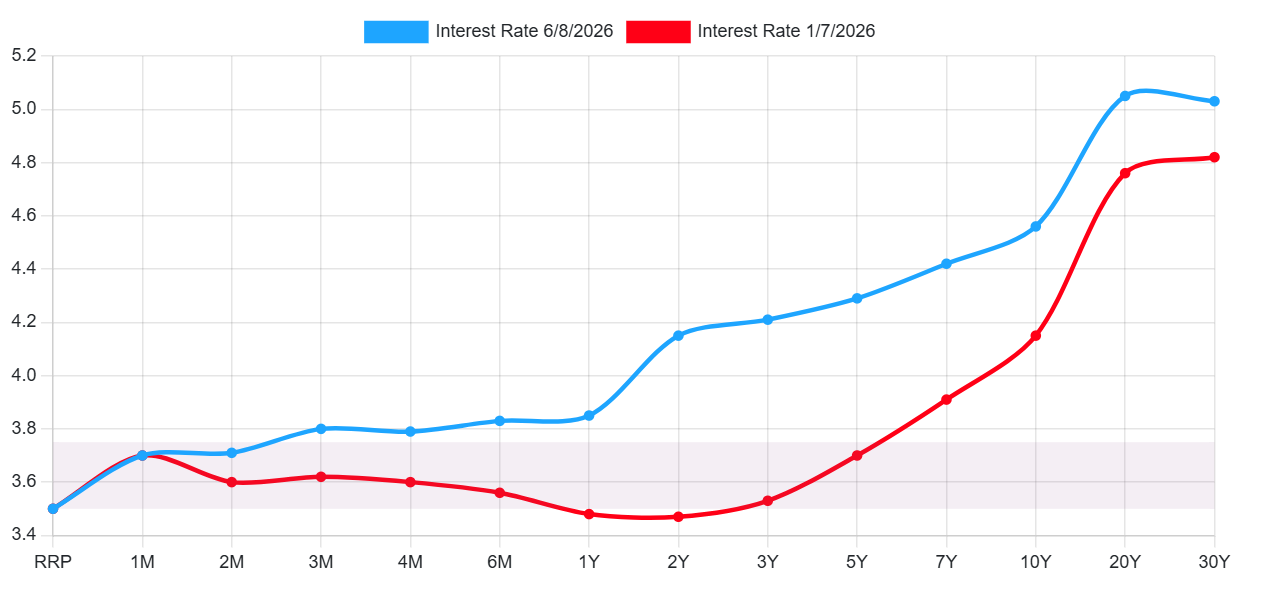
- Economic indicators
-
Employment
5Nonfarm payrolls for 172 thousand (forecast: 85 thousand previous: 179 thousand) → upward pressure on rates ↗
5ADP private payrolls for 122 thousand (forecast: 118 thousand previous: 105 thousand) → upward pressure on rates ↗ -
Inflation 5monthly ISM manufacturing index 54.0 (forecast: 53.3 previous: 52.7) -→ upward pressure on rates ↗ 5monthly PPI: before release 5monthly CPI: before release
- With a halt in mutual attacks between the United States and Iran, and between Iran and Israel, oil prices have stabilized → downward pressure on rates ↘
Macro indicators are pointing toward higher rates, but under this negotiation, there may be downward pressure in the short term.
Where is the U.S. policy rate now
The Fed kept the policy rate at 2026year 4month, for the third consecutive meeting, within a target range of 3.5 to 3.75%. After cutting a total of 2025 percentage points through three cuts at the end of 0.75year, it chose to slow the pace.
In its statement, the Fed said inflation was at a high level, reflecting the recent rise in global energy prices, and said the Middle East situation is creating high uncertainty about the economic outlook. This means the uncertainty is too great to move rates.
Governor Miran voted to cut rates by 0.25 percentage points, while three other members supported holding rates steady but opposed adding language to the statement with the nuance that 'rates will be lowered further going forward.' The result was a 8 to 4 vote, and for the first time since 1992year 10month, 4members cast dissenting votes on an FOMC decision.
The members who cast dissenting votes wanted different things.
-
Miran, Director: the position that rates should be cut immediately
-
Hammack, Kashkari, and President Logan: they supported holding rates steady, but opposed the word “additional” in the statement because it suggested rates would be cut further next. All three have voiced concerns about inflation becoming entrenched, meaning prices may not fall easily.
The direction of the dissenting votes was the exact opposite. One side said, “It’s too late, cut now,” while the other said, “Inflation has not been tamed yet, so do not send a signal of cuts.”
2026year 3month dot plot showed that most committee members expected rates to stay in the 3.25 to 3.75% range through the end of this year. As the rift within the committee deepens, more and more members are favoring a neutral stance rather than a cut or a hike.
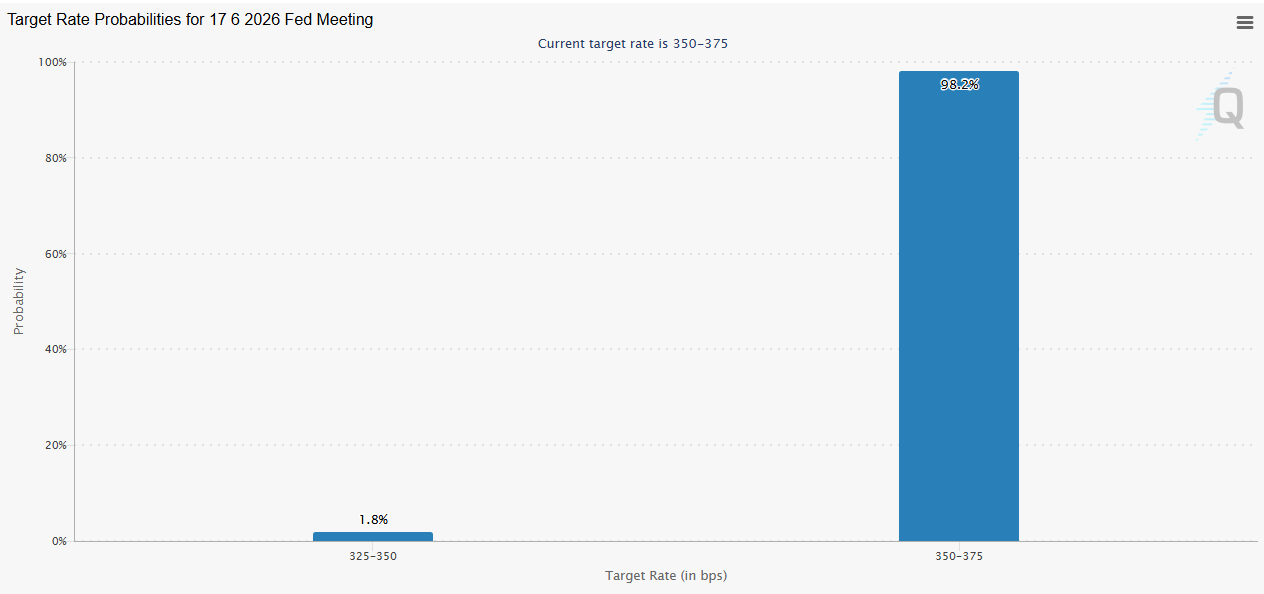
The market sees the probability of a hold in 6month at 95% or higher. Rates will stay here for now. The question is what comes next.
Factors Making It Difficult to Cut Rates
For the Fed to lower rates, two conditions must be met. Inflation must be moving down toward 2%, and the labor market must be cooling noticeably. Right now, both conditions are pointing in the opposite direction.
Let’s start with employment. 5Monthly nonfarm payrolls rose by 172,000jobs, more than twice the market estimate of 85,000jobs.
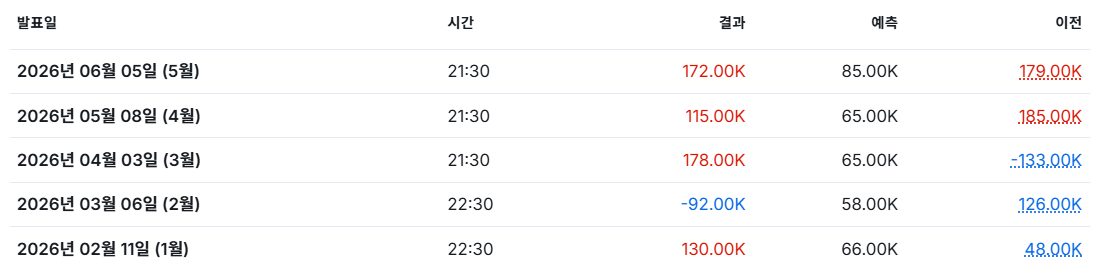
3and 4the figures for the previous month were also revised up by 93,000jobs in total, confirming that the strength in employment was not limited to one month. From the Fed’s perspective, this is a sign that there is no basis to cut rates. If the labor market remains solid, consumption holds up, and if consumption holds up, inflation is difficult to bring down.
That said, a closer look inside the data shows it is not entirely strong. Out of the total 172,000jobs, 73% was accounted for by leisure and hospitality and local governments. Leisure and hospitality added 70,000jobs, and local governments added 55,000jobs.
Excluding these two, the rest of the economy was only about 47,000people. The headline number looks strong, but the scope of actual private-sector hiring is narrow. This figure gives the new chair a reason to6hold rates steady at the FOMC meeting.
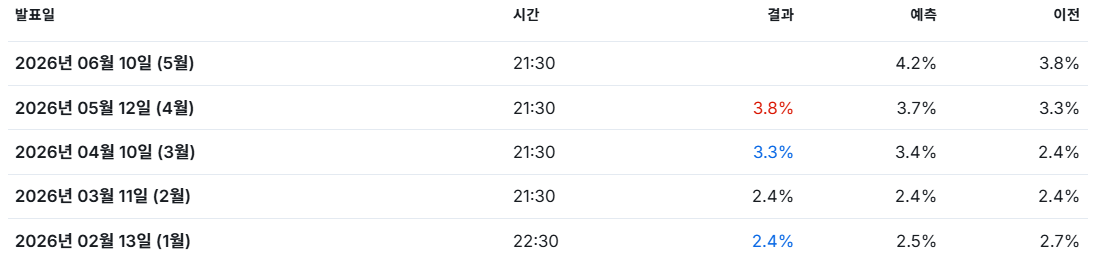
Inflation is the more direct problem. 3The consumer price index (CPI) for 3.3rose year over year by 2the highest in about 12.5years, with energy prices up by and driving a large part of that increase. There is one reason for the rise.
2026year 2month 28day, the United States and Israel began air strikes on Iran, and passage through the Strait of Hormuz was mostly blocked. This strait was the route through which about 25of global seaborne oil traffic had previously passed.
3In just the month of 21.2gasoline prices surged by 1967the largest monthly increase since records began in 3and only this one item can explain about 4of the total price increase in 3. The energy shock pushed prices higher.
Prices did not stop in 3. In 4they rose to 3.8year over year, reaching the highest level in about 3years. It was the result of the energy shock triggered by the war with Iran, which kept pushing prices up.
The problem is that the inflationary pressure from the Middle East war is not going away anytime soon.
-
Even if the Strait of Hormuz reopens, the opening is likely to be only partial, and damage to energy infrastructure and refining facilities in the Gulf region is substantial, while tanker operating conditions have also deteriorated.
-
Analysts projected that if oil-price disruption persists, it could add about 0.8 percentage points to global inflation.
-
A JPMorgan Private Bank economist described the nature of energy prices as “like a rocket on the way up, but like a feather on the way down.”
The Fed’s inflation target is 2%. The current policy rate is being held steady in the 3.50 to 3.75% range, and the Fed reiterated its 2% target while stating that “inflation is still somewhat elevated.”
With inflation in the 3s, cutting rates would run directly counter to the standards the Fed has set for itself. Employment is also strong, and inflation is high. That is why it is hard for the Fed to act.
Is there room to cut rates
The Fed is not completely of one mind internally. Some market participants emphasized that it would be appropriate to cut rates if signs emerge that the pace of inflation is on a decelerating track or that the labor market is clearly weakening. Although it is a minority view, the existence of this voice itself is meaningful. Members leaning toward cuts believe the current inflation level stems not from a structural problem but from temporary factors such as an energy shock.
Housing costs are a lagging indicator, so it takes time for actual rent slowdowns to be reflected in official inflation statistics. Because of this lag, there is a view that the short-term pressure from energy prices can later be offset by declines in rent. The interpretation is that, even if inflation looks high now, items that will gradually come down are accumulating.
The labor market is also starting to show small signs of cracking. If hiring slows, the labor market can cool without layoffs. If that cooling progresses further, the Fed gains room to wait rather than cut rates immediately, and if it weakens more, it turns into a rationale for cuts.
A more fundamental force is at work. If high interest rates persist for a long time, consumption will decline on its own.
-
If credit card, auto loan, and mortgage rates remain high, households' interest burden increases.
-
Household budgets are already squeezed by essential spending such as gas and groceries.
-
Many companies have put new hiring plans on hold, and consumer sentiment has fallen to record lows.
This is the self-correcting mechanism. Even if the Fed does not cut rates directly, higher rates restrain consumption and investment, cool the economy, and eventually create a path that lowers prices. If the economy slows faster than expected, the Fed’s options narrow. If the fight against inflation risks pushing the economy down too far, a rate cut becomes essential, not a matter of justification.
The Fed’s median projection points to 2026one rate cut during the year, and the actual path depends on three variables: inflation, energy prices, and the labor market. The possibility of a cut has not disappeared; it has merely come with conditions.
6FOMC and the indicators to watch right now
The order matters. 5CPI for 6 is released on 10 at 8 o’clock 30 minutes (U.S. Eastern Time). 6The FOMC meeting is held from 16 to 17. CPI comes out first, and based on that result the Fed makes its rate decision. 6If the 10 reading comes in badly, 6the atmosphere at the meeting on 17 changes.
Market participants are watching these two events together. 5CPI results for 6 and 16 FOMC are seen as a key turning point for whether bets on prolonged high rates will be strengthened further.17.
To gauge the mood, start with the inflation trend. As energy prices surged on geopolitical risks in the Middle East, 4CPI, the Consumer Price Index, rose 3.8 year on year. This is the highest level since 2023 and higher than 5 in 3. It is a sign that inflation is turning back up again.3.3.
Cleveland Fed’s inflation forecast model suggests 6monthly price pressure could rise to the 4.05percent range. If this model is right, 5monthly CPI results are also more likely to come in higher than or similar to those in 4the previous month. For the Fed, that makes it harder to cut rates.
6There is one more reason the monthly FOMC meeting is especially important. At this meeting, the dot plot and the Summary of Economic Projections, or SEP, are released together. It is the first meeting since the Middle East conflict in which the dot plot is updated. It shows whether the committee’s outlook is moving more hawkishly than in 3the previous month, or whether it is maintaining its existing direction.
3In the dot plot for the monthly meeting, the committee’s median projected 2026cut rates by 0.25percentage points in 2026the year. The Fed expected PCE inflation, the inflation gauge it mainly watches, to rise to 2.7percent by the end of 4the year. In the meantime, monthly CPI jumped more than expected in 6the month. If the monthly dot plot reflects this by reducing or eliminating cut expectations, markets will react immediately.
In short, there are two checkpoints to watch.
-
6Month 10day 5monthly CPI: 3.8If it falls below the threshold, the Fed gets some breathing room; if it is higher or unchanged, pressure for additional tightening increases. More decisive than the headline number itself is how core CPI, excluding energy and food, moves.
-
6Month 16to 17day FOMC dot plot: Watch whether the committee still supports cuts this year, or whether the dots move higher in a direction that erases cuts. The dot plot is a map of the Fed’s current thinking, but it is not a binding decision. It can change depending on subsequent data.
The two events are packed one week apart. Because the CPI result is directly reflected at the FOMC meeting, 6the figure for 10day becomes the starting point for the interest-rate path over the next several months.
How U.S. interest rates affect Korean investors
Right now, the Korean financial market is moving in direct lockstep with the U.S. interest-rate path.
**Citi’s warning: 6possibility of an extraordinary Monetary Policy Board meeting in
In a recent report titled 'Capital outflow pressure, won weakness, and the Bank of Korea’s faster rate hikes,' Citi said that while capital outflow pressure from foreign investors is accelerating, Korean export companies are maintaining a high exchange rate, and predicted that "because a strong KOSPI rally could raise won weakness and real-estate risks, the balance of risk should tilt toward a faster-than-expected rate-hike cycle."
Citi economist Kim Jin-wook said that the Bank of Korea would keep its existing forecast that it will raise rates in 7and 10, next year in 1and 4to reach a terminal rate of 3.5%, while also raising the possibility of a consecutive hike after 7or a surprise move of the benchmark rate by holding an extraordinary Monetary Policy Board meeting in 6 percentage points. 0.25is originally a month with no Monetary Policy Board meeting scheduled. An irregular extraordinary Monetary Policy Board meeting is held when there is a major shock to the financial market, such as the global financial crisis or the COVID-6 pandemic, or when large-scale foreign-exchange instability is feared.19.}}
The shock already visible in exchange rates, stocks, and bonds
Concerns over interest-rate hikes and the argument that AI semiconductors have already peaked overlapped, and the KOSPI 3trading days later 1,317points lower and a circuit breaker was triggered. When share prices fall this sharply over a short period, it may look like panic selling, but in reality it is a structural reaction in which expectations of higher interest rates drag down the future value of stocks.
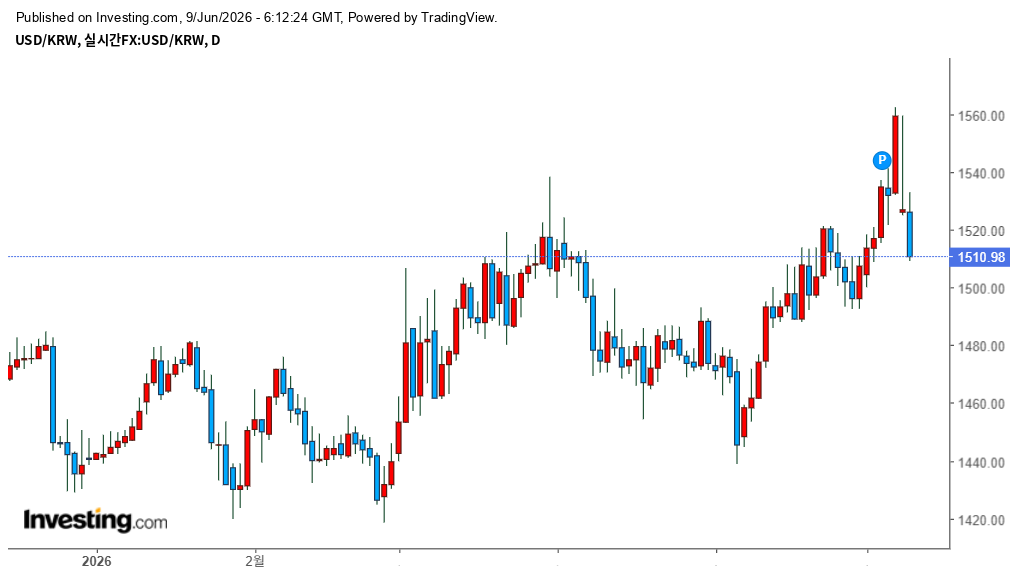
The exchange rate also reacted quickly. The won-dollar exchange rate surged intraday to 1,555.2won, then finished at 1,535.0won, helped by verbal intervention from the financial authorities.
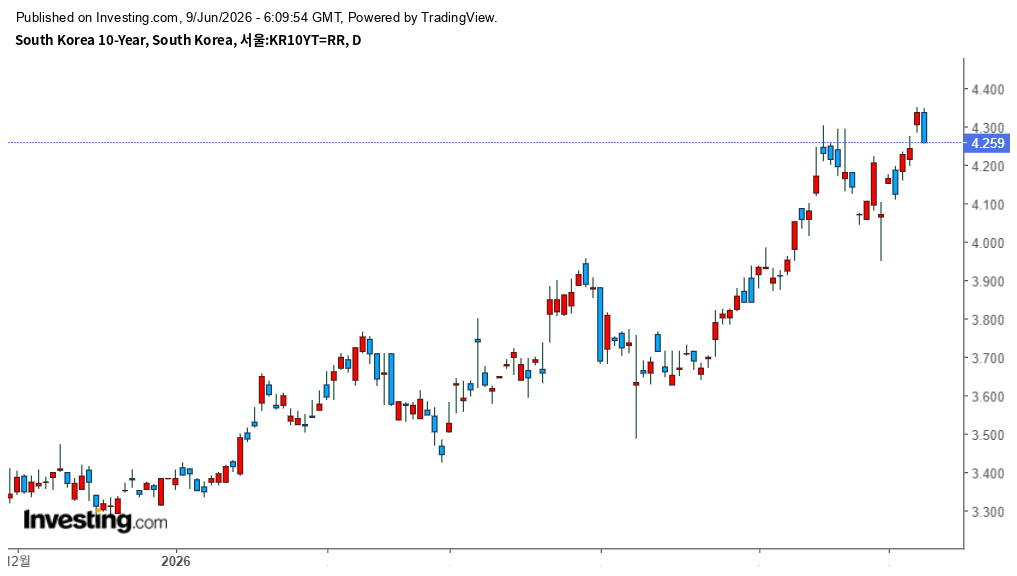
The bond market is not calm either. The winning yield on Treasury bonds 3-year 42months has broken above the psychological resistance level of 4%. For anyone invested in bonds, this means that unrealized losses are increasing because when bond yields rise, bond prices fall.
The Bank of Korea's dilemma
The problem is that the Bank of Korea cannot simply follow U.S. interest rates.
-
Pressure to raise rates: a weaker won, capital outflows by foreign investors, and a reacceleration of inflation, with the consumer price index for the month rising 5% year on year, up 3.1 from the previous month’s 2.6%.0.5. }
-
Constraints on raising rates: if rates are raised simply to lower the exchange rate, it would trigger household debt problems. Raising rates increases interest costs and could place a heavy burden on repayment for ordinary people who have taken out loans, dealing a major blow to the economy.
-
Structural trap: Unless the triple constraints of the exchange rate, real estate, and household debt are eased, it is difficult to find a rationale for a rate cut. Given the rise in delinquency rates among vulnerable households and the self-employed, even a rate hike is not easy.
Bank of Korea Governor Shin Hyun-song has already stated publicly a bias toward raising rates. The direction has tilted toward a hike. However, the pace and size are the issues. If additional tightening signals emerge at the Federal Open Market Committee (FOMC) meeting of the U.S. Federal Reserve, or 6if consumer prices come in high again, the Bank of Korea may also be pressed to make a faster decision.5/
Middle East war and the energy variable: rate scenario 3s
The variable making the interest-rate path most complicated right now is not U.S. economic data, but the Middle East. 2026After the military clash between the United States and Iran in 2the flow of traffic through some sections of the Strait of Hormuz was restricted, sharply increasing geopolitical risk on 28the Strait of Hormuz is a key energy shipping route through which about 25of global seaborne crude oil and about 20of LNG pass. Once this single strait was blocked, oil prices reacted directly. Brent crude has risen by about 50since the outbreak of the war and is trading around 110per barrel.
The surge in energy prices immediately pushed up inflation indicators. 2026In 3headline PCE, the inflation measure favored by the Fed, rose year on year by 3.5from 2in 2.8Core PCE excluding energy also climbed to 3.2Energy costs were the main driver. This made it structurally more difficult for the Fed to cut rates.
Bank of America (BofA) Global Research projected that the Fed would keep rates unchanged throughout this year and cut them by 2027in 7and 9respectively in 0.25. Many global investment banks also revised their rate outlooks. Views diverged by institution between those expecting a modest cut and those expecting rates to remain unchanged this year. The reason was that the Iran war pushed up energy prices and heightened the Fed’s vigilance over inflation.
Ultimately, the path of interest rates splits into three depending on how the Strait situation unfolds. Whether negotiations make progress is the key variable.
Scenario ① Negotiations reached → rate cuts resume
If negotiations are reached, a plan is under discussion for Iran to reopen the Strait of Hormuz without transit fees in 30 days and to extend the 60-day truce and move into peace talks. The agreement is also said to include guaranteeing ship passage through the strait without any restrictions and having Iran remove all mines installed in the strait within 30 days. If the strait returns to normal, oil prices would fall quickly and energy-driven inflation pressures would ease as well. For the Fed, provided employment does not overheat, there would be room to consider resuming rate cuts in 9 month. The International Energy Agency (IEA) said that if strait transit normalizes from 6 month, inventories are expected to recover from 9 month.
Scenario ② Negotiations deadlock → keep rates unchanged for the year
Iran is standing firm that it will not accept any deadline or pressure, and it said it will not open Hormuz as the price of a temporary truce. Its position is that it will not use the Hormuz card at the level of a ceasefire, rather than a permanent end to the war. If negotiations remain at a standstill, oil prices will stay at current levels and prices will not come down easily. At present, the blockade of the strait is disrupting the supply of about 1,300ten thousand barrels of crude oil a day, and the decline in crude inventories has widened from 3March daily 527ten thousand barrels to 4May 862ten thousand barrels. Some commercial inventories may fall below minimum operating levels as early as 8June. In that case, the Fed would keep a hold stance throughout the year, and any cut would move into 2027next year. That is BofA's base case.
Scenario ③ Blockade prolonged → rising possibility of hikes
This is the most extreme case. Axios, a U.S. business media outlet, reported that if the interruption of passage through the Strait of Hormuz were prolonged, international oil prices could surge to as high as 140 dollars per barrel. Oxford Economics analyzed that if oil prices break through 140 dollars per barrel, the global economy would effectively face a tipping point where growth stops. If oil prices become entrenched in the 140dollar range, inflation could rise again to at least the 4% range, and the Fed could face a situation in which it would need to consider hikes rather than cuts. Austan Goolsbee, president of the Chicago Fed, said that all options, including an increase in rates, are on the table. In the bond market as well, bets are increasing that the Fed could raise rates before cutting them.
The key factor dividing the three scenarios is whether the strait is normalized. The market is already factoring in the possibility of the end of the war. Because the truce could waver amid the fog surrounding negotiations, whether the Strait of Hormuz returns to normal is decisive. This is why oil prices swing on negotiation news. The fact that futures markets have begun to price in the possibility of rate hikes shows the market's view that the worst-case scenario cannot be completely ruled out at present.
Kevin Warsh Appointed as New Chair: The Fed’s Independence and the Path of Interest Rates
Kevin Warsh (Kevin Warsh) was 2026year 5month 15day, after Jerome Powell’s term ended, 5month 22day, officially took office as the 17th Chair of the Federal Reserve (Fed). The Senate confirmation vote was 54 to 45, the most partisan result in the history of Fed chair confirmations. He was starting from an unstable foundation.
What He Said at the Hearing
Warsh said at the Senate Banking Committee that "independence in monetary policy is essential" and that he would "make sure interest-rate decisions remain strictly independent." The remarks came as President Trump had been publicly urging Chair Powell to cut rates.
The key issue was whether there was a deal with Trump. Warsh said, "The president has never asked me to promise or decide any interest-rate move in advance, and I will not do that either." He also said, "The president’s remarks about rates sounded similar to the words of every president in history as I studied economic history."
However, market experts offered different assessments. David Wessel of the Brookings Institution, who watched the hearing, said that "Warsh did not look like someone who would lower rates soon, contrary to the president’s expectations," and that "an inflation hawk stance came through strongly in the entire statement." He did not even mention the Fed’s mission of 'maximum employment' in his opening remarks.
The reform theory of a ‘small Fed’ is the bigger variable
There is a point where the market reacts more sensitively than to interest rates. It is Washi’s so-called ‘Fed reform theory’.
It is viewed not as a ‘rate-cut advocate’ that the market expects, but as something closer to a ‘Fed downsizing advocate’ that seeks to reduce the Fed’s role itself. Specifically, there are two points.
-
Balance sheet reduction: Since his time as a Fed governor, he had been critical of large-scale monetary easing policies such as quantitative easing, and has maintained the position that the Fed’s asset size should be reduced. If the Fed’s assets are reduced, liquidity in the market would also decrease, and volatility in Treasury market rates could rise.
-
Change in communication style: In the hearing, he emphasized that the content of Fed communication matters more than how often it is done. He did not promise to keep the regular press conference held after FOMC meetings. This means that the regular press conferences institutionalized under the Powell regime could disappear.
Market analysts warn that Washi’s change in communication style could increase investor uncertainty and volatility. If the Fed speaks less, each word it does say carries far greater weight.
Even if the chair changes, interest rates are not decided alone
The FOMC is made up of Federal Reserve governors 7and regional Federal Reserve Bank presidents 5for a total of 12members, and while the chair presides over the meeting, policy cannot be pushed through without majority support. Deutsche Bank also said that “even the Federal Reserve chair would not find it easy to persuade fellow FOMC members” and that “monetary policy is unlikely to change noticeably in the short term.”
Market expectations also changed significantly. At the beginning of the year, in the futures market, 2026the view that there would be two rate cuts was dominant, but now the outlook that '2026there will be no rate cuts' has effectively become the market consensus.
If inflation were to reaccelerate, Waller would be in a position where he would have to raise interest rates, in other words, he could make a decision opposite to the intent of the president who nominated him. That is the paradox of this position. The more independently Waller moves, the more inevitable conflict with Trump becomes.
Frequently asked questions
What geopolitical risks remain even as oil prices and interest rates ease?
Geopolitical uncertainty remains, including the possibility of a partial reopening of the Strait of Hormuz, damage to refining and production facilities in the Gulf region, and disruptions to tanker operations.
Why is it difficult for the Fed to cut rates easily?
Inflation has not fallen to the Fed’s target of 2%, and the labor market remains strong, so there is not a clear basis for a rate cut.
5How did the monthly employment data affect the rate outlook?
5Monthly nonfarm payrolls increased by 172,000 jobs, confirming labor-market strength and weakening expectations for a rate cut.
How did a blockade of the Strait of Hormuz affect consumer prices?
With the Hormuz blockade, 3 gasoline rose by 21.2%, and that item accounted for about 3 of the monthly CPI increase, at roughly 4 out of 3.
What does a difference in voting among Fed members mean for future policy?
At the FOMC, 8a 4vote against it reflected differences in members’ views and signals short-term policy uncertainty and a greater likelihood of keeping interest rates unchanged.