Bullstory Research August 3, 2026
Foreign stock capital gains tax 22% calculation through tax savings, finish it all with this article
Key takeaways
(Sale amount - purchase amount - fees - 250ten thousand won) × 22% is the formula for foreign stock capital gains tax. All amounts must be converted into won using the exchange rate at the time of purchase and sale, respectively, and reporting based on the exchange rate and fee records in the brokerage firm's transaction statement can reduce calculation errors.
Tesla 1shares 250If you have made a profit of at least won from selling shares, you pay tax. There is no exception even if you are not a major shareholder, unlike with domestic stocks. The Income Tax Act sets the capital gains tax rate on overseas stocks at 20%, plus local income tax of 2%, making the final rate 22%. This law took effect in 2007.
If you read this article to the end, you can apply directly to your situation a way to reduce taxes by hundreds of thousands of won by adjusting when you sell. If you do not know this, you could simply lose 55won.
There is only one tax formula
(Selling price - purchase price - fees - 250won) × 22%
22% is the combined rate of capital gains tax 20% and local income tax of 2%. The 250won is the amount automatically deducted by the government each year and local income tax of 8%0%3%8%3%5%0%9%). The 0won is the [basic deduction](/hub/%EA%B22% rate and annual deduction of 250won.](/blog/%EB%AF%B8%5%96%91%8%84-84%8%9-8%99%84%0%84-0%95%6%3%8%9%6%80%8%99%82%0%3%84-8%4%0%9-84%8%8%88-3%84%82%0%2%95-2025) Even if the legal provisions look complicated, you only need to remember these numbers.
The basis is Article of the Income Tax Act, Paragraph (tax rate), and Article of the Income Tax Act, Paragraph (basic deduction).104Article of the Income Tax Act, Paragraph 1and Article of the Income Tax Act, Paragraph 103Article of the Income Tax Act, Paragraph 1 (basic deduction).
The Decisive Difference from Domestic Stocks
An ordinary investor holding Samsung Electronics 100 shares can sell them without paying tax. However, if an investor sells Tesla 1 shares and makes a gain exceeding ten thousand won, a reporting obligation arises. All individual investors are subject to taxation, regardless of whether they meet the major shareholder requirements.250 shares and makes a gain exceeding ten thousand won, a reporting obligation arises. All individual investors are subject to taxation, regardless of whether they meet the major shareholder requirements.
The scope of taxable assets is also broad. It includes not only stocks listed on overseas exchanges in the United States, but also those listed in Hong Kong, Japan, and elsewhere, as well as overseas-listed ETFs and ETNs and depositary receipts (DRs) for shares of foreign corporations. Even if you buy and sell a U.S. ETF, 250 exceeding ten thousand won is subject to taxation.
You do not pay tax simply because a stock you hold has risen. Capital gains tax applies only when you actually sell and the gain or loss is finalized. If you do not sell, there is no tax.
| Category | Details |
|---|---|
| Tax rate | 22% (income tax 20% + local income tax 2%) |
| Annual basic deduction | 250ten thousand won (applied automatically each year) |
| Tax basis | Taxable regardless of whether the investor is a major shareholder; small investors are also subject to tax |
| Tax timing | Only realized gains and losses after selling (excluding unrealized valuation gains) |
| Legal basis | Article 104 (tax rate), Article 103 (basic deduction) |
The formula is simple. However, there are points where the actual calculation can become difficult. Because the trades were made in dollars, they must be converted into won, and it is easy to overlook the treatment of fees. The following section works through the process step by step using Tesla and NVIDIA.

Applying the calculation formula to actual numbers
The formula is (sale amount - purchase amount - fees - 250ten thousand won) × 22%. Calculate after converting all amounts into won. Let’s work through it directly using Tesla and NVIDIA.
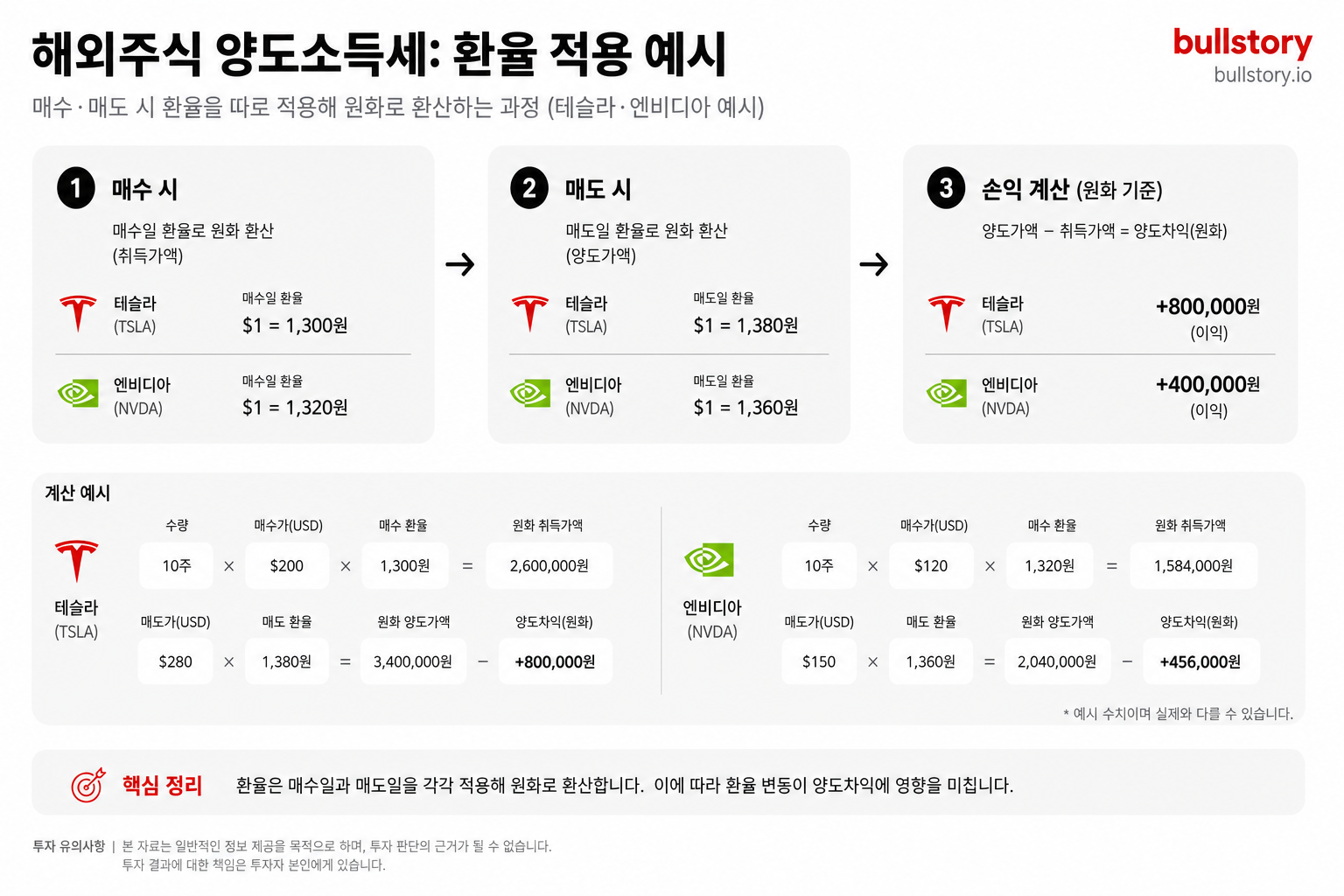
Start with currency conversion; this is where the most mistakes occur
Overseas stocks are traded in dollars, but taxes are paid based on the Korean won. Because the exchange rate when buying differs from the exchange rate when selling, simply multiplying the dollar profit by today’s exchange rate is incorrect.
Under the National Tax Service standard (Article 178 of the Enforcement Decree of the Income Tax Act, paragraph 5), the purchase amount is converted into Korean won separately using the exchange rate at the time of purchase, and the sale amount using the exchange rate at the time of sale. If the exchange rate rises, Korean-won taxes increase even when the profit in dollar terms is the same; if it moves in the opposite direction, they decrease.
Step-by-step calculation using Tesla as an example
Setting the conditions
| Item | Details |
|---|---|
| Purchase | 200 dollars per share × 100 shares, exchange rate 1,300 won |
| Sale | 300 dollars per share × 100 shares, exchange rate 1,400 won |
| Fees | Approximately 300,000 won in total for the purchase and sale |
**1Step: Calculate the won equivalent
- Purchase amount: 200dollars × 100shares × 1,300won = **2,600- Sale amount: 300dollars × 100shares × 1,400won = 4,200ten-thousand won
**2Step: Calculate the won equivalent
4,200ten-thousand won - 2,600ten-thousand won - 300,000won = 1,570ten-thousand won
**3Step: Deduct the basic exemption
1,570ten-thousand won - 250ten-thousand won = 1,320ten-thousand won (taxable income, the amount used to calculate tax)
4Step: Calculating taxes
1,320ten-thousand won × 22% = 290ten-thousand 4,000won
The exchange rate rose from 1,300won to 1,400won, resulting in higher taxes than the profit in dollar terms. This is why people who look only at their dollar profit and think, "It should be about this much," are surprised when they see the tax return.
Nvidia example: if the profit is small, the tax may be 0won
Setting the conditions
| Item | Details |
|---|---|
| Purchase | per share 500dollars × 2shares, exchange rate 1,350won |
| Sale | per share 560dollars × 2shares, exchange rate 1,350won |
| Fees | approximately 10,000won |
Conversion to Korean won and capital gain
- Purchase amount: 500dollars × 2shares × 1,350won = 135ten thousand won
- Sale amount: 560dollars × 2shares × 1,350won = 151ten thousand 2,000won
- Capital gain: 151ten thousand 2,000won - 135ten thousand won - 10,000won = 15ten thousand 2,000won
What about taxes?
15ten thousand 2,000won is far less than the basic deduction of 250ten thousand won. Since the tax base is 0 or less, the tax is 0won. The point that the return itself must be filed even when the profit is small is addressed separately below.
Three exchange-rate traps to remember
- Apply the buy and sell exchange rates separately: You need to look up the exchange rate on the purchase date and the exchange rate on the sale date separately. They are usually listed on the brokerage transaction statement.
- Foreign-exchange gains are also taxable: Even if the stock price stays the same, a rise in the won–U.S. dollar exchange rate creates a capital gain in won. You may owe taxes even though the stock price did not rise.
- Aggregate fees after converting them to won: Fees paid in dollars can be converted at the exchange rate on the settlement date and then deducted.
When buying and selling domestic stocks, most people do not need to worry about this calculation. The structure is fundamentally different. The two structures are compared side by side in the table below.
The tax structures for domestic and overseas stocks are this different
Most individual investors who buy and sell domestically listed stocks do not pay capital gains tax. Capital gains on listed stocks held by minority shareholders are tax-exempt. By contrast, when profits arise from overseas stocks, the entire amount is subject to capital gains tax, regardless of the amount. 1There is no exception even when selling shares alone or when the profit is only a few tens of thousands of won.
When do you pay tax on domestic stocks?
There are three cases in which capital gains tax is paid on domestic stocks. These are when a major shareholder of a corporation listed on KOSPI, KOSDAQ, or KONEX sells shares (even 1share is taxable), when a minority shareholder trades outside the securities market (over the counter), and when shares of an unlisted corporation are sold.
The major shareholder threshold is a stake of 1% or more, or shares with an assessed value of 50hundred million won or more. An ordinary investor holding 5,000won worth of Samsung Electronics shares falls far short of this threshold. Few individual investors in domestic stocks need to worry about capital gains tax.
Overseas stocks have no exception for 1major shareholders
All gains from trading shares of a foreign corporation listed on an overseas stock market are subject to capital gains taxation (Article 94, Paragraph 1, Item 3, Subitem (c) of the Income Tax Act). Even if you earn 3won by selling one Tesla share, it is included in the tax calculation.
However, if annual net profit does not exceed 250won, the actual tax is 0won. 250won is the basic deduction.
There is one more point to know. If a minority shareholder of a domestically listed stock incurs a loss through exchange trading, that loss cannot be combined with overseas stock gains to reduce taxes.
Put simply, if you lose ten thousand won on Samsung Electronics and earn ten thousand won on Apple, the loss on Samsung Electronics is not reflected in the tax calculation. From the profit of ten thousand won on Apple, you first receive the500ten thousand won basic deduction.500The remaining amount is taxed at a rate of500%.250The tax is calculated by applying the tax rate to the remaining amount.22The tax is calculated by applying the tax rate to the remaining amount.
Comparing the two structures at a glance
| Category | Domestic listed stocks (minority shareholders) | Overseas stocks |
|---|---|---|
| Taxation | Mostly tax-exempt | Always subject to taxation |
| 1stock sales | No tax | Included in the calculation |
| Tax rate | Not applicable (on-exchange minority shareholders) | 22% (income tax20% + local income tax2%) |
| Basic deduction | Not applicable | 250ten thousand won per year |
| Filing method | Processed automatically by the securities firm | The investor must file voluntarily |
| Legal basis | Article94of the Income Tax Act | Article94Paragraph1Item3Subitem (c), Article103of the Income Tax Act |
The easiest part to make a mistake about is the filing method. Taxes on overseas stocks are not withheld automatically. The investor must personally file and pay in5of the following year. The absence of a notification in the securities firm’s app does not mean there is no tax to pay. In some cases, a taxpayer may overlook this and then be contacted first by the National Tax Service.
By when and how do you file?
The filing deadline for capital gains tax on overseas stocks is from5of the year following the year in which the transfer date falls, through1,5.31of that year.
2026If there is income in a given year, 2027year 5months to file. 2025The filing deadline for income earned in 2026year 5month 31day has already passed. If you missed it, it is better to resolve the matter by filing late before the additional tax penalty grows.
There is no automatic notice. Unlike local resident tax or property tax, no notice is sent, so investors must [access Hometax directly and file voluntarily] and 95%4%99%8%3%8%9%96%91%8%84%86%8%93%9%84%8%8%0%3%0%0%9%2%95%99-88%83-9%8-4%85-80%94-84%8-0%3-0%99-84%0-84%0-95%3-5-2025%85-84%7-80%86%8) pay.
Based on the settlement date: through "12month 29day," not "12month 31day"
The year in which income is recognized is determined based on the settlement date, not the day the sell button is pressed.
Overseas stocks are calculated based on the settlement date, not the sale date. For U.S. stocks, the settlement cycle was shortened from month to T2024year 5month, to T+1the next business day after execution).
2025To be included in the annual income, the settlement date must be before 2025the year 12the month 31the day. Therefore, the actual sale must be completed before 2025the year 12the month 29the day.
The settlement date and market holidays may vary at the end of each year. Investors seeking to use a year-end tax-saving strategy must check the exact settlement date in advance.
Filing methods 3ways
There are several ways to file directly through the National Tax Service's Hometax, appoint a tax representative, or use the capital gains tax filing agency service provided by a securities firm.
| Method | Features | Points to note |
|---|---|---|
| Direct filing through Hometax | Free. Can combine holdings across all securities firms | Handle the entry and submission procedures yourself |
| Filing through a securities firm | Easy application linked to a tax accountant | In some cases, only transactions through the relevant securities firm are processed |
| Delegation to a tax accountant | Complex transaction records handled with confidence | Separate fee incurred |
The direct filing procedure through Hometax is simple. After accessing Hometax and entering the [Capital Gains Tax Filing] menu, proceed in the following order: enter the transfer and acquisition amounts → enter necessary expenses → apply the basic deduction → calculate the tax amount → make the payment.
The transfer amount is the total amount of money from selling stocks over 1 years. The acquisition amount is the total amount of money spent buying stocks over 1 years. Necessary expenses are the total costs, such as brokerage fees. If these three figures are entered accurately, the net profit is automatically calculated in the [Capital Gains Amount] field at the bottom.
If you filed a simplified return using the total amounts, you must submit a file containing your brokerage transaction history to prove the specific transaction details.
Local income tax (a separate tax imposed by local governments) is usually paid through linked payment via Hometax or leads to Wetax. There are quite a few cases where people pay only the national tax and omit the local tax, so check everything through to the end.
Surcharge for failure to file 20%, which may exceed the tax
If you fail to file a capital gains tax return for overseas stocks, a non-filing penalty 20% and a late-payment penalty will both be imposed.
The penalty for nonpayment is calculated as unpaid tax × number of days unpaid × 0.022% and accumulates day by day.
Even exceeding the deadline by just one month results in 20% of the original tax being lost.
If you voluntarily file within 1months after the deadline, a partial reduction of the penalty may be possible, so it is better to file even if you are late.
There is one trap. Some people omit foreign-exchange gains and fail to file, saying, "200ten-thousand won was all I earned?" In reality, they may exceed the threshold and incur a non-filing penalty. You must add foreign-exchange gains as well as stock-price gains and determine whether the total exceeds 250ten-thousand won. For safety, use the confirmed figure shown on the securities firm's capital gains tax inquiry screen as the basis.

Where can you use a free calculator?
[The overseas stock capital gains tax calculator is8%5%3%8%9%84%8%8%88%3%84%82%0%8%0%7%81%0%91%8%8%3%4%8%0%0%84%97%90%9%4%2%83%6%80%84%0%95%8%95%84%95%95%9%8%4) There are two main options: one is the built-in 'Automatic Capital Gains Tax Calculation function within the National Tax Service Hometax (hometax.go.kr), and the other is the filing-assistance service provided by major securities firms such as Samsung Securities, Kiwoom Securities, and NH Investment & Securities.
Most securities firms handle the filing free of charge. Whichever option you use, the required preparation is the same. You can get started with a single calculation statement for overseas stock capital gains tax issued by your securities firm.
Built-in Hometax calculator: enter the figures yourself and the tax is calculated automatically
After logging in to Hometax, go to 'Tax filing → Simulation calculation → Automatic Capital Gains Tax Calculation' to open the calculator.
There are exactly three figures to enter. Using the totals in the securities-firm materials you prepared, enter the proceeds from disposal (1the total money from selling stocks during the year), acquisition cost (1the total money from buying stocks during the year), and necessary expenses (the total of costs such as fees), and the actual profit will be calculated automatically in the 'Capital Gains Amount' field at the bottom.
There is one confusing point here. It may seem that you need to enter Tesla, NVIDIA, and Apple separately for each stock, but that is not necessary. You do not need to list every stock traded; you only need to enter the representative stock with the highest trading volume 1stock. The rest can simply be grouped into the total amount.
If you file a simplified return using the total amount, you must submit the brokerage transaction-history file prepared at the outset to prove the specific transaction details. After completing the filing, upload the file through the “Submit Filing Attachments and Supporting Documents” menu.
Brokerage Filing-Agency Services: They Handle Everything Once You Apply
Calculating exchange rates and determining trading profits and losses for each stock can be a complicated process for individuals to handle themselves. That is why many people look for professional filing-agency services every year. Major brokerages provide free filing services each year from 3~4 onward through 5mid-month.
Here is a comparison of representative services.
| Brokerage | Application method | Eligible customers | Combining trades from other brokerages |
|---|---|---|---|
| Samsung Securities | mPOP app, website, or branch | Customers with capital gains 250exceeding ten thousand won | Possible when submitting data from other brokerages |
| Kiwoom Securities | Hero Moon S# app or website | Customers with capital gains 250exceeding ten thousand won | Possible when submitting data from other brokerages |
| Toss Securities | Toss app | Customers with capital gains 250exceeding ten thousand won | 10Aggregation across brokerages possible |
Samsung Securities can be applied for through the mobile app mPOP, the website, or a branch, and if there are transaction records with another brokerage, submitting those materials as well allows it to handle the combined filing. Kiwoom Securities has the same structure. If there are sales records only with that brokerage, simply applying is sufficient without submitting separate materials; customers who use several brokerages can submit their capital gains records from other brokerages and have the combined filing handled.
However, the application timing is tighter than expected. The deadline for applying for the brokerage's free filing service is no later than the beginning of the 5month. If this period is missed, you must file directly through Hometax or entrust the filing to a tax accountant. If you do not hurry, you may simply let the 3~4month application period pass.
What to make sure to check when using a brokerage filing service
If you apply for filing through another brokerage as well, the tax may be calculated incorrectly. You must consolidate the filing through one brokerage. If you apply through two places at the same time, the same profit may be counted twice, potentially making the tax twice as high.
Some brokerages often process only transactions made through that brokerage. For investors who use several accounts, filing directly through Hometax may be more accurate. If you use several brokerages and the combined filing does not work properly, filing directly through Hometax is the sure choice.
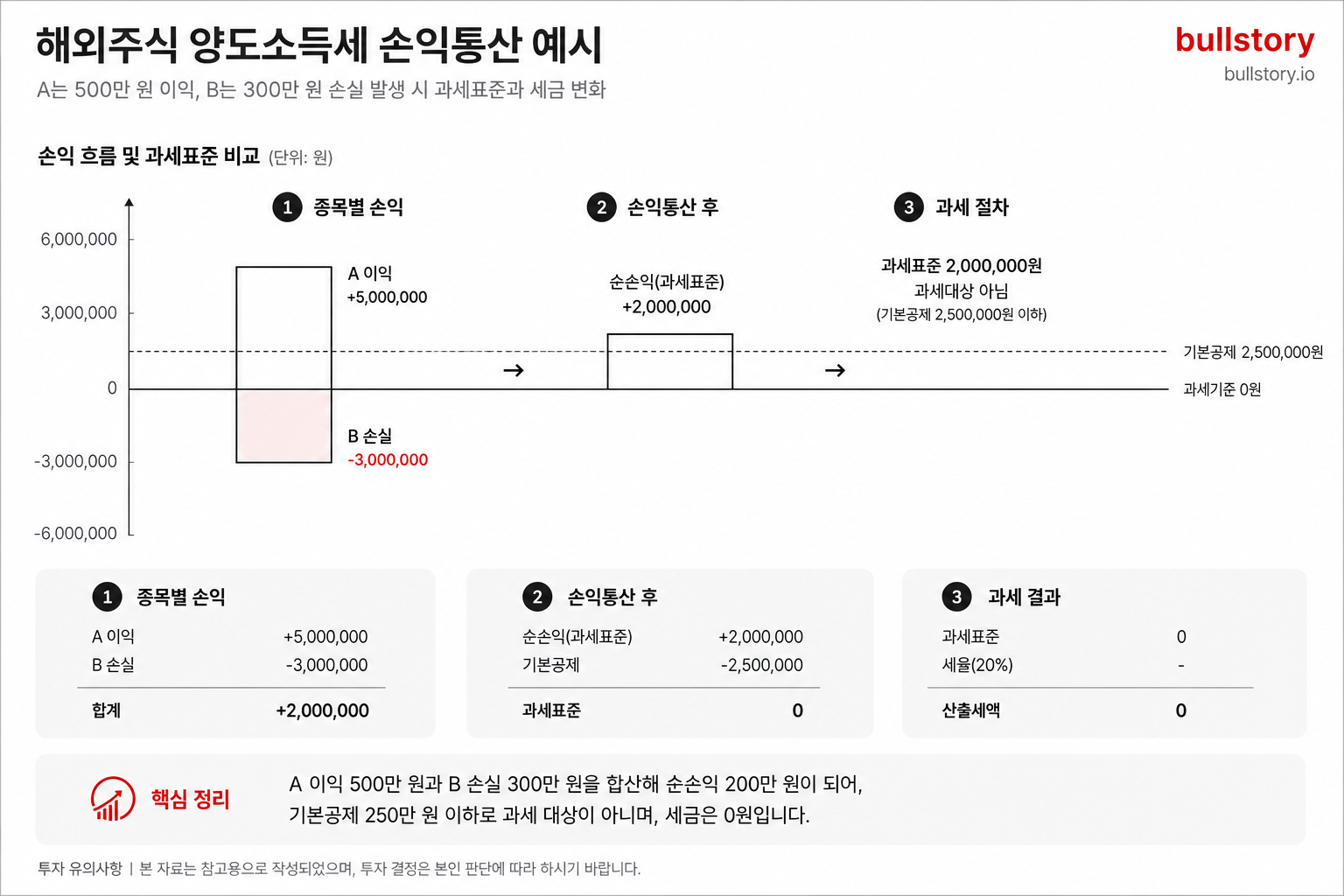
Once you know how to calculate and file, the real question remains. Even profits of the same 1,000ten thousand won can result in a difference of hundreds of thousands of won in tax depending on how they were sold. Below, the figures are calculated directly for cases in which the profit from stock A is +500ten thousand won and that from stock B is -300ten thousand won.
Capital gains and losses offset simulation: combining them changes the tax
For overseas stocks, gains and losses arising within the same tax period (1 to 12) are combined to calculate the taxable amount. This is called capital gains and losses offsetting. If you earn 500 ten thousand won from stock A and lose 300 ten thousand won from stock B, the basis for calculating tax is 200 ten thousand won. Since this is less than the basic deduction of 250 ten thousand won, the tax is 0 won.
Let’s verify it directly with the numbers.
Case 1: When only the profitable stock is sold
| Item | Amount |
|---|---|
| Capital gain on stock A | +500 ten thousand won |
| Basic deduction | -250 ten thousand won |
| Tax base | 250 ten thousand won |
| Tax (×22%) | 55 ten thousand won |
Case 2: When the loss-making stock is also sold
| Item | Amount |
|---|---|
| Capital gain on stock A | +500 ten thousand won |
| Capital loss on stock B | -300 ten thousand won |
| Result of offsetting gains and losses | 200 ten thousand won |
| Basic deduction | -250 ten thousand won |
| Tax base | 0 won |
| Tax | 0 won |
Whether or not you sold stock B makes a difference of 55ten-thousand won. The difference is whether you have a strategy or not.
Key pitfall: Unrealized losses are useless
The key to offsetting gains and losses is “realized gains and losses.” No matter how large the loss shown in the account is, it is of no use in reducing taxes unless it is realized by selling. Even if you are stuck with stock B at -300ten-thousand won, simply holding it is equivalent to having nothing. To use the loss for actual tax savings, you must sell it and realize the loss within that year.
Missing the year-end deadline means it is over
Losses from the previous year are not offset against this year’s gains. Only losses incurred this year are deducted from this year’s gains. If you do not realize the loss at year-end, you cannot use it at all to reduce taxes, and it disappears as is.
There is another pitfall here. For overseas stocks, the capital gains details actually reported are based on the “settlement-date data” provided by the brokerage. At year-end, settlement may carry over into the next year.
For example, a sale made on 12 month 30 day that settles on 1 month 2 day or 3 day of the following year will have this loss reflected in the following year’s profit and loss, not this year’s.
If you are planning a year-end tax-saving strategy, be sure to check the brokerage’s announcement of the “last possible sale date for reflecting the current year’s profit and loss.” As of T, in recent year-ends, the deadline has typically been around +1 month 12 day, but it varies each year depending on market holidays, so checking the brokerage’s announcement is essential. Once this date has passed, a year-end tax-saving strategy is effectively out of the question.30 month
12 month 29 day night is too late to hurriedly press the sell button.
Can you sell a loss-making position and buy it again?
Yes. The advantage of immediately buying back the same stock to maintain the existing position is that you can reduce taxes within the current year while continuing to invest in that stock.
However, in the United States, 30there is a “Wash Sale Rule” that disallows the deduction of losses when repurchasing within days. Korean tax law has no such provision. Even if you buy the same security again the day immediately after realizing the loss, there is no tax issue under Korean tax law. However, the investor must bear the market risk of price movements between the sale and repurchase timing.
Another structure for tax savings through the offsetting of gains and losses
In a year with substantial gains, you can deliberately sell some loss-making positions before the end of the year to lower the tax base itself. The offsetting of gains and losses applies only to transactions whose settlement was completed in the same year. You cannot apply next year’s losses to this year’s taxes. (based on Article102of the Income Tax Act)
Knowing the calculation formula for offsetting gains and losses is only half the preparation. The other half is checking by when you must sell for the tax savings to be reflected in that year and when the settlement-date deadline is. 250Adding a strategy of spreading transactions across years to receive the won basic deduction twice can increase the tax savings further. Below, 1,000we calculate how much actually decreases when won of profit is divided across two years.
Why splitting the timing of sales reduces taxes
If you sell all the shares with a profit of 1,000 won in a single year, the tax is 165 won.
If you split the same profit evenly between 12 and 1 and sell it, the tax is reduced to 110 won. If you sell only part at the end of the year and the rest in the new year, you can apply the basic deduction of 250 won twice. When calculating capital gains tax on overseas stocks, the timing of the sale is not simply a matter of timing. It is the key to tax planning involving 55 won.
Confirming with numbers how to receive the 250 won deduction twice
The basic deduction (the benefit of taking profits of up to 250 won per year without tax) resets on 1 month 1 day every year.
It disappears when the year ends and 250 won becomes available again in the new year. By using this structure, the tax paid can differ even when the total profit is the same.
| Category | Sell the full amount in one year | Spread the sale evenly over two years |
|---|---|---|
| Total capital gain | 1,000 won | 1,000 won |
| Basic deduction | 250 won (1 time) | 250 won × 2 time = 500 won |
| Taxable income (amount used as the tax basis) | 750 won | 500 won |
| Tax (22%) | 165 won | 110 won |
| Tax savings | 0 won | 55 won |
If everything is sold in a single year, the taxable base after the basic deduction is 750ten thousand won.
Applying 22%, the tax is 165ten thousand won. If the sale is split across two years, the taxable base for each year is reduced to 250ten thousand won. Therefore, simply splitting the sale dates between the 12end of the month and the 1beginning of the month creates the effect of receiving the deduction twice.
The trap behind “Selling on 12 of the month 31 would work”
Capital gains tax on overseas stocks is calculated based on the settlement date, not the sale date.
The local settlement date for U.S. stocks is the next business day after the sale is executed (T+1, 2024 shortened from 5 of that year. To have the gain counted as income for that year, the settlement date must be before 12 on 31, and the processing schedule of the domestic securities firm must be checked separately.
Because the settlement date is the next business day after the trade date, if the sale is made on 12 of the month 31, the settlement date carries over to 1 of the following year. Ultimately, this transaction is attributed as income for the following year.
The final trading time at which the year of attribution is determined differs by securities firm. Roughly, based on Korea Standard Time, it is safest to complete the transaction before 12month 29day to 30day. Settlement dates and market holidays differ at the end of each year, so be sure to check the notices from the securities firm you use.
How exactly should it be divided?
- 12month-end sales: Sell only 12month 31day500 worth based on gains, up to the last possible date on which the settlement date falls within 1month-start sales**: Sell the remaining 500 worth after the first trading day of the new year.
- The tax bases for the two years are 250 each.
- The tax for each year is 55, and the total is 110.
Of course, this strategy is not always the best option. If the stock price is expected to rise sharply in 1month, the gain may be greater than the tax savings. Conversely, if it is expected to fall, it may be better to sell everything within the year. The tax savings are 55, but stock-price fluctuations may be much larger than that. If tax saving takes precedence over investment judgment, the order is reversed.
The year-spreading strategy is particularly effective in the following cases.
- When, by year-end, the capital gain has already exceeded 500, and there are still holdings you want to sell
- When you judge that the stock price is unlikely to rise sharply early next year
- When you do not intend to hold the investment long term anyway, so there is little difference whether you sell at year-end or early in the new year
The method of reducing the tax base itself by using loss-making holdings was already discussed above. Year-by-year allocation can be used together with that strategy. Using both methods together doubles the effect.
2025Starting in the year, a regulatory change blocked the method of reducing capital gains by gifting stocks to family members. Below, we examine precisely what was blocked and under what conditions it remains possible.
What changed with tax-saving gifts to family members starting in the year?2025
From the stocks gifted after the year month day, if they are gifted to a spouse or a lineal ascendant or descendant and then sold within the year, capital gains tax is calculated based on the donor’s original acquisition cost rather than the market value on the date of the gift. This is called carryover taxation (a rule under which the recipient takes over the donor’s original acquisition cost as is and taxes are calculated based on it). If you transfer stocks to a family member thinking it will reduce taxes but do not complete the year, the tax becomes the same as if the stocks had been sold from the outset.2025year 1month 1day, for stocks gifted after that date, if they are gifted to a spouse or a lineal ascendant or descendant and then sold within the 1year, capital gains tax is calculated based on the donor’s original acquisition cost rather than the market value on the date of the gift. This is called carryover taxation (a rule under which the recipient takes over the donor’s original acquisition cost as is and taxes are calculated based on it). If you transfer stocks to a family member thinking it will reduce taxes but do not complete the 1year, the tax becomes the same as if the stocks had been sold from the outset.
2024Why was it possible until the year
2024Until the year, a separate rule, rather than carryover taxation, applied to stocks. If the actual sale proceeds belonged to the spouse, the market value on the date of the gift was recognized as the acquisition cost.
As a result, even when shares with substantial accumulated gains were transferred to a spouse and sold immediately, there was almost no tax. This method was widely used as a tax-saving strategy.2025The amendment closed that loophole.
For example, 1suppose an overseas stock bought for ten billion won 2became twenty billion won. If I sell it myself, the capital gain is 1ten billion won. Applying a tax rate of 22twenty percent, the tax is 2,200two hundred million won.
However, the situation changes if the shares are gifted to a spouse. If the spouse is recognized as having acquired the shares at the fair market value at the time of the gift, 2and sells them immediately, the capital gain is 0zero won, so there is no tax.
2025A structure changing from the year
2025From 1month 1day onward, for gifts made, if the shares are sold within 1years of the gift date, capital gains tax is calculated based on the donor’s original acquisition cost, regardless of whether the gift was genuine.
Recalculating the example above, the result is as follows.
| Situation | Acquisition cost basis | Capital gain | Tax (22%) |
|---|---|---|---|
| Direct sale | The 1billion won I paid | 1billion won | 2,200ten thousand won |
| Sale within 1years after the gift (from 2025onward) | Carryover taxation applies → 1billion won | 1billion won | 2,200ten thousand won |
| Sale after 1years have elapsed since the gift (from 2025onward) | Fair market value at the time of the gift 2billion won | 0won | 0won |
The tax-saving effect remains. However, it only takes effect after years have been completed.1years have been completed.
What is the gift tax deduction limit?
The gift itself may be subject to tax. However, 10there is no gift tax if the gift is made within the deduction limit on a cumulative basis over years.
- Spouse: billion won
- Adult child: ten-thousand won
- Minor child: ten-thousand won6Adult child: ten-thousand won5,000Minor child: ten-thousand won2,000ten-thousand won
If profitable foreign stocks are gifted to a spouse within a limit of billion won, there is no gift tax, and 6there is no gift tax, and 1when they are sold after years, the acquisition cost is recognized as the market value at the time of the gift, which can significantly reduce the capital gain.
One more thing. The gift value of foreign stocks is converted into Korean won by applying the average exchange rate for the relevant period to the average closing price over months before and after the gift date. The basis is the average over months, not the stock price on the gift date itself. Whether the deduction limit of billion won is exceeded is determined based on the amount calculated in this way.2The basis is the average over months, not the stock price on the gift date itself. 4months, not the stock price on the gift date itself. Whether the deduction limit of billion won is exceeded is determined based on the amount calculated in this way.6billion won is exceeded is determined based on the amount calculated in this way.
Essential precautions
If the family member who received the gift sells the asset and then returns the proceeds to the original owner or acquires real estate in the donor's name, the gift itself is denied. In this case, capital gains tax is recalculated based on the original acquisition price, and the amount is collected with additional penalties.
In summary, there are three points.
- 1 years of holding required: 2025 years and 1 months and 1 gifts made after 1 have no tax-saving effect if the holding period is not completed
- Do not return the money after the gift: The sale proceeds must actually belong to the recipient of the gift
- 10-year cumulative deduction limit: Amounts given to the same person during the previous 10 years are also aggregated
If you want to reduce taxes, you must secure a holding period of at least 1 years after the gift to avoid the risk of rollover taxation.
If you trade overseas stocks through accounts at multiple securities firms, you must include and report all gift-related transaction records without omission. The method for aggregating multiple accounts is covered below.
How should you combine the figures for reporting when using multiple brokerages?
If you traded overseas stocks through multiple brokerages, you must combine and report the gains and losses from all brokerages. This is because Hometax does not automatically combine them. You must obtain statements issued by each brokerage and add them up yourself.
Why must they be combined?
The situation most often overlooked is using multiple brokerages simultaneously. If you report based on only one brokerage, gains and losses are not properly combined through the offsetting of gains and losses, which can result in paying more tax.
For example, at A Securities, I made a profit of 500 won on Tesla. At B Securities, I incurred a loss of 300 won after selling NVIDIA at a loss.
When the two are combined, the net profit is 200 won. In this case, no tax is incurred.
If you report only the records from Brokerage A, 500the ten-thousand-won amount is reduced by a basic deduction of 250ten thousand won, and the resulting amount is taxed. In this case, as a result, 55you will pay an additional ten thousand won.
Self-filing: 3steps to complete
1steps, collect all brokerage statements
Before starting the filing, obtain the overseas stock capital gains tax calculation details from every brokerage you use. You can usually view and download them from the overseas stocks or capital gains tax menu on the brokerage’s HTS or website. Be sure to save them as files, as you will need to submit them later to the National Tax Service as supporting documents.
2steps, file the total amount with Hometax
The National Tax Service allows reporting a total amount. There is no need to list every security traded; you can select and enter just one representative security with a high trading volume. The input screen requires only three figures.
| Input item | Details |
|---|---|
| Transfer value | 1total amount of money from selling stocks over the year (combined across all securities firms) |
| Acquisition value | 1total amount of money spent buying stocks over the year (combined across all securities firms) |
| Necessary expenses | total amount of expenses such as commissions (combined across all securities firms) |
Once these three figures are entered accurately, the net profit is calculated automatically in the capital gains amount field.
3Step, Submit supplementary documents
Because the report was filed using the total amount, you must submit separate documents proving the specific transaction details. After completing the report, upload the prepared securities firm transaction-history file in the [Submit supplementary and supporting documents for the report] menu, and you are done.
Applying for a brokerage-firm filing service: convenient, but with pitfalls
Brokerage-firm filing services usually close their application period in 3~4month. If you miss the deadline, you must file directly. Even if you apply within the application period, there are several things to check.
- If you traded through two or more brokerage firms, even if you apply for the filing service through one of them, you must attach the transaction statements from the other brokerage firms as PDF files.
- The scope of other brokerage firms eligible for aggregation differs by brokerage firm. For example, Toss Securities has designated 10brokerage firms whose transactions can be aggregated. Any brokerage firm not included among these 10brokerage firms is excluded from the filing service and must be handled separately.
- Kiwoom Securities uses a different process. If you have records from another brokerage firm, register that firm's PDF of the “Overseas Stock Capital Gains Calculation Details” on the tax firm's website through the [Application for Another Firm] screen, and it will file an aggregated return.
There is one thing you must never do. If you also apply for the filing service through another brokerage firm, your tax may be calculated incorrectly. Proceed only by filing an integrated return through one brokerage firm.
Whether to use the filing service or file yourself: criteria for deciding
| Situation | Recommended method |
|---|---|
| 1securities firms only, within the application period | Brokerage-firm filing service (convenient) |
| 2or more securities firms, all of which allow aggregation | Brokerage-firm filing service + submission of statements from other firms |
| Includes a securities firm that does not allow aggregation | File directly through Hometax |
| Missed the filing-service application period | File directly through Hometax |
Some securities firms 3~4provide filing services between months. However, these services often process only transactions through the relevant securities firm, so for investors using multiple accounts, filing directly through Hometax is safer and more accurate.
Regardless of the method, the key point is the same. If you used multiple securities firms, you must download and aggregate the capital gains tax data for overseas stocks from all of them. If you skip this process, only profits may be calculated even when there were losses, resulting in a situation where you pay more tax.
Appendix: Glossary
When first encountering the calculation of capital gains tax on overseas stocks, the point that causes the most difficulty is not the calculation formula but the terminology. If you know the 6terms below precisely, you will not be confused wherever you look in the tax return.
-
Capital gain: The amount obtained by subtracting the purchase price and transaction fees from the price at which the stock was sold. Put simply, it is the net profit actually received. Before multiplying by the tax rate, the basic deduction of ten-thousand won250must be subtracted once more.
-
Basic deduction: The ten-thousand won amount that the government automatically deducts each year. If the capital gain for a year is no more than that amount, the tax is250won. However, unused amounts do not carry over to the following year, so spreading transactions across years is meaningful.0 },
-
Aggregation of gains and losses: A rule under which, if you made a profit on stock A and a loss on stock B in the same year, the two are combined and only the net profit is taxed (under Article102of the Income Tax Act). This is precisely why loss-making stocks are sold at the end of the year.
-
Tax base: The amount used to actually calculate the tax. It is the capital gain minus the basic deduction of ten-thousand won. For example, if the capital gain is250ten-thousand won, the tax base is determined using this calculation method.600 },
-
Settlement date: This is not the day you press the sell button, but the day the proceeds are actually settled in your account. For U.S. stocks, from2024year5month, the settlement date after a sale is the next business day (T+1). The tax year is determined based on this date.12If a stock sold at the end of1month is recorded in the following year based on its settlement date, it is subject to reporting in the following year, not that year.
-
Carryover taxation: This is a rule that applies when stock is gifted to a family member and then sold. For gifts made after2025year1month1day, if the holding period is less than1years, the capital gain is calculated using the donor’s (original owner’s) acquisition cost, not the gift recipient’s purchase price. This measure is intended to prevent situations in which an attempt to reduce taxes through a gift instead results in higher taxes.
Frequently asked questions
How is foreign stock capital gains tax calculated?
The formula is (sale amount - purchase amount - fees - 250ten thousand won) × 22%. All amounts are calculated after conversion into won.
When are the exchange rates for purchases and sales applied?
For purchases, the exchange rate on the date of purchase is applied; for sales, the exchange rate on the date of sale is applied, and the amount is converted into Korean won. The exchange rate appears on the brokerage transaction statement.
How are fees handled when calculating the capital gain?
Fees paid in U.S. dollars are converted into Korean won using the exchange rate on the settlement date. The purchase and sale fees are then added together and deducted from the capital gain.
How is the annual basic deduction of 250ten-thousand won applied?
After deducting 250ten-thousand won from the annual capital gain, 22% is multiplied by the remaining amount to calculate the tax. If the amount is no more than 250ten-thousand won, the tax is 0won.
Are U.S. ETFs also subject to capital gains tax on overseas stocks?
Yes. U.S. ETFs, including overseas-listed ETFs and ETNs, are250subject to taxation if the profit exceeds ten thousand won.
When is the taxation date for overseas stocks (the base date)?
Taxation is based on the realized gain or loss at the time of sale. Unrealized gains or losses on holdings are not subject to taxation.