Bullstory Research August 4, 2026
AMD stock -6.51% plunges, why Samsung earnings shook New York too (7month 7day)
Key takeaways
AMD stock fell intraday by -7.43%. The reason was that Samsung Electronics' 2quarterly earnings guidance shock spread into a Korean and Japanese semiconductor selloff and then into the U.S. market. AMD's own fundamentals were not damaged, and 1quarterly revenue was 103billion dollars.

Get free AMD email updates.
Bullstory sends one daily email when new analysis or important company news is available.
U.S. market close update (2026-07-07): AMD closed at 516.11 dollars (-6.51%). The key figures in this article were updated based on the closing price.
7On 7, AMD (Advanced Micro Devices) shares plunged intraday by as much as 7.43% and touched the 511dollar range. There was no problem with the company’s business itself. It was the result of selling pressure that began in Seoul and crossed the Pacific to hit semiconductor stocks in New York as they were.
The trigger was Samsung Electronics’s 2quarterly earnings guidance. Even though operating profit jumped 1,810% year over year to an all-time record, the stock price collapsed. If you unpack this paradox, you can see the full picture of today’s semiconductor selloff. At the same time, we will also look at the reality of sector rotation, in which money in the U.S. stock market is moving from big tech to the real economy and circulating among sectors.
Why Samsung’s earnings release crossed the Pacific all the way to New York
Samsung Electronics announced 2026year 2quarter guidance of roughly 171trillion won in consolidated revenue and about 89trillion 4,000billion won in operating profit. Operating profit surged 1,810.3% year over year to a record high.
But the market sold. That was because revenue came in just shy of market expectations of about 172trillion 1,810billion won.
A Samsung executive proclaimed that “this year’s profit will exceed the cumulative total for the semiconductor business 40year,” first raising expectations. When revenue fell short of those expectations, investors immediately took profits. Samsung Electronics’ share price dropped more than 8% on the day of the announcement in the Seoul market.
It did not stop in the Korean market. The Kospi fell to 6%, and the Korea Exchange invoked a temporary suspension of program selling at around 10o’clock and 23minutes in the morning. Japan’s Nikkei225 index also closed down by 1,480points.
This wave of selling carried straight into the U.S. premarket, dragging AMD’s share price down more than 7%. Investors used Samsung Electronics’ results as a test of how much farther the global AI rally could run. When the results failed to beat expectations, concerns about a correction spread across the semiconductor sector.
Experts’ broad assessment is that this is a healthy correction for a stock price that had become expensive relative to earnings. However, concerns remain that returns on AI capital expenditure may fall short of the scale of investment.
A structure that was hit hard only in semiconductors, seen in the numbers
Today, U.S. stocks fell, led by technology shares. The damage was concentrated in semiconductors.
| Market / Stock | Change |
|---|---|
| KOSPI (South Korea) | -4.91% |
| Samsung Electronics (South Korea) | -6.92% |
| SK hynix (South Korea) | -6.06% |
| Nasdaq (United States) | -1.01% |
| S&P500 (United States) | -0.32% |
| AMD (United States) | -6.51% |
South Korea’s decline was much steeper than in the United States. Profit 89.4trillion won was above the expected 85trillion won, but the gap that revenue 171trillion won fell short of consensus 172trillion won provided a pretext for profit taking. Samsung’s recent announcement that it will build a new semiconductor complex worth about 400trillion won in South Korea’s southwest also weighed on sentiment. The site has no existing infrastructure, so power and facilities must be built from scratch.
The key is concentration. So far this year, while the semiconductor index surged by more than 30%, other stocks were left behind. The larger the gains, the stronger the temptation to take profits.
Last week, while the semiconductor sector fell by 3%, small caps posted their best first-half performance since 1991. That means money pulled out of semiconductors moved elsewhere. Nathan Peterson, head of derivatives research at Schwab, said the recent weakness may be a process of unwinding excessive market positioning.
The next question is whether AMD has a real problem in its own business, or whether it was simply swept up in the mood.
2026U.S. stock market fund flow direction
This year, the biggest turning point in the stock market is fund rotation. The key is where the cash that has flowed out of Big Tech is headed. State Street chief investment strategist Michael Aron said, "Momentum in rotation picked up from late last year."
2025In the year, large caps 19.78% rose, but 2026the picture changed in the year. According to Morningstar, while small caps in the value stock index 5.94% rose, large caps only managed 2.80%.
The same pattern appeared in the growth stock index as well. Small caps 6.02% rose, while large caps only gained 0.13% rise. Russell 2000has climbed more than 12% since the start of the year, and it also set a record by outperforming the S&P 15for 500trading days in a row.
The background to this trend is the difference in valuation (how expensive or cheap a stock is relative to earnings). At the beginning of the year, the gap between small caps and the S&P 2026widened to the largest level in 500years. Small caps were at 25times expected earnings, while the S&P 18was around 500times.22]
Sector winners are also clear.
- Raw materials and materials: up 9.05% since the start of the year, 1higher than the market
- Energy: up 22% or more
- Industrials: up 16%
- Consumer staples: up 13.3%
- Technology, communication services, and consumer discretionary: relatively lagging
This rotation is not simply risk aversion. It is the shifting of capital into areas with better risk-adjusted returns. Money that had been concentrated in tech stocks is being redistributed to real-economy sectors such as financials, industrials, and materials. Morningstar points out that "the early gains in a large number of sectors are already reflected in valuations." The direction is clear, but this is a phase in which the choice is not simple.
"It was solid, so why sell?" Sell on the news pattern
Samsung Electronics operating profit jumped 1,810%, but the stock fell more than 6% intraday. In the stock market, there is an old rule: "buy on the rumor, sell on the news." If expectations are already reflected in the share price, the moment of the announcement can instead become the time to sell.
Stock prices anticipate the future in advance. While expectations spread that earnings will improve, the stock price is already rising. Earnings announcement date is simply the day those expectations are confirmed in reality. Today, Samsung Electronics 89 won and 4,000 hundred million won exceeded expectations, but it was still enough to trigger profit-taking from the AI rally that had been building for months.
Last 6 month 4 day, the Broadcom case had the same structure. When next quarter’s AI chip revenue guidance of 160 billion dollars fell short of analysts’ estimate of 172 billion dollars, the stock plunged by 12.6%. The shock spread across the entire semiconductor supply chain.
AMD was 2026up by about 131.7since the start of the year. 100For investors holding a stock that has risen more than 2026in 4month, the trailing P/E ratio — how many times this year’s expected earnings the share price represents — was about 52times. At this level, even a slight shift in sentiment can quickly turn into selling.
Has AMD’s own business started to crack?
To start with the conclusion, AMD’s fundamentals (the company’s actual business strength) have not been damaged. As of the AMD IR filing (year month day), the2026year 5month 5day) 2026year 1quarter revenue was 103billion dollars, and earnings per share were 1.37dollars (non-GAAP basis). Today’s decline is an external shock.
1quarter revenue 103billion dollars exceeded the company’s guidance ceiling of 98billion dollars. This becomes clearer when you look by business segment.
| Business segment | 2026year 1quarter revenue | year-over-year |
|---|---|---|
| Data Center | 58billion dollars | +57% |
| Client and Gaming | 36billion dollars | +23% |
| Embedded | 8hundred million 7,300dollars | +6% |
Data Center became AMD’s largest business segment at 58billion dollars. The center of gravity has fully shifted toward AI infrastructure. Gross margin was 55%, operating income was 25hundred million 4,000dollars, up 43% year over year.
AMD’s guidance for the 2quarter revenue is 112billion dollars (plus or minus 30billion dollars). That is above the analyst consensus of 105billion dollars. The year-over-year growth of 46% is faster than the 1% in the 38quarter. However, management’s warning that gaming revenue will fall by more than 20% from the first half because of rising memory and component costs in the second half is a variable.
AMD has recently beaten earnings-per-share estimates for 4consecutive quarters. Today’s -6.51% is not the result of a broken business, but of being swept up in a selloff. The remaining question is whether this drop is a buying opportunity or the start of further declines.
AMD falling -7% is not the first time
Today’s -6.51% drop stands out, but AMD has suffered two more similar declines this year alone. 6month 4~5day during Broadcom’s earnings shock, it fell by about 10% or more, and during Meta’s surplus computing report on 7month 1day, it declined by 6.9%. In both cases, the issue was not with AMD itself, and the share price moved in a direction that recovered the losses.
The first trigger was Broadcom. 3quarterly AI chip revenue guidance came in at 160billion dollars, missing market expectations of 172billion dollars, and AMD shares, which had risen more than 1% since 20month, plunged by 10.86% in a single day to close at 466dollars 38cents. The rebound afterward was fast. 6month 5day low to the all-time high on 6month 30day, it took less than a month.
The second was the Meta surplus computing report on 7month 1day. Right after AMD hit an all-time high of 6month 30day 580dollars 91cents, Bloomberg reported Meta’s plan to sell surplus AI computing power externally. AMD shares fell by 6.9% in a day to close at 540dollars 88cents, and about 650billion dollars in market capitalization vanished.
Meta had agreed to deploy AMD Instinct GPUs at a scale of up to 6gigawatts and is a key customer holding warrants equivalent to about 10% of AMD stock. That is why this report hurt more. Still, if you look closely at the substance of the contract, only the first 1gigawatt has confirmed delivery, and the remaining 5gigawatts were optional.
| Category | Date | Decline | Cause | Direct AMD issue? |
|---|---|---|---|---|
| Broadcom shock | 2026year 6month 4~5day | about 10.86% | Broadcom missed AI guidance | No |
| Meta excess computing | 2026year 7month 1day | -6.9% | Reports of Meta’s compute sales | No (reassessing contract structure) |
| Today (Samsung-led selloff) | 2026year 7month 7day | -6.51% | Spillover from a sharp drop in Korean and Japanese semiconductor stocks after Samsung Electronics’ results | No |
In both cases, AMD recovered the decline or went beyond it. 3from the monthly low to 6month 30day, it rose more than threefold, and after the 7month 1day drop, it rebounded 7month 6day later by 6.6% in a single day. Of course, there is no guarantee it will repeat in the same way this time. In the previous two cases, there was nothing wrong with AMD’s results themselves, and that fact helped reverse the decline. One question remains: is the stock now expensive or cheap relative to earnings?
Is AMD’s stock expensive or cheap right now
After today’s drop, AMD’s stock is 516.11dollars. Wall Street’s consensus for annual earnings per share for 2026is 7.37dollars, making the forward P/E based on that about 69times. That means paying more than twice the semiconductor sector average of around 34times. It is expensive. But looking only at this number tells only half the story.
In the consensus of 51analysts compiled by S&P Global, the average target price is 508dollars. After today’s plunge, 516.11dollars is almost the same as this average value. On the surface, that suggests a fair price, but the internal distribution shows a large gap.
| Category | Target Price | vs. Current Price |
|---|---|---|
| Consensus high (Cantor Fitzgerald·UBS) | 670dollars ~700dollars | +31~+37% upside |
| Consensus average (S&P Global, 51names) | 508dollars | -0.6% (almost identical) |
| Consensus low | 320dollars | -37% downside risk |
| 24/7Wall St. own target | 586dollars | +15% |
Cantor Fitzgerald and UBS cited expanded server CPU share and each put forward 700dollars and 670dollars. On the other hand, the fact that the lower bound is open all the way to 320dollars means the distance between optimism and pessimism is that large.
AMD's forward P/E of 69times is about 34% higher than the industry median of 79times. On the numbers alone, that looks excessive. But AMD's revenue growth rate is 34%, far above the industry median of about 10%.
Looking at AMD through the PEG ratio, which factors in growth as well, AMD is 1.26times, while the industry average is 1.45times. It looks expensive on the surface, but once growth speed is taken into account, it is actually closer to the less expensive side.
Based on past earnings, the P/E ratio is more than 180times, so if results wobble even a little, the stock is set up to swing sharply. Even so, quarterly sales of 1million 102thousand dollars (up 5,000% year over year) and data center sales of 38million 57thousand dollars (up 8,000% year over year) support this premium. Free cash flow more than tripled on a quarterly basis to 57million 25thousand dollars.6,600.
Right now, AMD is a stock you buy while paying a growth premium. The variable that determines whether that premium is justified is whether MI450 shipments proceed as scheduled in the 2026second half of the year. If everything goes as planned, the bullish case holds, but if forward EPS estimates are revised lower or China export restrictions are tightened further, this structure falls apart. After today's drop, it has come down into the 510dollar range, but it is hard to call it cheap. It is only a little less expensive than an expensive stock.
7Month 22Day 'Advancing AI 2026' a tailwind or a risk
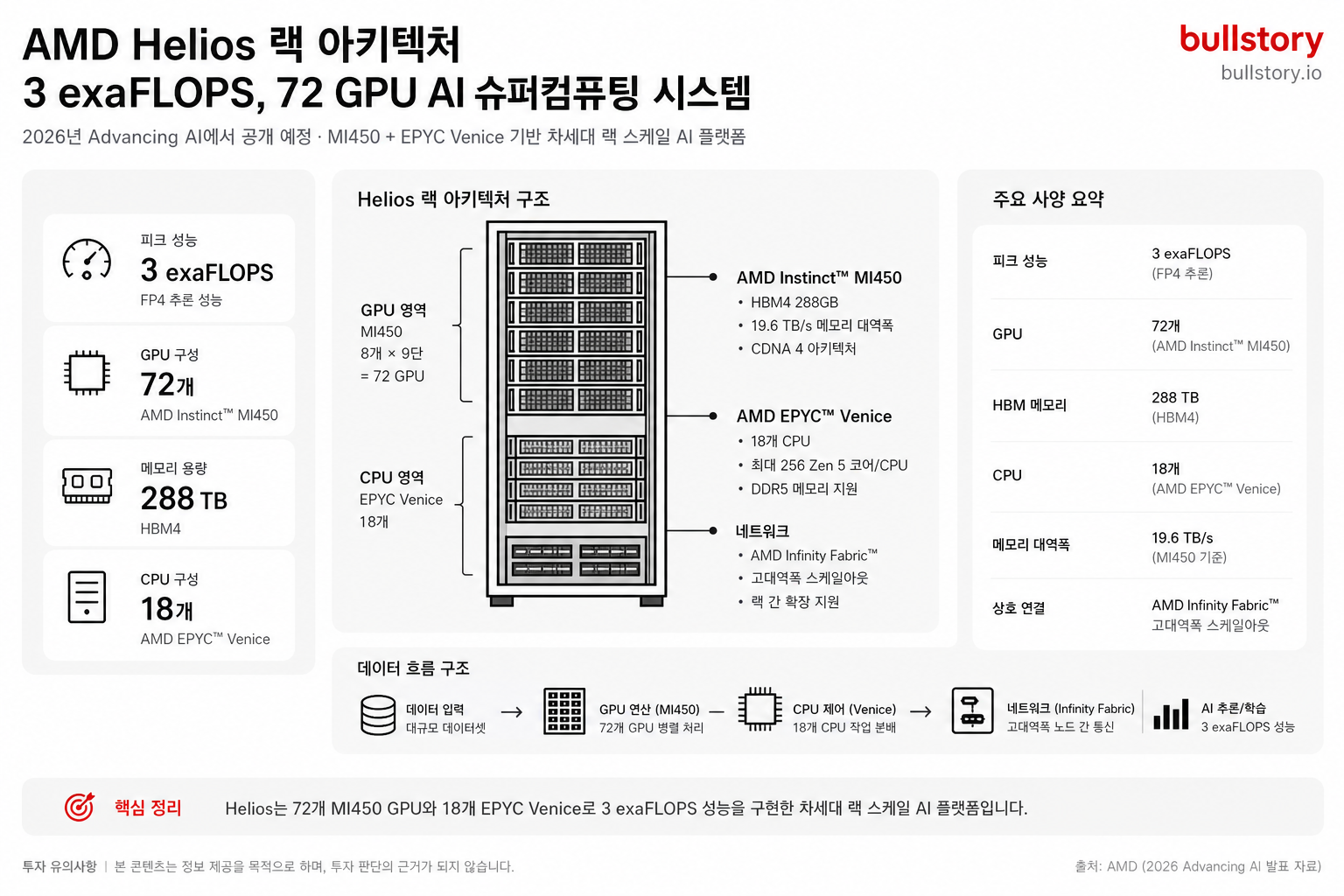
AMD will hold 7 in San Francisco from the 22 to the 23 event, 'Advancing AI 2026'. Around CEO Lisa Su's keynote, the formal unveiling of the MI450 accelerator, Zen6-based EPYC Venice CPU, and Helios rack platform is scheduled. When the stock is already expensive, merely meeting expectations can still lead to a drop. AMD has become a stock that can only hold up by delivering more than expected.
The Helios rack packs AI computing power of 3 exaflops (3,000 hundred trillion operations per second) into a single rack and carries HBM4 memory of 31 terabytes. With a structure that includes 72 GPUs, shipment is scheduled for the 2026 quarter of 3. It is built around
The EPYC Venice CPU provides up to 256 cores, and memory and GPU bandwidth have doubled compared with the previous generation. In terms of memory capacity, it surpasses Nvidia Vera Rubin (20.7 terabytes), but it is still seen as lagging in training throughput and the software ecosystem. A first look at the next-generation MI2027 accelerator roadmap, targeted for release in 500, is also expected.
Wall Street price targets have been raised recently.
| Brokerage | Price target | Opinion |
|---|---|---|
| Cantor Fitzgerald | 700 dollars | raised |
| Goldman Sachs | 640 dollars | raised |
| Wells Fargo | 615 dollars | overweight |
| Bank of America | 560 dollars | top pick CPU stock |
| Bernstein | 525 dollars | outperform |
Most of these price targets are based on the premise that the MI450 and Helios will ship on schedule. The contract with Meta is for a total of 6 gigawatts, and the first 1 gigawatts are scheduled to ship in the second half of the year. Oracle has decided to deploy 450 MI50,000 GPUs from the 3 quarter, and it is expected to become AMD's first AI supercluster based on the Helios rack.
There is an important distinction. Helios will ship engineering samples and small-volume production units in the second half of 2026-and mass production ramp-up is seen by the industry after 2027- 2quarter. AMD pushed back on the word “delay,” insisting that shipments remain on schedule. But small-volume shipments and a mass ramp-up are entirely different matters from a buyer’s perspective. The biggest market focus is whether Lisa Su can present concrete shipment figures for Helios at this event.
| Item | NTM EV/EBITDA |
|---|---|
| AMD | 44.5x |
| Semiconductors peer average | 21x |
| Nvidia | 16.1x |
| Broadcom | 19.0x |
This table shows how much premium AMD is trading at versus competitors. If MI450 shipments are below plan or the Venice CPU timeline slips even a little, the downside could be large. The good scenario is one where Venice ships on schedule, Helios volume increases in the 4 quarter, and 2quarter revenue meets guidance of about 110billion dollars. The bad scenario is one in which Venice is delayed, MI450 volume falls short, and margin pressure all hit at once. Investing in AMD now is no different from betting that this event will deliver more than expected.
Practical response guide for retail Korean investors
Today AMD’s share price fell by 516.11 dollars, or -6.51%. The company’s fundamentals did not break; rather, a selloff originating in Korea spread into the U.S. market. Non-GAAP earnings per share for the 2026 quarter were 1 dollars, and revenue was 1.37billion dollars. If the business has no problem, what is needed now is not panic but a baseline.103,
The criterion for holding is one thing: has the fundamental changed, or is market sentiment the one that has wavered? Today, it is the latter. 1Quarterly data center revenue increased by 57year on year to 58billion dollars, and whether that figure carries into the next quarter is the key point. Today’s one-day decline is not a basis for judgment.
- Conditions to maintain the hold 1: 8on the 4day results, when quarterly sales consensus of around 2billion dollars is confirmed.
- Conditions to maintain the hold 113: 2when the MI 7to 22day event in 23is concretized.
- Reassessment signal 450: 1if quarterly results come in below the bottom of guidance at 2billion dollars, reassess.
- Reassessment signal 109: if the data center growth rate falls below 2%, reduce the position.40.
Based on the current share price, the lower end of the market’s bear case is around 439dollars, meaning there is about 15% more downside room. If you are fully invested, it is worth reviewing the position size.
Buying all at once at 516.11dollars now is a burden. The all-time high was 6on 30day at 580.91dollars, and although that is about 12% below the peak, an all-in strategy is risky. 3It is advisable to approach in stages.
| Buy timing | Reference price range | Rationale |
|---|---|---|
| 1rd time (now) | 505~515dollars | Around today’s low of 509dollars, a mechanical buy rather than an emotional one |
| 2nd time | 470~480dollars | A range that could pull back again if expectations for the 7day event in 22are insufficient |
| 3th time | 440dollars or so | Lower end of the bear case, to respond if results disappoint |
1Place 30% of the total budget in the 51rd tranche and buy the rest in stages after seeing the event results is the realistic approach. The target price of the consensus from 508institutions is 700dollars, the highest is 320dollars, and the lowest is said to be
The number of events that should be marked on the calendar 3.
| Date | Event | Key points |
|---|---|---|
| 7month 22~23day | Advancing AI 2026 (San Francisco) | MI450 mass-production schedule, whether Helios platform customer cases are disclosed |
| 8month 4day | 2 quarterly earnings release | data center revenue, 3 quarterly guidance |
| Ongoing monitoring | U.S.-China semiconductor export controls trend | If additional sanctions are announced, immediate downside pressure |
Last year at Advancing AI 2025, Instinct MI350 series and ROCm 7 were unveiled, and the first teaser for the Helios rack was released. This year, there is a high likelihood that specific shipment plans for MI450 and the EPYC Venice CPU will be announced. Because expectations are already largely priced into the stock, if the announcement is only in line with expectations, the share price could fall instead.
Holders should review their position size before the earnings release on 8month 4day. Those waiting to buy can determine the timing for staged purchases after checking the stock reaction around the event on 7month 22day. Whether today’s decline is an opportunity or a trap will be told by the numbers on 2day of the month.8month 4day.
Frequently asked questions
Why did AMD stock fall 2026year 7month 7day by -7.43%?
As the semiconductor selloff from Korea spread to the U.S., AMD fell intraday by -7.43%. The trigger was profit-taking after Samsung revenue missed consensus.
How did Samsung Electronics' earnings release affect U.S. semiconductor stocks?
In the Korean market, large-scale selling after Samsung's earnings release spilled over into the pre-market. Investors questioned the durability of AI demand and took profits.
Was AMD's stock decline due to a problem with the company's fundamentals?
No. The report does not mention any problem with AMD itself. The decline that day was due to broad selling across the global sector and weaker investor sentiment.
Why did only the semiconductor sector fall so sharply?
Positions heavily concentrated on AI expectations were large. Because those expectations were already reflected in stock prices, even a slight miss in earnings led to profit-taking.
Are there any examples of the “‘sell on the news’ pattern?”
There are. Broadcom 6month 4day missed guidance, and the stock 12.6fell sharply, and the same pattern carried from Samsung’s announcement to AMD.